


Involvement of reactive oxygen species in the action of ciprofloxacin against Escherichia coli
- PMID: 16495256
- PMCID: PMC1426460
- DOI: 10.1128/AAC.50.3.949-954.2006
Involvement of reactive oxygen species in the action of ciprofloxacin against Escherichia coli
Abstract
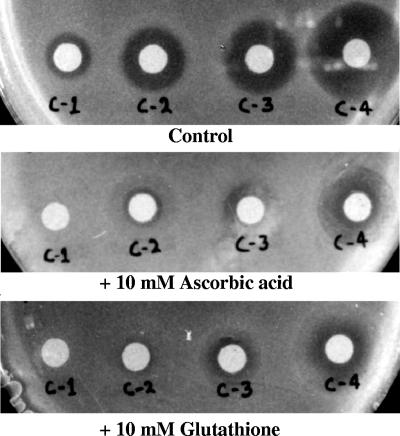
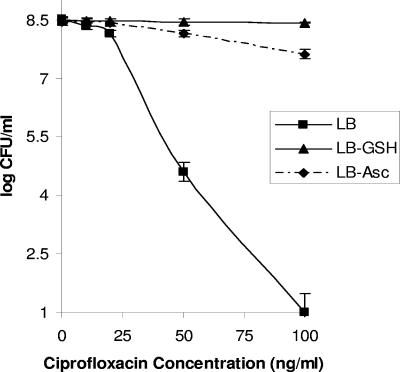
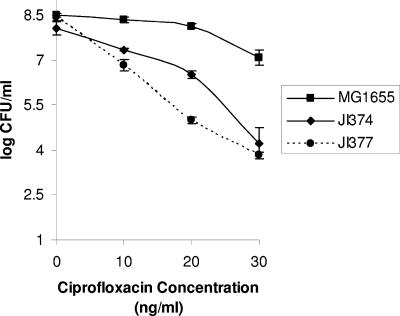
Ciprofloxacin is an important and commonly used member of the fluoroquinolone group of antibiotics. Ciprofloxacin inhibits DNA topoisomerase II and DNA topoisomerase IV activities, eventually leading to bacterial cell death. In addition, an increase of reactive oxygen species in the bacterial cells in response to ciprofloxacin has been shown. We investigated the role of reactive oxygen species in the antibacterial action of ciprofloxacin by studying the effects of different antioxidant compounds on ciprofloxacin susceptibility of Escherichia coli. Among the antioxidants checked, glutathione and ascorbic acid provided substantial protection against ciprofloxacin. The involvement of superoxide anion (O2-) and hydrogen peroxide (H2O2) in the antibacterial action of ciprofloxacin was analyzed using superoxide dismutase, catalase, and alkyl hydroperoxide reductase knockout strains of E. coli. The effects of multicopy sod genes on ciprofloxacin susceptibility of E. coli were also analyzed. On the basis of our results, we conclude that O2- and H2O2 may be involved in antibacterial action of ciprofloxacin. Our findings that glutathione gave protection against other fluoroquinolones and not against nonfluoroquinolone antibiotics imply that reactive oxygen species may have a similar role in the antibacterial action of all these fluoroquinolones and that glutathione-mediated protection is not a general phenomenon but specific to fluoroquinolones. These observations are of significance, as fluoroquinolones are important antibiotics with immense therapeutic value, and the effectiveness of treatment by these drugs may be affected by dietary intake and cellular levels of these antioxidants.
Figures
References
-
- Alba, M. A., R. R. Sanchez, G. P. Cervantes, F. B. Moreno, R. F. Paz, and E. G. Jimenez. 2000. Antimutagenesis of β-carotene to mutations induced by quinolone on Salmonella typhimurium. Arch. Med. Res. 31:156-161. - PubMed
-
- Albesa, I., M. C. Becerra, P. C. Battan, and P. L. Paez. 2004. Oxidative stress involved in the antibacterial action of different antibiotics. Biochem. Biophys. Res. Commun. 317:605-609. - PubMed
-
- Appelbaum, P. C., and P. A. Hunter. 2000. The fluoroquinolone antibacterials: past, present and future perspectives. Int. J. Antimicrob. Agents 16:5-15. - PubMed
-
- Armstrong, G. A. 1997. Genetics of eubacterial carotenoid biosynthesis: a colourful tale. Annu. Rev. Microbiol. 51:629-659. - PubMed
-
- Bauer, A. W., W. M. M. Kirby, J. C. Sherris, and M. Turck. 1966. Antibiotic susceptibility testing by a standard single disk method. Am. J. Clin. Pathol. 45:493-496. - PubMed
MeSH terms
Substances
LinkOut - more resources
Full Text Sources
Other Literature Sources
