. 2006 Feb 27;81(4):573-82.
doi: 10.1097/01.tp.0000183878.53367.77.

Association of mixed hematopoietic chimerism with elevated circulating autoantibodies and chronic graft-versus-host disease occurrence

Affiliations

Association of mixed hematopoietic chimerism with elevated circulating autoantibodies and chronic graft-versus-host disease occurrence

Sylvain Perruche et al. Transplantation. .

Abstract

Background: Use of a reduced-intensity conditioning regimen before an allogeneic hematopoietic cell transplantation is frequently associated with an early state of mixed hematopoietic chimerism. Such a coexistence of both host and donor hematopoietic cells may influence posttransplant alloreactivity and may affect the occurrence and severity of acute and chronic graft-versus-host disease (GVHD) as well as the intensity of the graft-versus-leukemia effect. Here we evaluated the relation between chimerism state after reduced-intensity conditioning transplantation (RICT), autoantibody production, and chronic GVHD (cGVHD)-related pathology.

Methods: Chimerism state, circulating anticardiolipin, and antidouble stranded DNA autoantibody (Ab) titers as well as occurrence of cGVHD-like lesions were investigated in a murine RICT model.

Results: We observed a novel association between mixed chimerism state, high levels of pathogenic IgG autoantibodies, and subsequent development of cGVHD-like lesions. Furthermore, we found that the persistence of host B cells, but not dendritic cell origin or subset, was a factor associated with the appearance of cGVHD-like lesions. The implication of host B cells was confirmed by a host origin of autoantibodies.

Conclusion: Recipient B cell persistence may contribute to the frequency and/or severity of cGVHD after RICT.


Figures
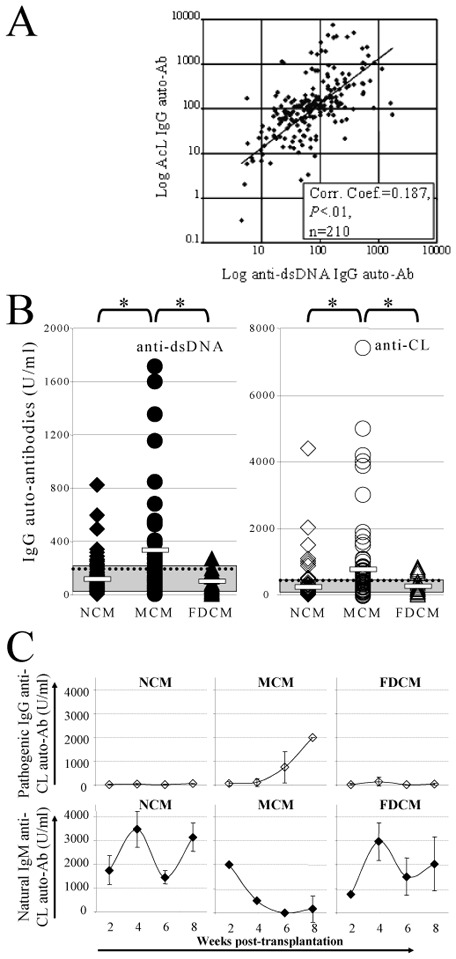
Figure 1
Figure 1. Auto-immunity is preferentially observed in mixed chimeric mice
(A) A correlation between the levels of circulating anti-cardiolipin (AcL, x axis, Logarithmic representation) and anti-dsDNA (y axis, Logarithmic representation) IgG auto-Abs assessed by ELISA was found in recipient mice 9 weeks post-BMT. The solid line represents the calculated linear regression line of the observed data. Correlation coefficient =0.187, P<.01, n=210 recipient mice (Pearson Product Moment Correlation). (B) Circulating anti-dsDNA (black symbols - left hand side panel) and AcL (open symbols - right hand side panel) IgG auto-Abs were significantly higher 9 weeks post-BMT in mixed chimeric mice (MCM, circles) than in non- (NCM, diamonds) or full-donor chimeric mice (FDCM, triangles). White bars: mean for each group; doted line: mean of all groups; gray area: serum auto-Ab titers in 10 age-matched naive mice; *: P<.01 (Mann-Whitney Rank Sum Test). (C) Kinetics of both IgG (open diamonds) and IgM (black diamonds) AcL auto-Abs demonstrated a self-immunization in 4 out of 8 tested MCM, as attested by a simultaneous decrease of natural IgM auto-Abs and an increase of pathogenic IgG auto-Abs. In contrast, low levels of pathogenic IgG auto-Abs and normal levels of natural IgM auto-Abs (as compared to age-matched naive mice, range of AcL IgM auto-Ab titers: 2210.8–4358.3 U/ml) were observed in NCM (n=8) and FDCM (n=8). Error bars: SEM.
Figure 2
Figure 2. Significant higher levels of circulating total IgGs correlated with higher levels of IgG auto-Abs are preferentially found in mixed chimeric mice
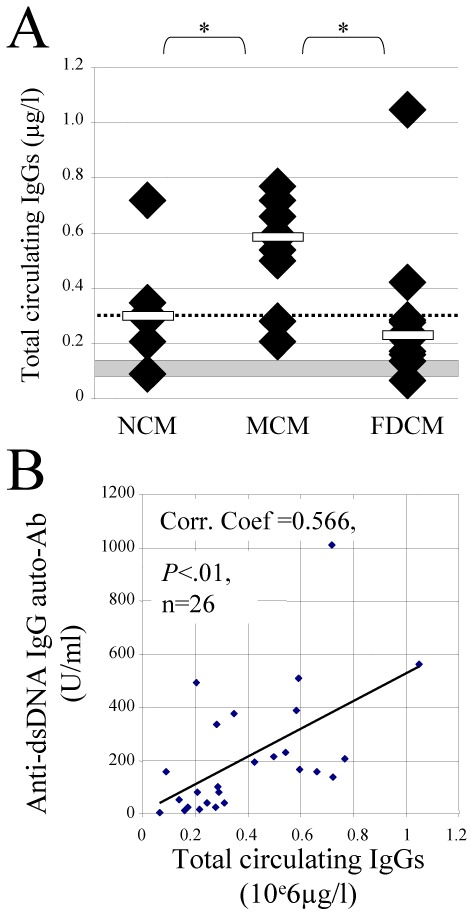
(A) Circulating total IgGs (μg/l) 9 weeks post-BMT were significantly higher in mixed chimeric mice (MCM; n=10) than in non- (NCM; n=6) or in full-donor chimeric mice (FDCM; n=10). White bars: median for each group; doted line: median of all groups; grey area: median + 2 SEM total IgGs found in 6 age-matched naive BALB/c mice; *: P<.01 (Mann-Whitney Rank Sum Test for NCM vs FDCM, otherwise Student t test). (B) Correlation between the levels of circulating total IgGs (x axis, 106 μg/l) and anti-dsDNA (y axis, U/ml) IgG auto-Ab assessed by ELISA in recipient mice 9 weeks post-BMT. The solid line represents the calculated linear regression line of the observed data. Correlation coefficient =0.566, P<.01, n=26 recipient mice (Pearson Product Moment Correlation).
Figure 3
Figure 3. Chronic GVHD-like lesions are detected in mixed chimeric recipient mice
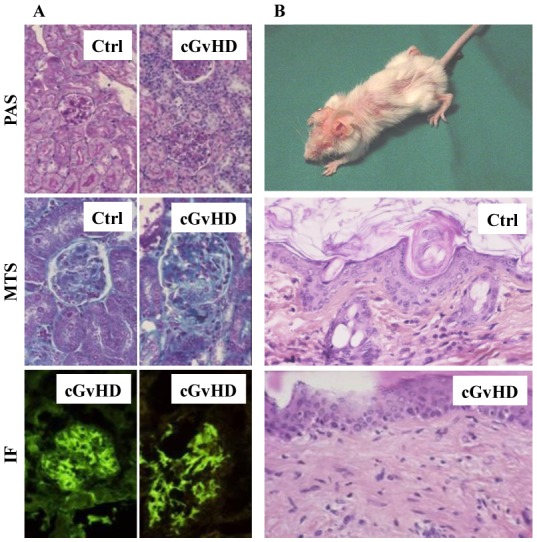
(A) Mixed chimeric mice (8/10) developed glomerulonephritis as attested by renal mononuclear cell infiltrate (noted cGVHD, periodic acid Schiff [PAS] staining, original magnification [OM] x80), a thickening of the glomerulus basal membrane due to IC deposition and a crescent formation due to epithelial cell proliferation (noted cGVHD, Masson’s trichrome [MT] staining, OM x128). Glomerulus from a BM grafted mouse non-developing cGVHD stained with PAS and MT (noted Ctrl) was shown as control. Immune complex deposition is identified by UV fluorescent microscopy after labeling with either FITC-conjugated anti-kappa (right hand side immunofluorescence panel, OM x128) or anti-lambda Abs (left hand side immunofluorescence panel, OM x128). (B) Sclerodermatous cGVHD-like lesions in a mixed chimeric mouse were attested by hair loss (upper panel) and skin structure alterations including fibrosis and mononuclear cell infiltrate (noted cGVHD, lower panel, HES staining, OM x80). Skin section from a healthy BM grafted mouse was shown as control (noted Ctrl, HES staining, OM x80).
Figure 4
Figure 4. Chronic GVHD is associated with the presence of host B cells and donor T cells
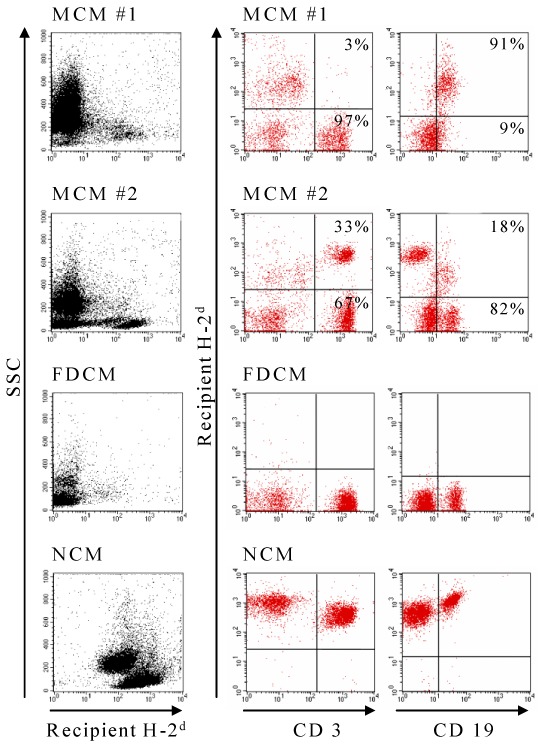
Recipient H-2d expression on CD3+ T cells (middle column panel) and CD19+ B cells (last column panel) was analyzed by flow cytometry on peripheral blood cells at time of sacrifice. Left hand side panels represented lymphoid chimerism obtained using an anti-recipient H-2 mAb versus SSC gating. A representative flow cytometry profile from a mixed chimeric mouse among 16 mice developing cGVHD (MCM#1) shows B cells from recipient origin and T cells from donor origin. A representative flow cytometry profile from a healthy mixed chimeric mouse out of 20 mice (MCM#2) shows similar proportions of T and B cells from both origins. Representative flow cytometry profiles for full-donor- (FDCM, n=34) and non-chimeric (NCM, n=64) mice are also shown.

References

    1. McSweeney PA, Niederwieser D, Shizuru JA, et al. Hematopoietic cell transplantation in older patients with hematologic malignancies: replacing high-dose cytotoxic therapy with graft-versus-tumor effects. Blood. 2001;97:3390. - PubMed
    1. Khouri IF, Saliba RM, Giralt SA, et al. Nonablative allogeneic hematopoietic transplantation as adoptive immunotherapy for indolent lymphoma: low incidence of toxicity, acute graft-versus-host disease, and treatment-related mortality. Blood. 2001;98:3595. - PubMed
    1. Martino R, Caballero MD, Simon JA, et al. Evidence for a graft-versus-leukemia effect after allogeneic peripheral blood stem cell transplantation with reduced-intensity conditioning in acute myelogenous leukemia and myelodysplastic syndromes. Blood. 2002;100:2243. - PubMed
    1. Mielcarek M, Martin PJ, Leisenring W, et al. Graft-versus-host disease after nonmyeloablative versus conventional hematopoietic stem cell transplantation. Blood. 2003;102:756. - PubMed
    1. Sykes M. Mixed chimerism and transplant tolerance. Immunity. 2001;14:417. - PubMed

Publication types