Spontaneous preterm delivery in primiparous women at low risk in Denmark: population based study
- PMID: 16497733
- PMCID: PMC1444877
- DOI: 10.1136/bmj.38751.524132.2F
Spontaneous preterm delivery in primiparous women at low risk in Denmark: population based study
Abstract
Objectives: To analyse trends in preterm delivery and the factors contributing to preterm delivery in Denmark. To construct a standard population at low risk (white European, 20-40 years of age, with a singleton spontaneous pregnancy) and describe the changes in this population so that time trends can be compared internationally.
Design: Population based study.
Participants: 99.8% of all deliveries in Denmark, 1995-2004.
Main outcome measures: Proportion of babies born at less than 37 weeks' completed gestation for each year in the overall population and in a standard population at low risk.
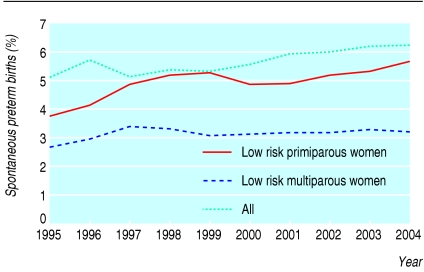
Results: Overall, the proportion of preterm deliveries increased by 22% from 1995 to 2004. During the same period, known risk factors for preterm delivery such as in vitro fertilisation, multiple pregnancies, and elective deliveries also increased, and logistic regression analyses showed that these factors were associated with an increased risk of preterm delivery. Spontaneous preterm deliveries in primiparous women at low risk rose 51% (from 3.8% to 5.7%) during this time compared with 20% (2.7% to 3.2%) in multiparous women at low risk.
Conclusions: The overall proportion of preterm deliveries increased significantly from 1995 to 2004 and primiparity and multiple birth were the most important contributing factors. The rise in spontaneous preterm deliveries in the standard population of primiparous women at low risk was greater than in the total population.
Figures
Comment in
-
Why should preterm births be rising?BMJ. 2006 Apr 22;332(7547):924-5. doi: 10.1136/bmj.332.7547.924. BMJ. 2006. PMID: 16627490 Free PMC article. No abstract available.
-
Preterm delivery in primiparous women at low risk: could epidemic chlamydia contribute to rise in preterm births?BMJ. 2006 May 6;332(7549):1094. doi: 10.1136/bmj.332.7549.1094-b. BMJ. 2006. PMID: 16675824 Free PMC article. No abstract available.
References
-
- National Center for Health Statistics fund. Preterm birth: US, 1992-2002. www.marchofdimes.com/peristats/ (accessed 1 Aug 2005).
-
- Medical Birth Registry of Norway. Preterm births: Norway 1995-2002. www.mfr.no/ (accessed 1 Aug 2005).
-
- Balchin I, Whittaker JC, Steer PJ, Lamont RF. Are reported preterm birth rates reliable? An analysis of interhospital differences in the calculation of the weeks of gestation at delivery and preterm birth rate. Br J Obstet Gynaecol 2004;111: 160-3. - PubMed
-
- Yang H, Kramer MS, Platt RW, Blondel B, Breart G, Morin I, et al. How does early ultrasound scan estimation of gestational age lead to higher rates of preterm birth? Am J Obstet Gynecol 2002;186: 433-7. - PubMed
-
- Hedegaard M, Henriksen TB, Sabroe S, Secher NJ. The relationship between psychological distress during pregnancy and birth weight for gestational age. Acta Obstet Gynecol Scand 1996;75: 32-9. - PubMed
Publication types
MeSH terms
LinkOut - more resources
Full Text Sources
Other Literature Sources