


Plasma levels of soluble interleukin 2 receptor, soluble CD30, interleukin 10 and B cell activator of the tumour necrosis factor family during follow-up in vasculitis associated with proteinase 3-antineutrophil cytoplasmic antibodies: associations with disease activity and relapse
- PMID: 16504995
- PMCID: PMC1798350
- DOI: 10.1136/ard.2005.046219
Plasma levels of soluble interleukin 2 receptor, soluble CD30, interleukin 10 and B cell activator of the tumour necrosis factor family during follow-up in vasculitis associated with proteinase 3-antineutrophil cytoplasmic antibodies: associations with disease activity and relapse
Abstract
Objectives: To evaluate whether T cell activation, as reflected by levels of soluble interleukin 2 receptor (sIL2R), soluble CD30 (sCD30), IL-10 and B cell activator of the tumour necrosis factor family (BAFF) at diagnosis and during initial follow-up, is predictive for persistent or renewed antineutrophil cytoplasmic antibody (ANCA) positivity and clinical relapse in patients with vasculitis associated with proteinase 3-antineutrophil cytoplasmic antibodies (PR3-ANCA).
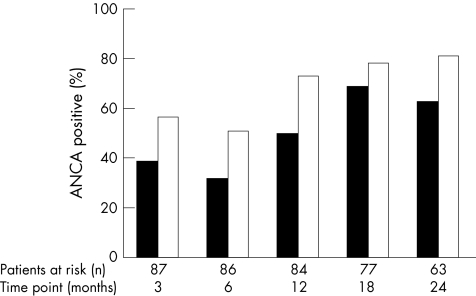
Methods: 87 Patients with PR3-ANCA-associated vasculitis and at least 2 years of follow-up were included in the study. At diagnosis, and at 3, 6, 12, 18 and 24 months after diagnosis, cytoplasmic ANCA titres were detected by indirect immunofluorescence (IIF), and PR3-ANCA, sIL2R, sCD30, IL-10 and BAFF levels were assessed by ELISA. 31 healthy volunteers provided plasma samples for comparison. Levels of immune markers were related to ANCA positivity and relapse during follow-up.
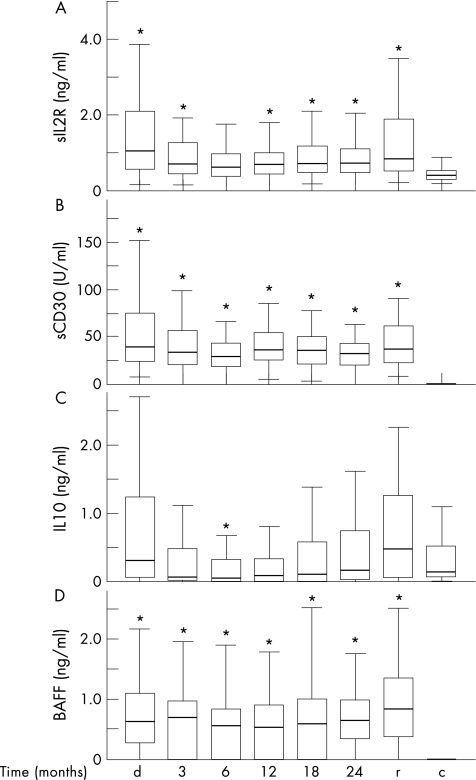
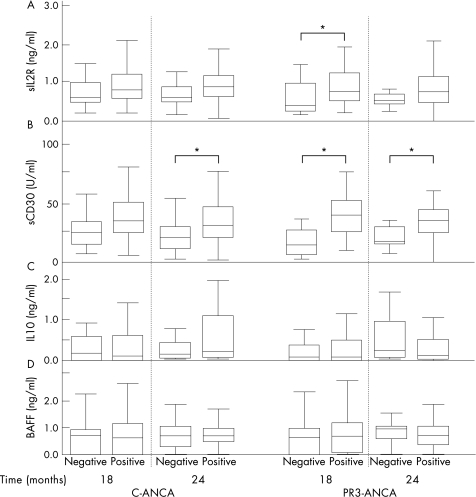
Results: Plasma levels of sIL2R, sCD30 and BAFF were higher in patients than in controls at all time points. Plasma levels of sIL2R, sCD30 and IL-10 were higher at diagnosis and relapse than during remission. At 18 months, sCD30 (p<0.001) and sIL2R levels (p = 0.01) were significantly higher in PR3-ANCA-positive patients (detected by ELISA) than in PR3-ANCA-negative patients. ANCA-positive patients detected by ELISA or IIF at 24 months had significantly higher plasma sCD30 levels (p = 0.02 and p = 0.03, respectively) than ANCA-negative patients.
Conclusion: Increased T cell activation in patients with ANCA-associated vasculitis in remission during and after immunosuppressive treatment is associated with persistent or renewed ANCA positivity.
Conflict of interest statement
Competing interests: None.
References
-
- Tervaert J W, Goldschmeding R, Elema J D, van der G M, Huitema M G, van der Hem G K.et al Autoantibodies against myeloid lysosomal enzymes in crescentic glomerulonephritis. Kidney Int 199037799–806. - PubMed
-
- Jennette J C, Falk R J. Small‐vessel vasculitis. N Engl J Med 19973371512–1523. - PubMed
-
- Stegeman C A. Anti‐neutrophil cytoplasmic antibody (ANCA) levels directed against proteinase‐3 and myeloperoxidase are helpful in predicting disease relapse in ANCA‐associated small‐vessel vasculitis. Nephrol Dial Transplant 2002172077–2080. - PubMed
-
- Slot M C, Tervaert J W, Boomsma M M, Stegeman C A. Positive classic antineutrophil cytoplasmic antibody (C‐ANCA) titer at switch to azathioprine therapy associated with relapse in proteinase 3‐related vasculitis. Arthritis Rheum 200451269–273. - PubMed
-
- Sanders J S, Huitma M G, Kallenberg C G, Stegeman C A. Prediction of relapses in PR3‐ANCA‐associated vasculitis by assessing responses of ANCA titres to treatment. Rheumatology (Oxford) 200645724–729. - PubMed
Publication types
MeSH terms
Substances
LinkOut - more resources
Full Text Sources
Medical
