


An evaluation of molecular markers for improved detection of breast cancer metastases in sentinel nodes
- PMID: 16505281
- PMCID: PMC1860352
- DOI: 10.1136/jcp.2005.028357
An evaluation of molecular markers for improved detection of breast cancer metastases in sentinel nodes
Abstract
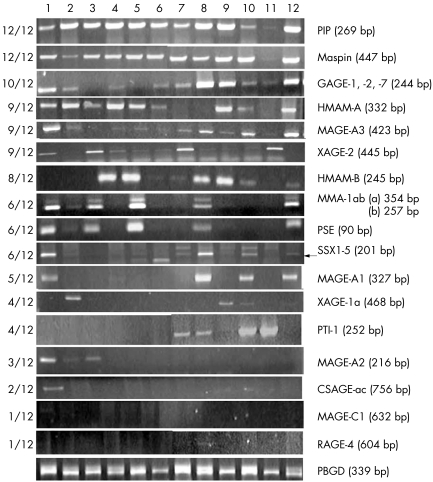
Background and objectives: In patients with breast cancer (BC), the sentinel node (SN) is the first node in the axillary basin that receives the primary lymphatic flow and can be used to accurately assess the axillary nodal status without removal of the axillary contents. Currently, histology and/or immunohistochemistry are the routine methods of SN analysis. The primary objective of this study was to develop a reproducible reverse transcription (RT) PCR assay, with emphasis on achieving high specificity for accurate detection of BC micrometastases in the SN. To correct for the heterogeneity of BC cells, a multimarker approach was followed, with the further aim of improving the detection rate of the assay.
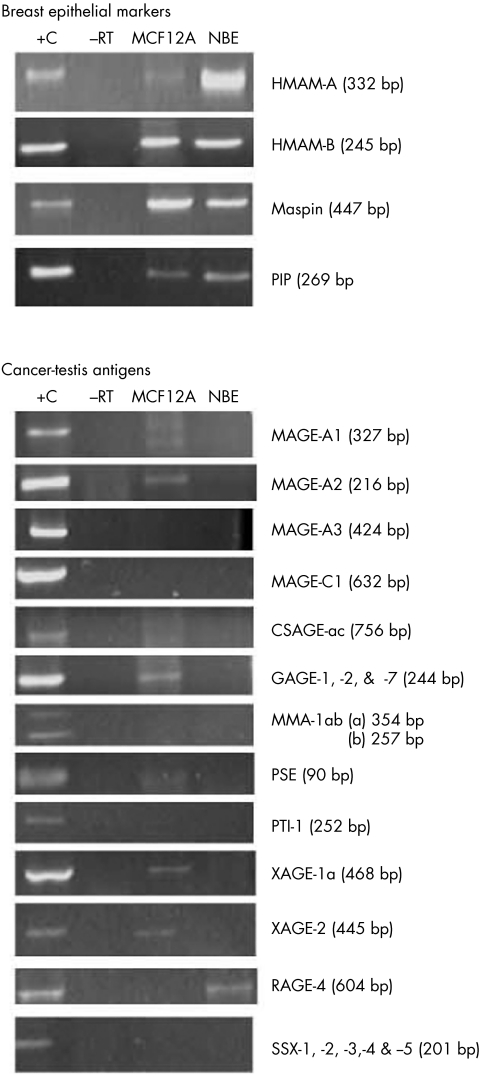
Methods: In total, 73 markers were evaluated, of which 7 were breast epithelial markers and 66 were either cancer testis or tumour associated antigens. Twelve BC cell lines and 30 SNs (from 30 patients) were analysed using RT-PCR to determine the in vitro and in vivo detection rates for each of the markers. In addition, 20 axillary nodes obtained from a patient with brain death were used as controls to optimise the PCR cycle numbers for all the markers.
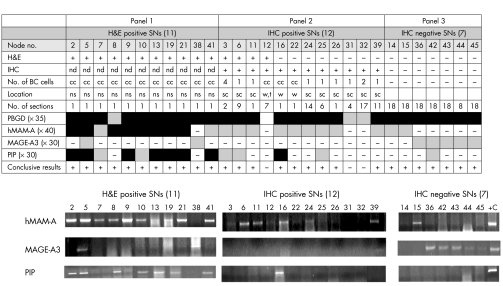
Results: Of the 30 SNs, 37% (11/30) were positive on haematoxylin and eosin analysis. Extensive immunohistochemical (IHC) analyses of the haematoxylin and eosin negative nodes confirmed the presence of very small numbers of BC cells in an additional 40% (12/30) of SNs. Molecular analysis with the hMAM-A alone identified metastases in 70% (21/30) of SNs. Using MAGE-A3 in combination with hMAM-A identified metastases in 90% (27/30) of patients. Seven SNs (23%) were negative for micrometastases (with haematoxylin and eosin and IHC) but RT-PCR positive for either hMAM-A or MAGE-A3.
Conclusions: As IHC analysis resulted in a 77% detection rate compared with 37% for haematoxylin and eosin analysis, we consider that IHC is essential in order not to miss SN micrometastases. Molecular analysis with hMAM-A and MAGE-A3 allows detection of BC micrometastases with a 90% detection rate. However, the clinical value of histologically negative but RT-PCR positive SNs can only be determined with long term follow up.
References
-
- Parkin D M, Pisani P, Ferlay J. Estimates of the worldwide incidence of 25 major cancers in 1990. Int J Cancer 199980827–841. - PubMed
-
- Boyle P, Leon M E, Maisonneuve P.et al Cancer control in women. Update 2003. Int J Gynaecol Obstet 200383(suppl 1)179–202. - PubMed
-
- Braun S, Pantel K. Clinical significance of occult metastatic cells in bone marrow of breast cancer patients. Oncologist 20016125–132. - PubMed
-
- Turner R R, Giuliano A E, Hoon D S.et al Pathologic examination of sentinel lymph node for breast carcinoma. World J Surg 200125798–805. - PubMed
-
- Diel I J. Bone marrow staging for breast cancer: is it better than axillary node dissection? Semin Oncol 200128236–244. - PubMed
Publication types
MeSH terms
Substances
LinkOut - more resources
Full Text Sources
Medical
