. 2006 Mar 7;103(10):3598-603.
doi: 10.1073/pnas.0600082103. Epub 2006 Feb 27.

Changes produced by bound tryptophan in the ribosome peptidyl transferase center in response to TnaC, a nascent leader peptide

Affiliations

Changes produced by bound tryptophan in the ribosome peptidyl transferase center in response to TnaC, a nascent leader peptide

Luis Rogelio Cruz-Vera et al. Proc Natl Acad Sci U S A. .

Abstract

Studies in vitro have established that free tryptophan induces tna operon expression by binding to the ribosome that has just completed synthesis of TnaC-tRNA(Pro), the peptidyl-tRNA precursor of the leader peptide of this operon. Tryptophan acts by inhibiting Release Factor 2-mediated cleavage of this peptidyl-tRNA at the tnaC stop codon. Here we analyze the ribosomal location of free tryptophan, the changes it produces in the ribosome, and the role of the nascent TnaC-tRNA(Pro) peptide in facilitating tryptophan binding and induction. The positional changes of 23S rRNA nucleotides that occur during induction were detected by using methylation protection and binding/competition assays. The ribosome-TnaC-tRNA(Pro) complexes analyzed were formed in vitro; they contained either wild-type TnaC-tRNA(Pro) or its nonfunctional substitute, TnaC(W12R)-tRNA(Pro). Upon comparing these two peptidyl-tRNA-ribosome complexes, free tryptophan was found to block methylation of nucleotide A2572 of wild-type ribosome-TnaC-tRNA(Pro) complexes but not of ribosome-TnaC(W12R)-tRNA(Pro) complexes. Nucleotide A2572 is in the ribosomal peptidyl transferase center. Tryptophanol, a noninducing competitor of tryptophan, was ineffective in blocking A2572 methylation; however, it did reverse the protective effect of tryptophan. Free tryptophan inhibited puromycin cleavage of TnaC-tRNA(Pro); it also inhibited binding of the antibiotic sparsomycin. These effects were not observed with TnaC(W12R)-tRNA(Pro) mutant complexes. These findings establish that Trp-12 of TnaC-tRNA(Pro) is required for introducing specific changes in the peptidyl transferase center of the ribosome that activate free tryptophan binding, resulting in peptidyl transferase inhibition. Free tryptophan appears to act at or near the binding sites of several antibiotics in the peptidyl transferase center.


Conflict of interest statement

Conflict of interest statement: No conflicts declared.

Figures

Fig. 1.
Fig. 1.
Analysis of tryptophan inhibition of puromycin cleavage of ribosome complexes containing wild-type TnaC-tRNAPro or mutant TnaC(W12R)-tRNAPro. Complexes formed with either wild-type tnaC mRNA or mutant tnaC (W12R) mRNA, prepared in cell-free extracts pretreated with anti-RF2 antibodies, were isolated by using streptavidin beads. These bead-bound complexes were washed and resuspended in the presence (+) or absence (−) of 2 mM tryptophan (Trp). (A) Mixtures with or without tryptophan were incubated with different concentrations of puromycin (Puro) for 7 min at 37°C. Reaction products were then resolved by electrophoresis in 10% Tris-Tricine polyacrylamide gels and transferred to nitrocellulose membranes. Northern blot assays were used to detect and measure the levels of wild-type and mutant peptidyl-tRNA by using a 32P-labeled oligonucleotide complementary to tRNAPro. (B) Curves displaying the extent of hydrolysis of the two peptidyl-tRNAs examined in A. (C) Isolated bead complexes were washed with a solution lacking tryptophan and were then incubated with increasing concentrations of tryptophan for 5 min at 37°C. Puromycin was (+) or was not (−) added, and the peptidyl-tRNA level was determined as described in A. (D) Curves showing the extent of hydrolysis of the peptidyl-tRNAs displayed in C. The percent value shown represents the cpm in each peptidyl-tRNA in the “+” tryptophan lane divided by the cpm in the peptidyl-tRNA in the lane minus puromycin. Each experiment was performed three times.
Fig. 2.
Fig. 2.
Analysis of TnaC-tRNAPro and TnaC (W12R)-tRNAPro accumulation after tryptophan induction in vivo of wild-type or mutant tnaC genes with the added isoleucine codon, AUA25 or AUU25. Cultures of strain W3110 (tnaA2) transformed with plasmid pCV25–00A25 (tnaC-AUA25), pCV25–00U25 (tnaC-AUU25), or pCV25–14A25 [tnaC (W12R)-AUA25] were grown in the presence (+) or absence (−) of 100 μg/ml tryptophan. Clarified cell extracts were prepared and subjected to electrophoresis as described in Materials and Methods, and the peptidyl-tRNA TnaC-tRNAPro and tRNAPro levels were detected as described in Fig. 1A. Each experiment was performed three times.
Fig. 3.
Fig. 3.
Analyses of methylation changes in 23S rRNA induced by free tryptophan, with TnaC-tRNAPro or TnaC(W12R)-tRNAPro complexes treated with anti-RF2 antibodies. (A) Ribosomes isolated from cell-free extracts were incubated in the presence (+) or absence (−) of tryptophan (Trp) for 5 min at 37°C. The solutions were mixed with 1/150 (vol/vol) of the methylation agent DMS and incubated at room temperature for 10 min. Total RNA was extracted and used in primer extension assays with a 32P-labeled oligonucleotide complementary to nucleotides 2654–2674 of 23S rRNA. The extension assays were resolved by electrophoresis in 7 M urea/6.5% polyacrylamide gels. The nucleotides indicated on the left were methylated by DMS. (B) Complexes bound to streptavidin beads were isolated as described in Fig. 1. The beads were washed and resuspended in a solution without tryptophan. These mixtures were then incubated with (+) or without (−) tryptophan for 5 min at 37°C. The 23S rRNA in each sample was methylated with DMS, and the rRNA nucleotides resolved as indicated above. Primer extension analyses were performed by using the various 23S rRNAs and a 32P-labeled oligonucleotide complementary to 23S rRNA nucleotides 2654–2674. For nucleotide A2572, the percent methylation shown corresponds to the ratio of the cpm detected for the experimental A2572 band divided by the cpm for the band obtained with the control sample of Ribo-tnaC mRNA without tryptophan. (C) Samples of an isolated bead complex in a solution without tryptophan were incubated with (+) or without (−) tryptophanol (Trp-OH) for 5 min at 37°C. Tryptophan was then added, and the mixtures were incubated an additional 10 min. The mixtures were finally incubated in the presence (+) or absence (−) of puromycin for 5 min. The reaction products were separated by electrophoresis and the peptidyl-tRNA TnaC-tRNAPro was measured as described in Fig. 1. (D) The various bead complexes were washed and resuspended in a solution without tryptophan. They were then incubated with (+) or without (−) tryptophanol (Trp-OH) for 5 min at 37°C, after prior incubation for 5 min in the presence (+) or absence (−) of tryptophan (Trp). The 23S rRNA was methylated with DMS, and the labeled bands were resolved and identified. The percent methylation was calculated as indicated above. Each experiment was performed four times. The band corresponding to nucleotide A2602 was used as a methylation control and for standardizing recovery.
Fig. 4.
Fig. 4.
Analysis of methylation changes in 23S rRNA produced by the addition of antibiotics to isolated ribosome complexes. Complexes were isolated as described in the legend to Fig. 1. (A) Complexes containing wild-type tnaC mRNA or tnaC(W12R) mRNA bound to streptavidin beads were isolated, washed, resuspended, and incubated with (+) or without (−) tryptophan for 5 min at 37°C. Inhibitors of translation were then added at the concentrations indicated, and the mixtures were incubated for an additional 10 min. The 23S rRNA was then methylated by using DMS, and the methylated nucleotides were detected as described in Fig. 3. Primer extension assays were performed by using a 32P-labeled oligonucleotide complementary to nucleotides 2102–2122 of 23S rRNA. (B) Isolated complexes with wild-type tnaC mRNA that had been washed to remove free tryptophan were incubated with (+) or without (−) tryptophanol (Trp-OH) for 5 min at 37°C, after which they were incubated with (+) or without (−) sparsomycin for an additional 10 min. The samples were then treated with DMS, and nucleotide methylation was analyzed as described above. The percent methylation of nucleotides A2058 and A2059 was calculated as described in Fig. 3. Each experiment was performed three times.
Fig. 5.
Fig. 5.
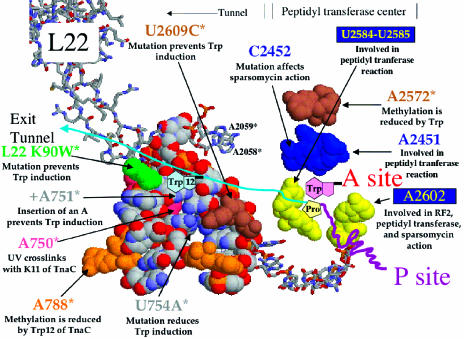
Regions of the E. coli 50S ribosome subunit believed to play a role in tryptophan induction of tna operon expression. This figure is based on the structure determined by Schuwirt et al. (19). Identified are nucleotides of 23S rRNA and residue K90 of the L22 ribosomal protein that are required for tryptophan inhibition of TnaC-tRNAPro hydrolysis. Also indicated are the putative locations of (i) the tRNAPro (curved purple line) in the ribosomal P-site, (ii) Trp-12 (light blue) of the TnaC-tRNAPro peptide (blue line) in the peptide exit tunnel, (iii) proline residue 24 (light yellow) of the TnaC-tRNAPro peptidyl-tRNA, and (iv) free tryptophan (pink) at the peptidyl transferase center. Locations of residues are based on the studies described in this paper and in Cruz-Vera et al. (7). The positions of nucleotides A2058 and A2509, nucleotides whose methylation was affected by antibiotic presence, are shown. An asterisk marks each residue we observed to affect induction, or whose methylation was altered by the presence of tryptophan and/or an antibiotic.

References

    1. Deeley M. C., Yanofsky C. J. Bacteriol. 1981;147:787–796. - PMC - PubMed
    1. Deeley M. C., Yanofsky C. J. Bacteriol. 1982;151:942–951. - PMC - PubMed
    1. Stewart V., Landick R., Yanofsky C. J. Bacteriol. 1986;166:217–223. - PMC - PubMed
    1. Gong F., Ito K., Nakamura Y., Yanofsky C. Proc. Natl. Acad. Sci. USA. 2001;98:8997–9001. - PMC - PubMed
    1. Gong F., Yanofsky C. J. Biol. Chem. 2002;277:17095–17100. - PubMed

Publication types

MeSH terms

LinkOut - more resources