


Intramolecular Pd-catalyzed carboetherification and carboamination. Influence of catalyst structure on reaction mechanism and product stereochemistry
- PMID: 16506768
- PMCID: PMC2710616
- DOI: 10.1021/ja057489m
Intramolecular Pd-catalyzed carboetherification and carboamination. Influence of catalyst structure on reaction mechanism and product stereochemistry
Abstract
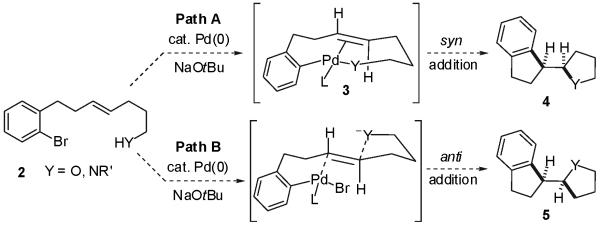
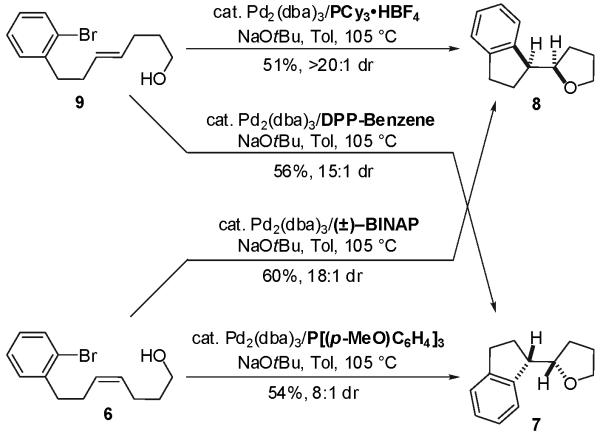
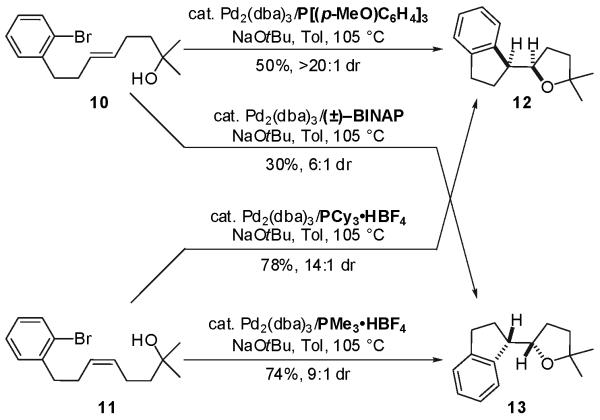
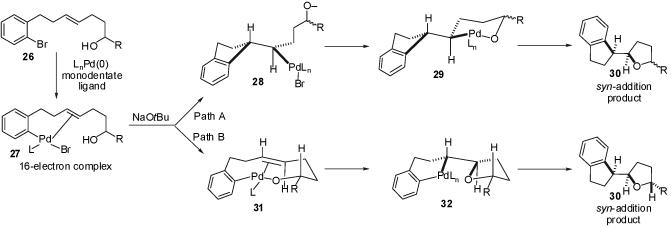
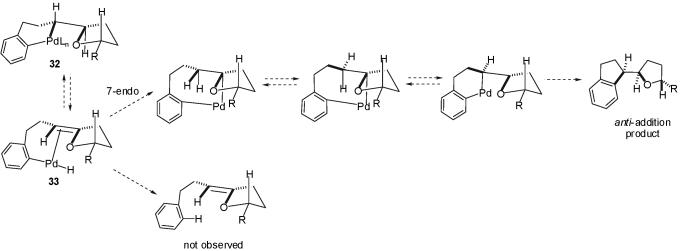
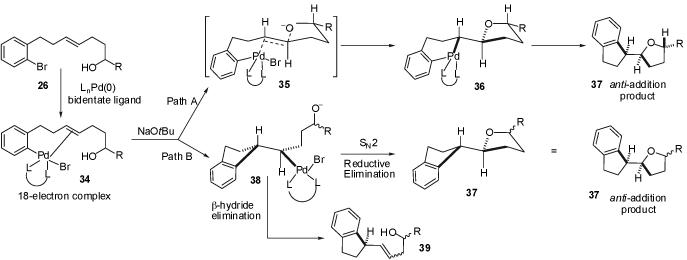
The intramolecular Pd-catalyzed carboetherification of alkenes affords 2-indan-1-yltetrahydrofuran products in moderate to good yield with good to excellent levels of diastereoselectivity. The stereochemical outcome of these reactions is dependent on the structure of the Pd catalyst. Use of PCy(3) or P[(4-MeO)C(6)H(4)](3) as the ligand for Pd leads to syn-addition of the arene and the oxygen atom across the double bond, whereas use of (+/-)-BINAP or DPP-benzene affords products that result from anti-addition. The catalyst-induced change in stereochemistry is likely due to a change in reaction mechanism. Evidence is presented that suggests the syn-addition products derive from an unprecedented transannular alkene insertion of an 11-membered Pd(Ar)(OR) complex. In contrast, the anti-addition products appear to arise from Wacker-type anti-oxypalladation. Studies on analogous Pd-catalyzed intramolecular carboamination reactions, which afford 2-indan-1-ylpyrrolidines that result from syn-addition, are also described.
Figures
References
-
-
X-ray structure analysis was performed by Jeff W. Kampf.
-
-
-
For examples of heterocycles bearing attached heterocycles, see:Bermejo A, Figadere B, Zafra-Polo M-C, Barrachina I, Estornell E, Cortes D. Nat. Prod. Rep. 2005;22:269–303.Faul MM, Huff BE. Chem. Rev. 2000;100:2407–2474.Hoppe R, Scharf H-D. Synthesis. 1995:1447–1464.Koert U. Angew. Chem., Int. Ed. 1995;34:298–300.
-
-
-
For examples of heterocycles bearing attached carbocycles, see:Ukiya M, Akihisa T, Yasukawa K, Kasahara Y, Kimura Y, Koike K, Nikaido T, Takido M. J. Agric. Food Chem. 2001;49:3187–3197.Spinella A, Mollo E, Trivellone E, Cimino G. Tetrahedron. 1997;53:16891–16896.Rasmusson GH, Reynolds GF, Steinberg NG, Walton E, Patel GF, Liang T, Cascieri MA, Cheung AH, Brooks JR, Berman C. J. Med. Chem. 1986;29:2298–2315.Arthur HR, Ko PDS. Phytochemistry. 1974;13:2551–2557.
-
-
-
For representative examples of other strategies that generate attached rings via C-C bond-forming reactions between cyclic precursors, see:Lemieux RM, Meyers AI. J. Am. Chem. Soc. 1998;120:5453–5457.Lebsack AD, Overman LE, Valentekovich RJ. J. Am. Chem. Soc. 2001;123:4851–4852.
-
-
-
a) For attached-ring synthesis via pincaol-terminated Prins cyclizations, which generate two stereocenters and one ring in a single step see:Overman LE, Pennington LD. Can. J. Chem. 2000;78:732–738.b) For attached-ring synthesis via intramolecular 1,3-dipolar cycloaddition followed by Mo-catalyzed ring cleavage, see:Tranmer GK, Tam W. Org. Lett. 2002;4:4101–4104.c) For attached ring synthesis via Mn(III)-promoted oxidative cyclization reactions of malonates bearing tethered unsaturated alcohols, see:Hulcoop DG, Sheldrake HM, Burton JW. Org. Biomol. Chem. 2004;2:965–967.
-
Publication types
MeSH terms
Substances
Grants and funding
LinkOut - more resources
Full Text Sources
Research Materials
Miscellaneous
