Altered breast development in young girls from an agricultural environment
- PMID: 16507474
- PMCID: PMC1392245
- DOI: 10.1289/ehp.8280
Altered breast development in young girls from an agricultural environment
Abstract
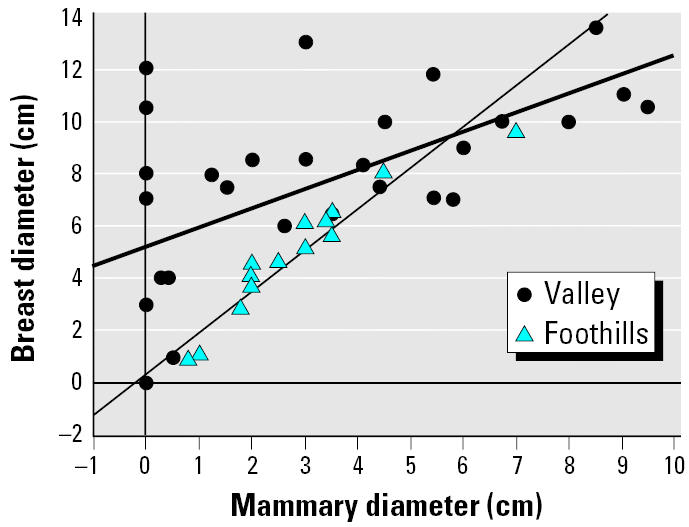
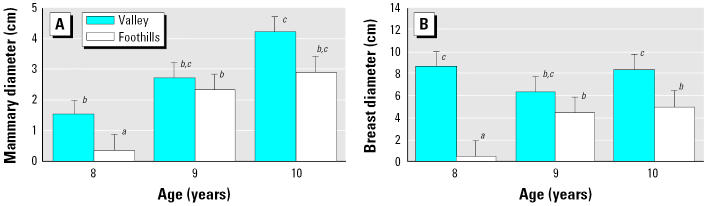
In several human populations, the age at which female breast development begins is reported to have declined over the last five decades. Much debate has occurred over whether this reported decline has actually occurred and what factors contribute to it. However, geographical patterns reflecting earlier developmental onset in some human populations suggest environmental factors influence this phenomenon. These factors include interactions between genetic makeup, nutrition, and possible cumulative exposure to estrogens, both endogenous as well as environmental beginning during in utero development. We examined the onset of breast development in a group of peripubertal girls from the Yaqui Valley of Sonora, Mexico. We observed that girls from valley towns, areas using modern agricultural practices, exhibited larger breast fields than those of girls living in the foothills who exhibited similar stature [e.g., weight, height, body mass index (BMI)], and genetic background. Further, girls from valley towns displayed a poorly defined relationship between breast size and mammary gland development, whereas girls from the Yaqui foothills, where traditional ranching occurs, show a robust positive relationship between breast size and mammary size. The differences noted were obtained by a medically based exam involving morphometric analysis and palpation of tissues, in contrast to visual staging alone. In fact, use of the Tanner scale, involving visual staging of breast development for puberty, detected no differences between the study populations. Mammary tissue, determined by palpation, was absent in 18.5% of the girls living in agricultural areas, although palpable breast adipose tissue was present. No relationship was seen between mammary diameter and weight or BMI in either population. These data suggest that future in-depth studies examining mammary tissue growth and fat deposition in breast tissue are required if we are to understand environmental influences on these phenomena.
Figures
References
-
- Almada-Bay I. 2000. Historia Regional de Sonora: perfil socioeconomico. Mexico City:Ed. LIMUSA, S.A. de C.V.
-
- Bern H. 1992. The fragile fetus. In: Chemically-Induced Alterations in Sexual and Functional Development: The Wildlife/Human Connection (Colborn T, Clement C, eds). Princeton,NJ:Princeton Scientific Publishing Company, Inc., 9–15.
-
- Blanck HM, Marcus M, Tolbert PE, Rubin C, Henderson AK, Hertzberg VS, et al. Age at menarche and Tanner stage in girls exposed in utero and postnatally to polybrominated biphenyl. Epidemiology. 2000;11:641–647. - PubMed
-
- Bongiovanni AM. An epidemic of premature thelarche in Puerto Rico. J Pediatr. 1983;103:245–246. - PubMed
-
- Boyd MT, Hildebrandt RH, Bartow SA. Expression of the estrogen receptor gene in developing and adult human breast. Breast Cancer Res Treat. 1996;37:243–251. - PubMed
Publication types
MeSH terms
LinkOut - more resources
Full Text Sources