Review
. 2006 Mar;116(3):598-606.
doi: 10.1172/JCI27958.

Involvement of PPAR nuclear receptors in tissue injury and wound repair

Affiliations
Review

Involvement of PPAR nuclear receptors in tissue injury and wound repair

Liliane Michalik et al. J Clin Invest. 2006 Mar.

Abstract

Tissue damage resulting from chemical, mechanical, and biological injury, or from interrupted blood flow and reperfusion, is often life threatening. The subsequent tissue response involves an intricate series of events including inflammation, oxidative stress, immune cell recruitment, and cell survival, proliferation, migration, and differentiation. In addition, fibrotic repair characterized by myofibroblast transdifferentiation and the deposition of ECM proteins is activated. Failure to initiate, maintain, or stop this repair program has dramatic consequences, such as cell death and associated tissue necrosis or carcinogenesis. In this sense, inflammation and oxidative stress, which are beneficial defense processes, can become harmful if they do not resolve in time. This repair program is largely based on rapid and specific changes in gene expression controlled by transcription factors that sense injury. PPARs are such factors and are activated by lipid mediators produced after wounding. Here we highlight advances in our understanding of PPAR action during tissue repair and discuss the potential for these nuclear receptors as therapeutic targets for tissue injury.


Figures
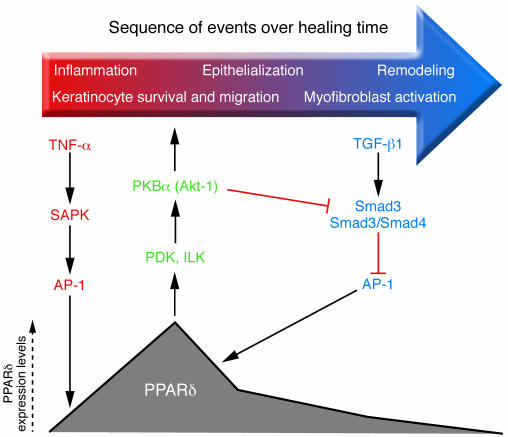
Figure 1
Figure 1
Dynamic control of PPARδ expression after skin injury. Left: TNF-α released by injured epidermal keratinocytes activates stress-associated protein kinase (SAPK) and induces AP-1 binding to the PPARδ promoter and transcription of PPARδ target genes. TNF-α also triggers production of endogenous PPARδ ligands, which activate PPARδ in keratinocytes and macrophages. Center: PPARδ activation helps maintain a sufficient number of keratinocytes for re-epithelialization by improving apoptosis resistance through expression of integrin-linked kinase (ILK) and 3-phosphoinositide–dependent kinase (PDK), as well as via activation of the PKB/Akt-1 survival pathway. Right: The initial inflammatory signals that stimulate PPARδ are countered by TGF-β1/Smad3–mediated suppression of PPARδ in the late re-epithelialization/remodeling stage. This suppression occurs via Smad3/4 complex–mediated abrogation of AP-1 activity. In addition, TGF-β1 released by dermal wound fibroblasts increases macrophage numbers and stimulates ECM production for wound remodeling. The diverse cell types and feedback signals regulating would repair are discussed in detail in the text.
Figure 2
Figure 2
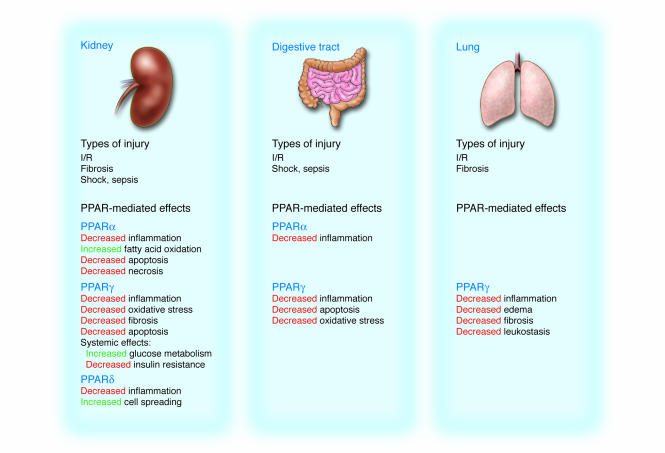
Epithelial repair pathways controlled by PPARs during kidney, digestive tract, and lung injury. Common to all tissue injury is a rapid increase in inflammation. PPAR activation, mediated by the binding of natural and synthetic ligands, restricts inflammation to prevent extensive tissue necrosis and chronic oxidative damage.
Figure 3
Figure 3
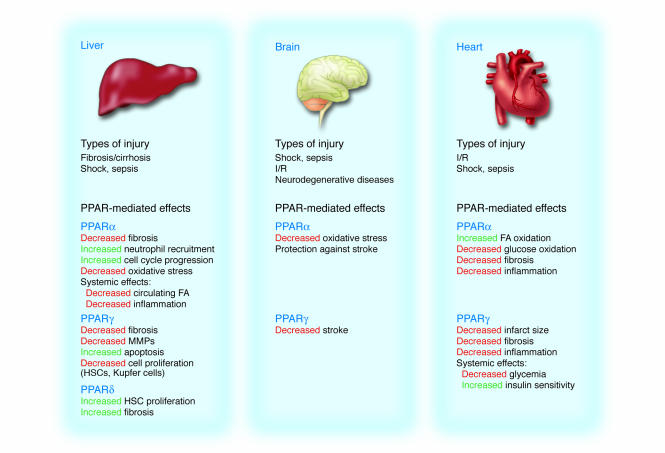
Role of PPARs in repair of liver, brain, and heart damage. Various systemic states such as shock or sepsis can lead to organ injury and failure. These injuries, as well as tissue-specific insults such as cirrhosis, fibrosis, and I/R injury, can be partially alleviated or prevented through the actions of PPARs.

References

    1. Michalik L, et al. Impaired skin wound healing in peroxisome proliferator-activated receptor (PPAR)alpha and PPARbeta mutant mice. J. Cell Biol. 2001;154:799–814. - PMC - PubMed
    1. Barak Y, et al. Effects of peroxisome proliferator-activated receptor delta on placentation, adiposity, and colorectal cancer. Proc. Natl. Acad. Sci. U. S. A. 2002;99:303–308. - PMC - PubMed
    1. Mao-Qiang M, et al. Peroxisome-proliferator-activated receptor (PPAR)-gamma activation stimulates keratinocyte differentiation. J. Invest. Dermatol. 2004;123:305–312. - PubMed
    1. Lemberger T, et al. Regulation of the peroxisome proliferator-activated receptor alpha gene by glucocorticoids. J. Biol. Chem. 1994;269:24527–24530. - PubMed
    1. Tan NS, Michalik L, Di-Poi N, Desvergne B, Wahli W. Critical roles of the nuclear receptor PPARbeta (peroxisome-proliferator-activated receptor beta) in skin wound healing. Biochem. Soc. Trans. 2004;32:97–102. - PubMed

Publication types

Substances