Retroposed elements as archives for the evolutionary history of placental mammals
- PMID: 16515367
- PMCID: PMC1395351
- DOI: 10.1371/journal.pbio.0040091
Retroposed elements as archives for the evolutionary history of placental mammals
Abstract
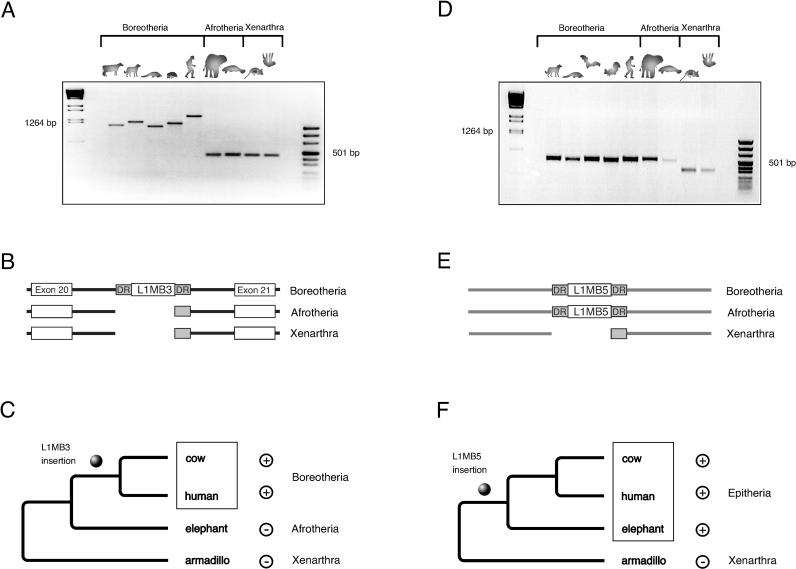
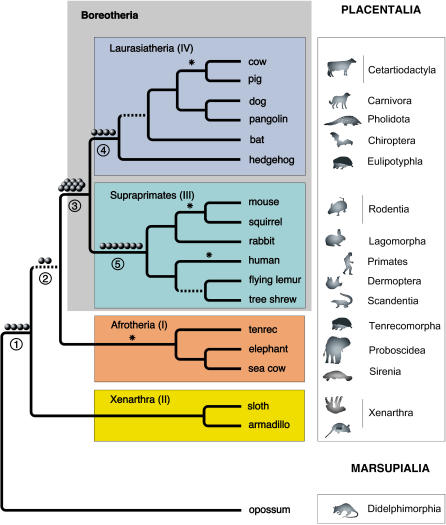
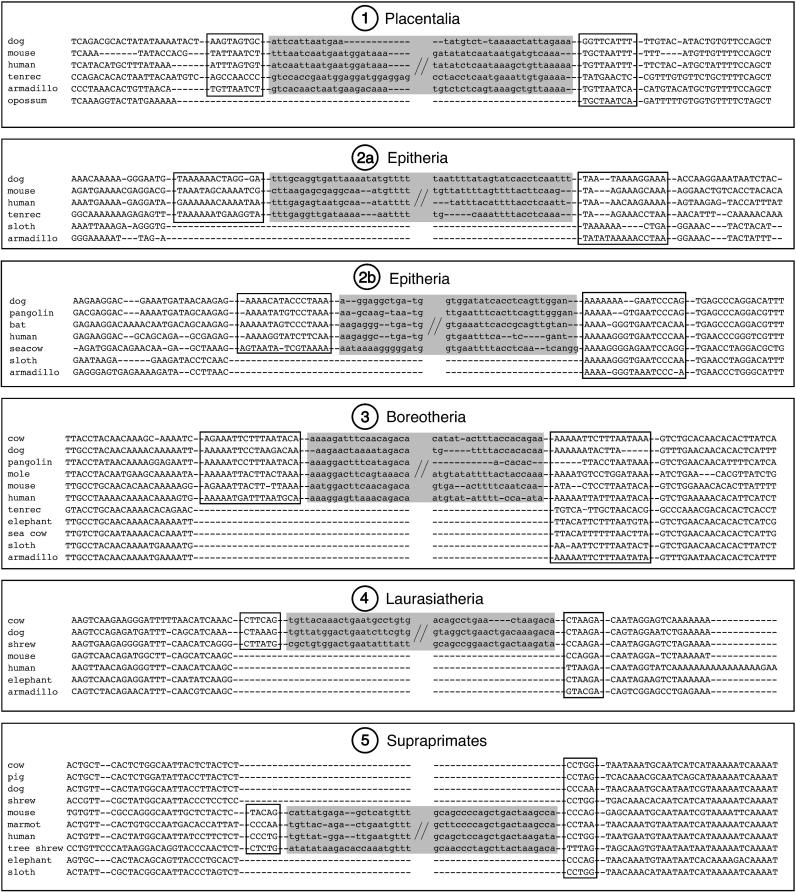
Reconstruction of the placental mammalian (eutherian) evolutionary tree has undergone diverse revisions, and numerous aspects remain hotly debated. Initial hierarchical divisions based on morphology contained many misgroupings due to features that evolved independently by similar selection processes. Molecular analyses corrected many of these misgroupings and the superordinal hierarchy of placental mammals was recently assembled into four clades. However, long or rapid evolutionary periods, as well as directional mutation pressure, can produce molecular homoplasies, similar characteristics lacking common ancestors. Retroposed elements, by contrast, integrate randomly into genomes with negligible probabilities of the same element integrating independently into orthologous positions in different species. Thus, presence/absence analyses of these elements are a superior strategy for molecular systematics. By computationally scanning more than 160,000 chromosomal loci and judiciously selecting from only phylogenetically informative retroposons for experimental high-throughput PCR applications, we recovered 28 clear, independent monophyly markers that conclusively verify the earliest divergences in placental mammalian evolution. Using tests that take into account ancestral polymorphisms, multiple long interspersed elements and long terminal repeat element insertions provide highly significant evidence for the monophyletic clades Boreotheria (synonymous with Boreoeutheria), Supraprimates (synonymous with Euarchontoglires), and Laurasiatheria. More importantly, two retropositions provide new support for a prior scenario of early mammalian evolution that places the basal placental divergence between Xenarthra and Epitheria, the latter comprising all remaining placentals. Due to its virtually homoplasy-free nature, the analysis of retroposon presence/absence patterns avoids the pitfalls of other molecular methodologies and provides a rapid, unequivocal means for revealing the evolutionary history of organisms.
Figures
Comment in
-
Resolving the family tree of placental mammals.PLoS Biol. 2006 Apr;4(4):e111. doi: 10.1371/journal.pbio.0040111. Epub 2006 Mar 14. PLoS Biol. 2006. PMID: 20076552 Free PMC article. No abstract available.
References
-
- Waddell PJ, Kishino H, Ota R. A phylogenetic foundation for comparative mammalian genomics. Genome Inform Ser Workshop Genome Inform. 2001;12:141–154. - PubMed
-
- Murphy WJ, Eizirik E, O'Brien SJ, Madsen O, Scally M, et al. Resolution of the early placental mammal radiation using Bayesian phylogenetics. Science. 2001;294:2348–2351. - PubMed
-
- Scally M, Madsen O, Douady CJ, de Jong WW, Stanhope MJ, et al. Molecular evidence for the major clades of placental mammals. J Mamm Evol. 2001;8:239–277. - PubMed
-
- Waddell PJ, Shelley S. Evaluating placental inter-ordinal phylogenies with novel sequences including RAG1, [gamma]-fibrinogen, ND6, and mt-tRNA, plus MCMC-driven nucleotide, amino acid, and codon models. Mol Phylogenet Evol. 2003;28:197–224. - PubMed
-
- Lin YH, McLenachan PA, Gore AR, Phillips MJ, Ota R, et al. Four new mitochondrial genomes and the increased stability of evolutionary trees of mammals from improved taxon sampling. Mol Biol Evol. 2002;19:2060–2070. - PubMed
Publication types
MeSH terms
Substances
Associated data
- Actions
- Actions
- Actions
- Actions
- Actions
- Actions
- Actions
- Actions
- Actions
- Actions
- Actions
- Actions
- Actions
- Actions
- Actions
- Actions
- Actions
- Actions
- Actions
- Actions
- Actions
- Actions
- Actions
- Actions
- Actions
- Actions
- Actions
- Actions
- Actions
- Actions
- Actions
- Actions
- Actions
- Actions
- Actions
- Actions
- Actions
- Actions
- Actions
- Actions
- Actions
- Actions
- Actions
- Actions
- Actions
- Actions
- Actions
- Actions
- Actions
- Actions
- Actions
- Actions
- Actions
- Actions
- Actions
- Actions
- Actions
- Actions
- Actions
LinkOut - more resources
Full Text Sources
Other Literature Sources