. 2006 Mar;44(3):999-1017.
doi: 10.1128/JCM.44.3.999-1017.2006.

Pre- and postvaccination clonal compositions of invasive pneumococcal serotypes for isolates collected in the United States in 1999, 2001, and 2002

Affiliations

Pre- and postvaccination clonal compositions of invasive pneumococcal serotypes for isolates collected in the United States in 1999, 2001, and 2002

Bernard Beall et al. J Clin Microbiol. 2006 Mar.

Abstract

Monitoring of serotypes and their clonal associations is critical as pneumococci adapt to the selective pressures exerted by the pneumococcal seven-valent conjugate vaccine (PCV7). We genotyped 1,476 invasive isolates from the Active Bacterial Core surveillance (705 [89.8%] of the isolates were obtained from children <5 years of age, and 771 [18.4%] of the isolates were obtained from individuals >5 years of age) in 2001 and 2002 (after the introduction of PCV7). The data were compared to the results for 1,168 invasive isolates (855 [83.9%] of the isolates were from children <5 years of age) collected in 1999. Among children <5 years of age, the incidence of invasive disease due to non-PCV7 serogroups together with serogroup 19A increased (P < 0.001). Eighty-three clonal sets, representing 177 multilocus sequence types (STs), were compiled from the 3-year isolate set. Among the non-PCV7 serogroups, newly emerging clones were uncommon; and a significant expansion of already established clones occurred for serotypes 3 (ST180), 7F (ST191), 15BCF (ST199), 19A (ST199), 22F (ST433), 33F (ST662), and 38 (ST393). However, additional minor clonal types within serotypes 1, 6A, 6B, 7C, 9N, 10A, 12F, 14, 15B/C, 17F, 19A, 19F, 20, 22F, and 33F that were absent in 1999 were found during 2001 and 2002. Although 23 clonal sets exhibited multiple serotypes, for most serotypes there were either no changes or modest changes in clonal compositions since the introduction of PCV7. The only example of an identical ST shared between non-PCV7 and PCV7 or PCV7-related serotypes was ST199; however, ST199 was prevalent within serotypes 15B/C and 19A before and after PCV7 introduction. Continued genotypic surveillance is warranted, since certain clones not targeted by PCV7 are expanding, and their emergence as significant pathogens could occur with maintained vaccine pressure.


Figures
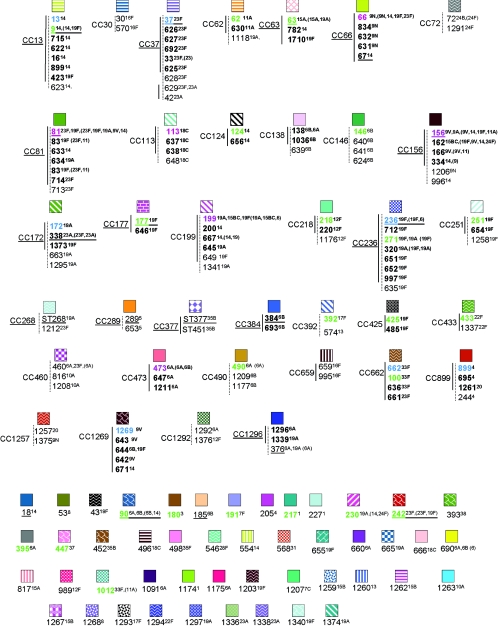
FIG. 1.
FIG. 1.
Eighty-three clonal sets representing the isolates genotyped and the STs encountered in 1999, 2001, and 2002. Solid lines connect STs within the same clonal group determined by eBURST analysis. STs within the same eBURST group are indicated in boldface. Closely related outliers within the same clonal set are connected to eBURST sets by dotted lines. Numbers in red indicate STs calculated as founders by using eBURST with the STs generated from this study and also calculated as founders by using all known STs (28). Numbers in green indicate STs calculated as founders solely by using all known STs. Numbers in blue indicate STs calculated as founders by using only the STs found in this study for the analysis. Serotypes in parentheses indicate different serotype associations listed at www.mlst.net for the indicated STs. When no parentheses are indicated, no differences in serotype associations for the STs were observed between this study and www.mlst.net.
FIG.2.
FIG.2.
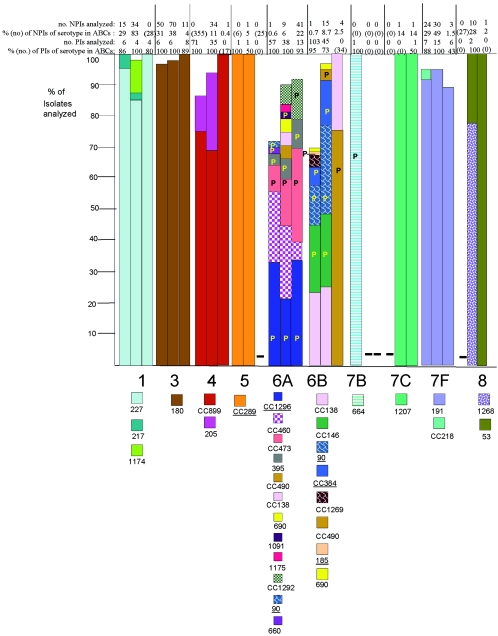
Clonal compositions of individual serotypes from invasive surveillance. The left, middle, and right columns represent isolates recovered in 1999, 2001, and 2002, respectively. The NPIs analyzed depict the numbers of isolates from individuals 5 years of age or older that were subjected to PFGE. The PIs analyzed depict the numbers of isolates from individuals less than 5 years of age that were subjected to PFGE. The percentages depict the proportions of invasive pneumococcal isolates within these serotypes that were subjected to genetic analysis. Where the numbers corresponding to these percentages are in parentheses, they refer to the total numbers of ABCs isolates within that age and serotype. The letter P indicates that at least 15% of the indicated clonal set within the indicated serotype were penicillin nonsusceptible. Serotypes in parentheses are shown when the serotype distributions listed in the global database (28) differed in any way from what we observed. Underlines indicate STs directly shared by PMEN clones (27) or clonal complexes containing these STs found among PMEN clones. Up to 30% of the isolates within a given serotype had unique PFGE profiles and were not subjected to MLST (represented by gaps in the columns). Such isolates could possibly belong to any of the clonal sets included or could represent additional clonal sets.
FIG.2.
FIG.2.
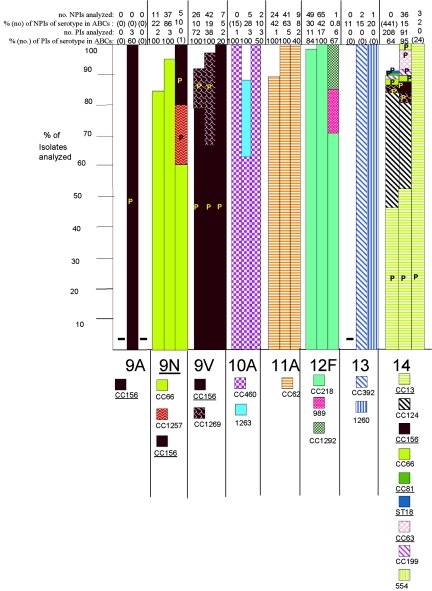
Clonal compositions of individual serotypes from invasive surveillance. The left, middle, and right columns represent isolates recovered in 1999, 2001, and 2002, respectively. The NPIs analyzed depict the numbers of isolates from individuals 5 years of age or older that were subjected to PFGE. The PIs analyzed depict the numbers of isolates from individuals less than 5 years of age that were subjected to PFGE. The percentages depict the proportions of invasive pneumococcal isolates within these serotypes that were subjected to genetic analysis. Where the numbers corresponding to these percentages are in parentheses, they refer to the total numbers of ABCs isolates within that age and serotype. The letter P indicates that at least 15% of the indicated clonal set within the indicated serotype were penicillin nonsusceptible. Serotypes in parentheses are shown when the serotype distributions listed in the global database (28) differed in any way from what we observed. Underlines indicate STs directly shared by PMEN clones (27) or clonal complexes containing these STs found among PMEN clones. Up to 30% of the isolates within a given serotype had unique PFGE profiles and were not subjected to MLST (represented by gaps in the columns). Such isolates could possibly belong to any of the clonal sets included or could represent additional clonal sets.
FIG.2.
FIG.2.
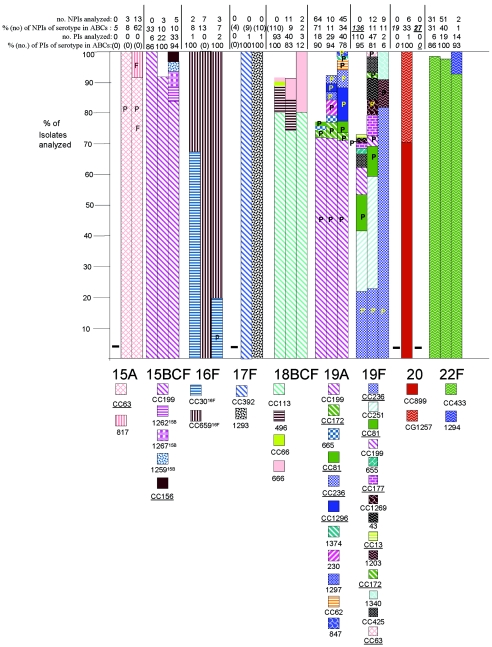
Clonal compositions of individual serotypes from invasive surveillance. The left, middle, and right columns represent isolates recovered in 1999, 2001, and 2002, respectively. The NPIs analyzed depict the numbers of isolates from individuals 5 years of age or older that were subjected to PFGE. The PIs analyzed depict the numbers of isolates from individuals less than 5 years of age that were subjected to PFGE. The percentages depict the proportions of invasive pneumococcal isolates within these serotypes that were subjected to genetic analysis. Where the numbers corresponding to these percentages are in parentheses, they refer to the total numbers of ABCs isolates within that age and serotype. The letter P indicates that at least 15% of the indicated clonal set within the indicated serotype were penicillin nonsusceptible. Serotypes in parentheses are shown when the serotype distributions listed in the global database (28) differed in any way from what we observed. Underlines indicate STs directly shared by PMEN clones (27) or clonal complexes containing these STs found among PMEN clones. Up to 30% of the isolates within a given serotype had unique PFGE profiles and were not subjected to MLST (represented by gaps in the columns). Such isolates could possibly belong to any of the clonal sets included or could represent additional clonal sets.
FIG.2.
FIG.2.
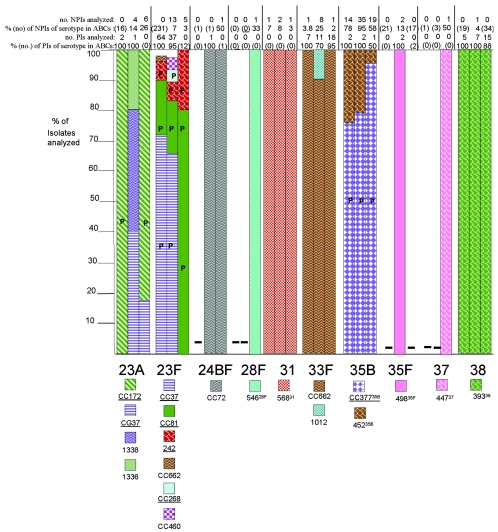
Clonal compositions of individual serotypes from invasive surveillance. The left, middle, and right columns represent isolates recovered in 1999, 2001, and 2002, respectively. The NPIs analyzed depict the numbers of isolates from individuals 5 years of age or older that were subjected to PFGE. The PIs analyzed depict the numbers of isolates from individuals less than 5 years of age that were subjected to PFGE. The percentages depict the proportions of invasive pneumococcal isolates within these serotypes that were subjected to genetic analysis. Where the numbers corresponding to these percentages are in parentheses, they refer to the total numbers of ABCs isolates within that age and serotype. The letter P indicates that at least 15% of the indicated clonal set within the indicated serotype were penicillin nonsusceptible. Serotypes in parentheses are shown when the serotype distributions listed in the global database (28) differed in any way from what we observed. Underlines indicate STs directly shared by PMEN clones (27) or clonal complexes containing these STs found among PMEN clones. Up to 30% of the isolates within a given serotype had unique PFGE profiles and were not subjected to MLST (represented by gaps in the columns). Such isolates could possibly belong to any of the clonal sets included or could represent additional clonal sets.

References

    1. Active Bacterial Core Surveillance. 26. December 2004, posting date. http://www.cdc.gov/ncidod/dbmd/abcs/.
    1. Beall, B., M. C. McEllistrem, R. E. Gertz, D. J. Boxrud, J. M. Besser, L. H. Harrison, J. H. Jorgensen, C. G. Whitney, and the Active Bacterial Core Surveillance/Emerging Infections Program Network. 2002. Emergence of a novel penicillin-nonsusceptible, invasive serotype 35B clone of Streptococcus pneumoniae within the United States. J. Infect. Dis. 186:118-122. - PubMed
    1. Brueggemann, A. B., D. T. Griffiths, E. Meats, T. Peto, D. W. Crook, and B. G. Spratt. 2003. Clonal relationships between invasive and carriage Streptococcus pneumoniae and serotype- and clone-specific differences in invasive disease potential. J. Infect. Dis. 187:1424-1432. - PubMed
    1. Brueggemann, A. B., and B. G. Spratt. 2003. Geographic distribution and clonal diversity of Streptococcus pneumoniae serotype 1 isolates. J. Clin. Microbiol. 41:4966-4970. - PMC - PubMed
    1. Brueggemann, A. B., T. E. Peto, D. W. Crook, J. C. Butler, K. G. Kristinsson, and B. G. Spratt. 2004. Temporal and geographic stability of the serogroup-specific invasive disease potential of Streptococcus pneumoniae in children. J. Infect. Dis. 190:1203-1211. - PubMed

Publication types

MeSH terms

Substances

LinkOut - more resources