. 2006 Feb;2(2):e22.
doi: 10.1371/journal.pgen.0020022. Epub 2006 Feb 24.

DNA sequences shaped by selection for stability

Affiliations

DNA sequences shaped by selection for stability

Martin Ackermann et al. PLoS Genet. 2006 Feb.

Abstract

The sequence of a stretch of nucleotides affects its propensity for errors during replication and expression. Are proteins encoded by stable or unstable nucleotide sequences? If selection for variability is prevalent, one could expect an excess of unstable sequences. Alternatively, if selection against targets for errors were substantial, an excess of stable sequences would be expected. We screened the genome sequences of different organisms for an important determinant of stability, the presence of mononucleotide repeats. We find that codons are used to encode proteins in a way that avoids the emergence of mononucleotide repeats, and we can attribute this bias to selection rather than a neutral process. This indicates that selection for stability, rather than for the generation of variation, substantially influences how information is encoded in the genome.


Conflict of interest statement

Competing interests. The authors have declared that no competing interests exist.

Figures
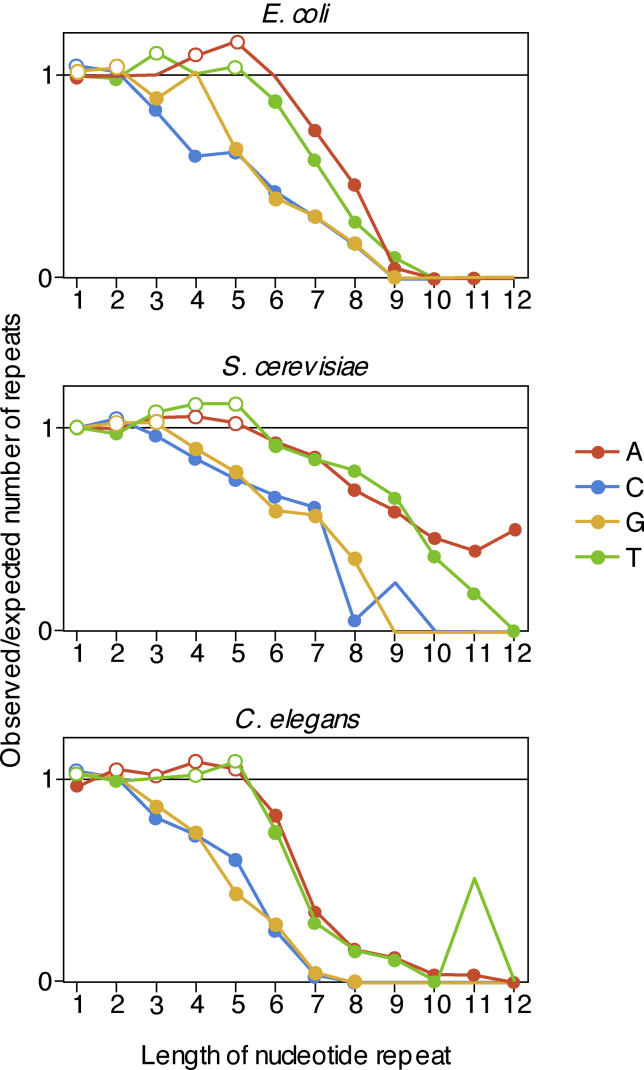
Figure 1
Figure 1. Long Mononucleotide Repeats Are Less Frequent than Expected by Change
The figure shows the ratio between observed and expected number of mononucleotide repeats (y-axis) as a function of their length (x-axis) in all open reading frames of E. coli, S. cerevisiae, and C. elegans. Observed and expected numbers were summed over all the genes in a genome. Each line represents repeats of one nucleotide. While very short repeats occur at about the expected frequencies, longer repeats are consistently rarer than expected. Dots mark cases where the difference between observed and expected number of repeats is significant (at p < 0.05, two-sided test, based on 1,000 randomizations). Open dots indicate that the observed number is higher than the expected number; filled dots indicate that the observed number is lower than the expected number.
Figure 2
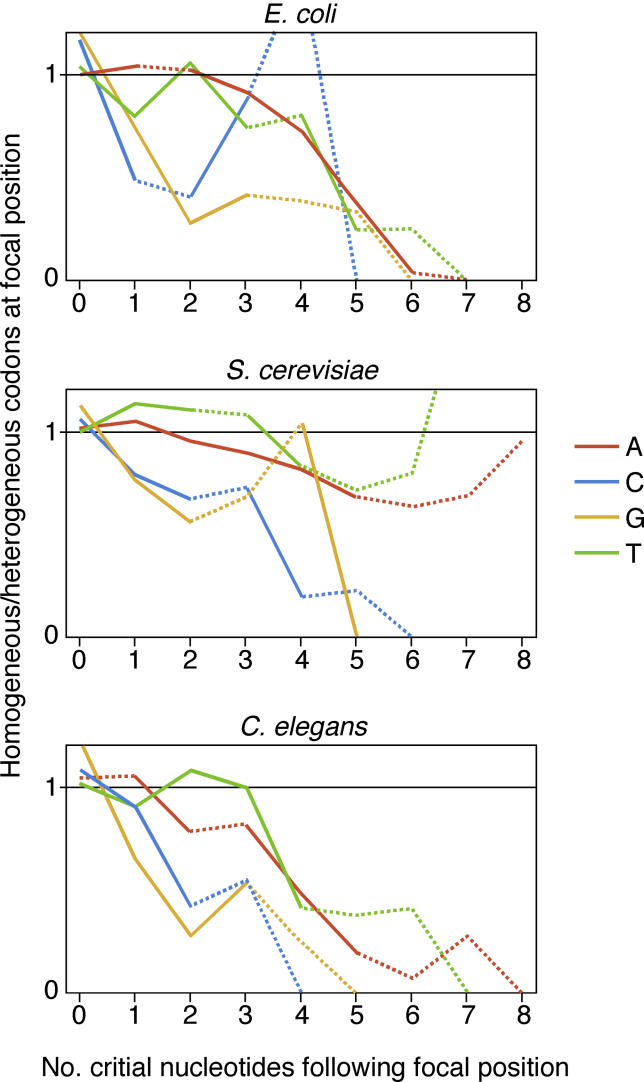
Figure 2. The Bias against Mononucleotide Repeats Is a Consequence of Context-Dependent Codon Choice
We analyzed codons choice for the four amino that can be encoded by a homogenous codon (NNN, N ∈ {A, C, G, T}) as well as by one or more heterogeneous codons (NNX, X ≠ N). The ratio of homogeneous and heterogeneous codons encoding these amino acids (y-axis) is plotted in dependence of the number of nucleotides constituting the homogeneous codon (N) immediately following (x-axis). This ratio decreases at positions followed by runs of the critical nucleotide (N) of increasing length. The figure is based on all occurrences of these four amino acids from open reading frames of E. coli, S. cerevisiae, and C. elegans. Each line represents one nucleotide. The y-axis is standardized by the genome-wide average ratio between homogeneous and heterogeneous codons for that particular nucleotide. Solid lines between x = i and x = i+1 indicate that the ratio between homogeneous codon and heterogeneous codons differs significantly between positions followed by i and i+1 of the critical nucleotide (p < 0.05, chi-square test). Dotted lines indicate that the difference is not significant.

References

    1. Moxon ER, Rainey PB, Nowak MA, Lenski RE. Adaptive evolution of highly mutable loci in pathogenic bacteria. Curr Biol. 1994;4:24–33. - PubMed
    1. Rocha EPC, Matic I, Taddei F. Over-representation of repeats in stress response genes: A strategy to increase versatility under stressful conditions? Nucleic Acids Res. 2002;30:1886–1894. - PMC - PubMed
    1. Chang DK, Metzgar D, Wills C, Boland CR. Microsatellites in the eukaryotic DNA mismatch repair genes as modulators of evolutionary mutation rate. Genome Res. 2001;11:1145–1146. - PubMed
    1. Kashi Y, King D, Soller M. Simple sequence repeats as a source of quantitative genetic variation. Trends Genet. 1997;13:74–78. - PubMed
    1. King DG, Soller M, Kashi Y. Evolutionary tuning knobs. Endeavour. 1997;21:36–40.

LinkOut - more resources