


An in vivo study of free radicals generated in murine skin by protoporphyrin IX and visible light
- PMID: 16522136
- PMCID: PMC1892593
- DOI: 10.1562/2006-01-30-RA-787
An in vivo study of free radicals generated in murine skin by protoporphyrin IX and visible light
Abstract
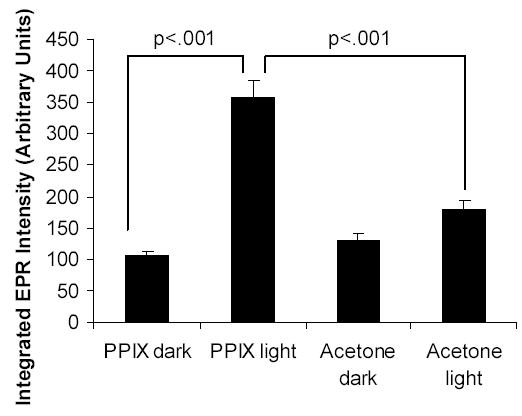
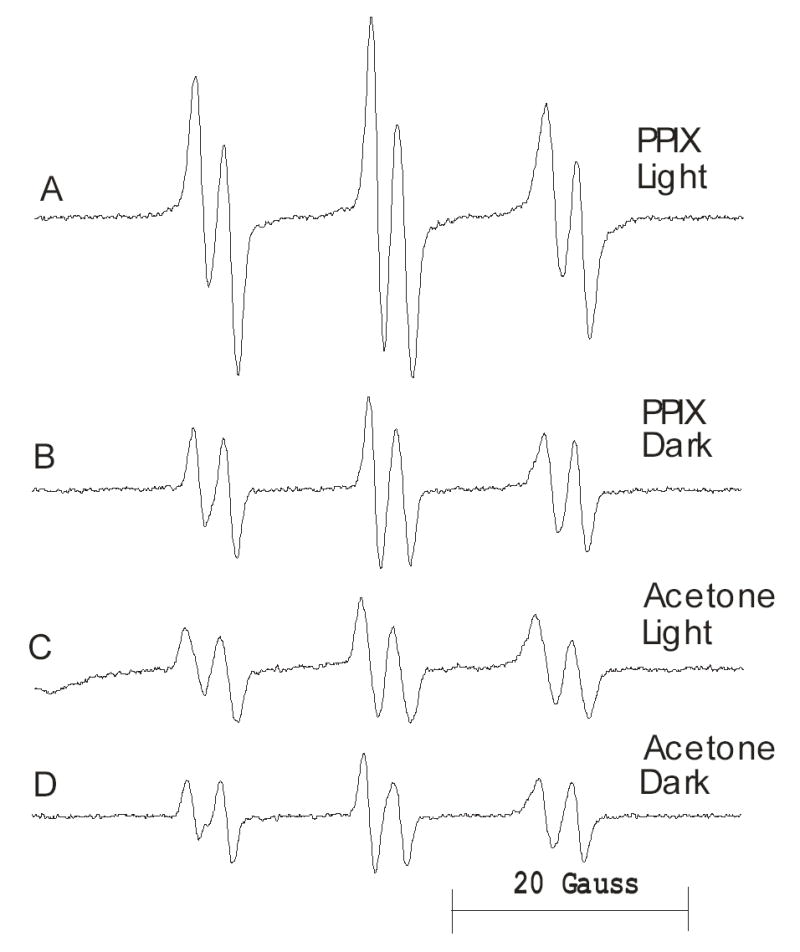
Lipids extracted from the skin of C57BL/6J mice injected subcutaneously with alpha-(4-pyridyl-1-oxide)-N-tert-butylnitrone (POBN) and exposed to topical protoporphyrin IX (PPIX) and visible light had significantly higher levels of POBN spin adducts compared with dark PPIX exposed or vehicle-treated controls. Computer analysis of the POBN adduct electron paramagnetic (spin) resonance (EPR) spectra indicated that two radical species were present in each extract, one of which was a lipid-derived carbon-centered adduct (1, a(N) = 14.8 G and a(H) = 2.6 G), whereas the other (2, a(N) = 13.8 G and a(H) = 1.8 G) was probably oxygen centered. Adduct 2 was present in greater proportion in lipids extracted from PPIX/light-exposed mice compared with dark or vehicle-treated controls. These findings suggest that PPIX/light generates free radicals in mouse skin, thus providing a radical mechanism for PPIX-induced photosensitivity. Our approach may be useful for the detection of free radicals generated by other skin photosensitizers and may also provide a means for testing putative skin-protecting agents.
Figures
References
-
- Baart de la Faille H, Bijlmer-Iest JC, van Hattum J, Koningsberger J, Rademakers LK, van Weelden H. Erythropoietic protoporphyria: clinical aspects with emphasis on the skin. Curr Probl Dermatol. 1991;20:123–134. - PubMed
-
- Radakovic-Fijan S, Blecha-Thalhammer U, Kittler H, Honigsmann H, Tanew A. Efficacy of 3 different light doses in the treatment of actinic keratosis with 5-aminolevulinic acid photodynamic therapy: A randomized, observer-blinded, intrapatient, comparison study. J Am Acad Dermatol. 2005;53:823–827. - PubMed
-
- Niedre MJ, Patterson MS, Giles A, Wilson BC. Imaging of photodynamically generated singlet oxygen luminescence in vivo. Photochem Photobiol. 2005;81:941–943. - PubMed
-
- Moore DE. Drug-induced cutaneous photosensitivity: incidence, mechanism, prevention and management. Drug Saf. 2002;25:345–372. - PubMed
-
- Niziolek M, Korytowski W, Girotti AW. Self-sensitized photodegradation of membrane-bound protoporphyrin mediated by chain lipid peroxidation: inhibition by nitric oxide with sustained singlet oxygen damage. Photochem Photobiol. 2005;81:299–305. - PubMed
Publication types
MeSH terms
Substances
Grants and funding
LinkOut - more resources
Full Text Sources
