


Fine particulate air pollution and hospital admission for cardiovascular and respiratory diseases
- PMID: 16522832
- PMCID: PMC3543154
- DOI: 10.1001/jama.295.10.1127
Fine particulate air pollution and hospital admission for cardiovascular and respiratory diseases
Abstract
Context: Evidence on the health risks associated with short-term exposure to fine particles (particulate matter < or =2.5 microm in aerodynamic diameter [PM2.5]) is limited. Results from the new national monitoring network for PM2.5 make possible systematic research on health risks at national and regional scales.
Objectives: To estimate risks of cardiovascular and respiratory hospital admissions associated with short-term exposure to PM2.5 for Medicare enrollees and to explore heterogeneity of the variation of risks across regions.
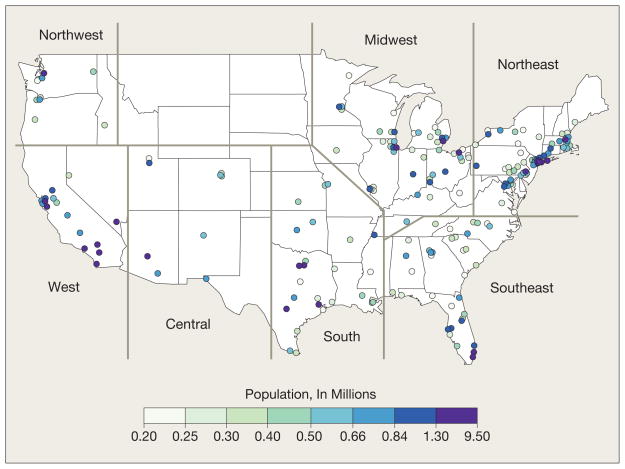
Design, setting, and participants: A national database comprising daily time-series data daily for 1999 through 2002 on hospital admission rates (constructed from the Medicare National Claims History Files) for cardiovascular and respiratory outcomes and injuries, ambient PM2.5 levels, and temperature and dew-point temperature for 204 US urban counties (population >200,000) with 11.5 million Medicare enrollees (aged >65 years) living an average of 5.9 miles from a PM2.5 monitor.
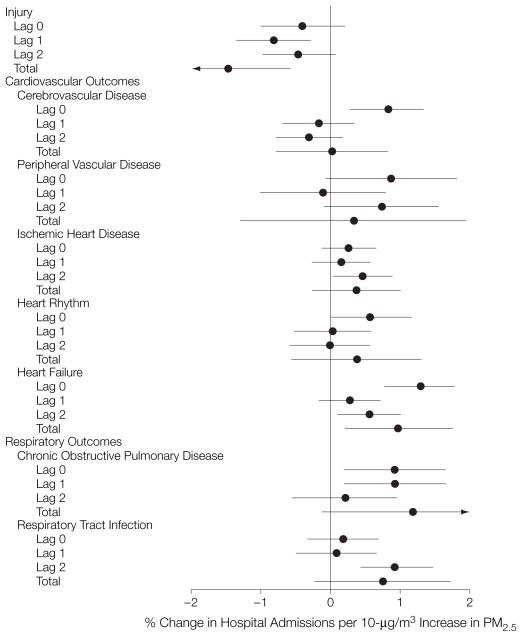
Main outcome measures: Daily counts of county-wide hospital admissions for primary diagnosis of cerebrovascular, peripheral, and ischemic heart diseases, heart rhythm, heart failure, chronic obstructive pulmonary disease, and respiratory infection, and injuries as a control outcome.
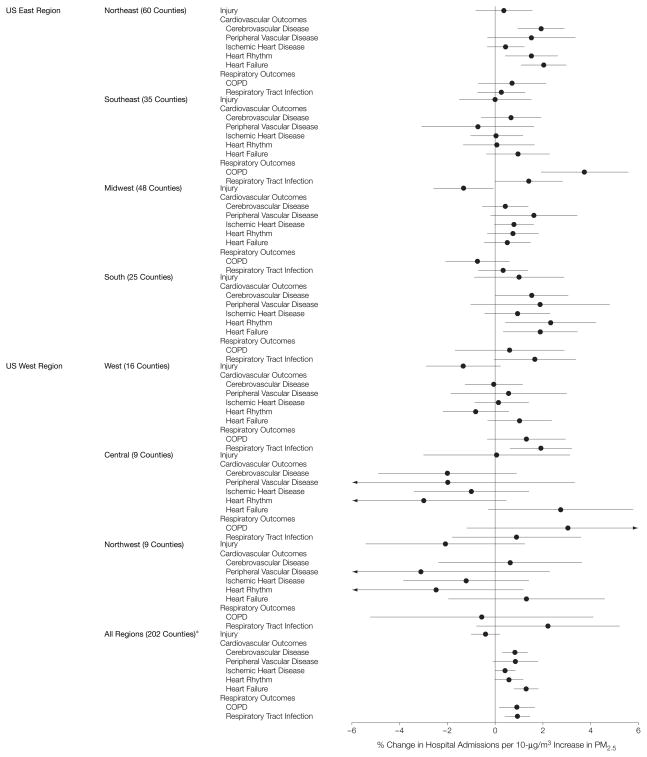
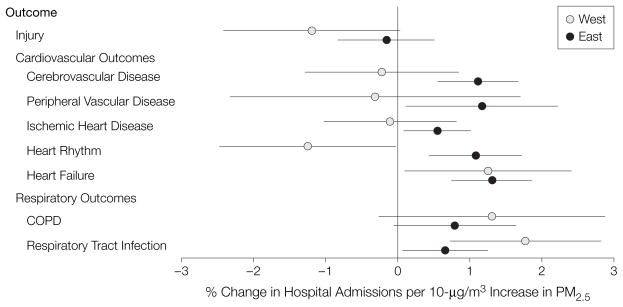
Results: There was a short-term increase in hospital admission rates associated with PM2.5 for all of the health outcomes except injuries. The largest association was for heart failure, which had a 1.28% (95% confidence interval, 0.78%-1.78%) increase in risk per 10-microg/m3 increase in same-day PM2.5. Cardiovascular risks tended to be higher in counties located in the Eastern region of the United States, which included the Northeast, the Southeast, the Midwest, and the South.
Conclusion: Short-term exposure to PM2.5 increases the risk for hospital admission for cardiovascular and respiratory diseases.
Figures
Comment in
-
Hospital admissions and fine particulate air pollution.JAMA. 2006 Oct 25;296(16):1966; author reply 1966-7. doi: 10.1001/jama.296.16.1966-b. JAMA. 2006. PMID: 17062854 No abstract available.
-
Hospital admissions and fine particulate air pollution.JAMA. 2006 Oct 25;296(16):1966; author reply 1966-7. doi: 10.1001/jama.296.16.1966-a. JAMA. 2006. PMID: 17062855 No abstract available.
References
-
- National Research Council; Committee on Research Priorities for Airborne Particulate Matter. Research Priorities for Airborne Particulate Matter, IV: Continuing Research Progress. Washington, DC: National Academies Press; 2004.
-
- National Center for Environmental Assessment. Air Quality Criteria for Particulate Matter. Research Triangle Park, NC: US Environmental Protection Agency; 2004.
-
- US Environmental Protection Agency. National ambient air quality standards for particulate matter. [Accessed February 9, 2006.];Fed Regist. 1997 62:138. Available at: http://www.epa.gov/ttn/caaa/t1/fr_notices/pmnaaqs.pdf.
-
- US Environmental Protection Agency; Office of Research and Development. Air Quality Criteria for Particulate Matter. Washington, DC: US Government Printing Office; 1996.
-
- Samet JM, Dominici F, Curriero FC, Coursac I, Zeger SL. Fine particulate air pollution and mortality in 20 U.S. cities, 1987–1994. N Engl J Med. 2000;343:1742–1749. - PubMed
