. 2006 Apr;9(4):526-33.
doi: 10.1038/nn1668. Epub 2006 Mar 12.

Social isolation delays the positive effects of running on adult neurogenesis

Affiliations

Social isolation delays the positive effects of running on adult neurogenesis

Alexis M Stranahan et al. Nat Neurosci. 2006 Apr.

Abstract

Social isolation can exacerbate the negative consequences of stress and increase the risk of developing psychopathology. However, the influence of living alone on experiences generally considered to be beneficial to the brain, such as physical exercise, remains unknown. We report here that individual housing precludes the positive influence of short-term running on adult neurogenesis in the hippocampus of rats and, in the presence of additional stress, suppresses the generation of new neurons. Individual housing also influenced corticosterone levels--runners in both housing conditions had elevated corticosterone during the active phase, but individually housed runners had higher levels of this hormone in response to stress. Moreover, lowering corticosterone levels converted the influence of short-term running on neurogenesis in individually housed rats from negative to positive. These results suggest that, in the absence of social interaction, a normally beneficial experience can exert a potentially deleterious influence on the brain.


Figures
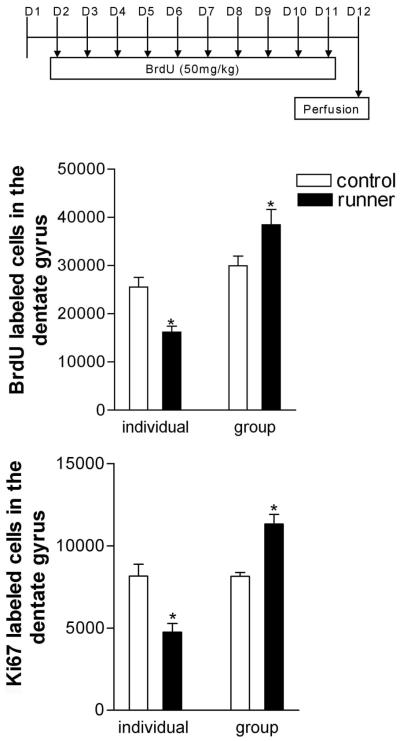
Figure 1
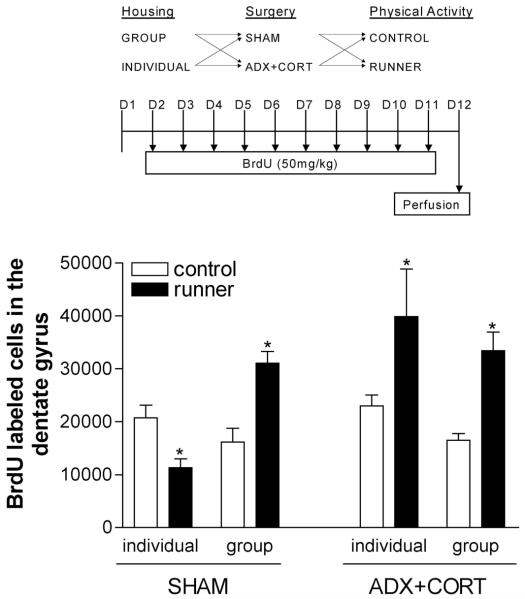
Figure 1. Social isolation reverses the positive influence of short-term running on adult neurogenesis
The top panel outlines the BrdU injection protocol for these studies. The animals received daily injections of BrdU on days 2-11 and were perfused 24 hours after the last injection. (Top graph) The number of BrdU labeled cells is lower in individually-housed short-term runners compared to individually-housed controls. By contrast, the number of BrdU labeled cells in group-housed animals is elevated compared to group-housed controls. (Bottom graph) Similar results were obtained with the endogenous marker of cell proliferation, Ki67 – individually-housed runners have fewer Ki67 labeled cells, while group-housed runners have more Ki67 labeled cells, when compared with their respective control conditions. Asterisks indicate significance from controls following 2-way ANOVA and Tukey post hoc comparisons (p<.05).
Figure 2
Figure 2. Social context mediates the running effect on cell proliferation - newly generated cells express neuronal, glial, and endothelial markers
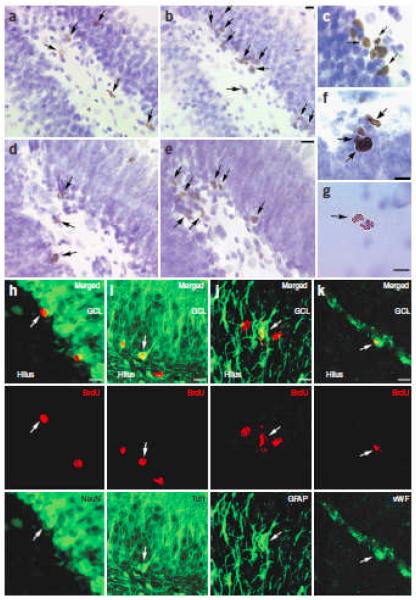
[A-B], The number of BrdU labeled cells in the dentate gyrus of an individually-housed runner (A) is lower than that of a group-housed runner (B). [C-D], The number of Ki67-labeled cells in an individually-housed runner (C) is lower than that of a group-housed runner (D). [E-G], High magnification examples of proliferating cells in the dentate gyrus of a long-term runner – (E) BrdU labeled cells; (F) Ki67-labeled cells and; (G) phosphorylated histone H3 labeled cell that appears to be undergoing cytokinesis. [H-K], Immunofluorescence double-labeling for cell type specific markers (green) and BrdU (red). (H) cell double labeled with BrdU and a marker of mature neurons, NeuN; (I) cell double labeled with BrdU and a marker of immature and mature neurons, Tuj1; (J) cell double labeled with BrdU and a marker of astroglia, GFAP; and (K) cell double labeled with BrdU and a marker of endothelial cells, vWF . Arrows indicate labeled [A-G], or double-labeled [H-K] cells. Scale bars = 10μm.
Figure 3
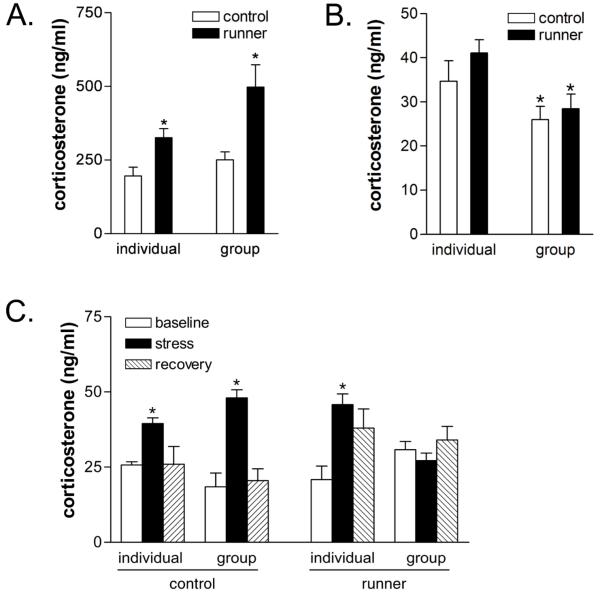
Figure 3. Glucocorticoid levels are altered by running and social housing
(A) Running increases corticosterone levels in both individually housed and group housed animals at the beginning of the active phase (7PM), when corticosterone levels are at their circadian peak. Asterisk (*) indicates significant difference from controls following 2-way ANOVA. (B) Group housing is associated with lower levels of corticosterone at a later time period during the active phase (11PM). Note also the overall decline in corticosterone levels between 7PM and 11PM. Asterisk (*) indicates significant difference from socially isolated animals (C) Group housing and running interact to buffer the stress response. Group housed runners fail to show a stress-induced increase in corticosterone, when tested during the inactive phase (10AM). A stress-induced increase in corticosterone levels was observed in all other conditions. Asterisks equal significant difference from baseline within each experimental condition (p<.05).
Figure 4
Figure 4. Lowering glucocorticoid levels reverses the suppression of neurogenesis in isolated runners
The top panel describes the experimental design for this study. Controls or runners were housed in groups or individually and subjected to sham operation or bilateral adrenalectomy (ADX+CORT). ADX animals received 25μg/ml of exogenous corticosterone in drinking water. The BrdU injection protocol was identical to the one described for Fig. 1. (Graph) BrdU labeling in the dentate gyrus of sham-operated (SHAM) controls and runners exhibits the same pattern seen in intact animals. Individually-housed runners have fewer labeled cells, while group-housed runners have more labeled cells, than controls. Lowering glucocorticoid levels by removing the adrenal glands and providing a low dose of corticosterone in the drinking water (ADX+CORT) permits the enhancement of neurogenesis in individually-housed runners and does not change the running effect on neurogenesis in the group-housed animals. Asterisks indicate significant difference from controls following 2-way ANOVA with Tukey HSD post hoc tests (p<.05).
Figure 5
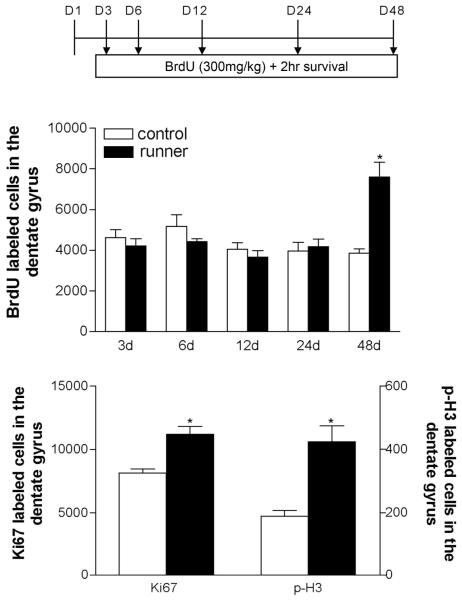
Figure 5. A longer duration of physical activity enhances cell proliferation in the dentate gyrus of socially isolated animals
The top panel describes the experimental design for this study – separate cohorts of individually-housed animals ran for 3, 6, 12, 24, or 48 days before being injected once with BrdU (300 mg/kg) and perfused 2 hr later. (Top graph) In socially isolated animals, the number of BrdU labeled cells in the dentate gyrus is increased by 48 days of running but not at earlier time points examined. (Bottom graph) After 48 days of running, similar increases were observed in the numbers of cells that stained for the endogenous markers of cell proliferation Ki67 and phospho-histone H3. Error bars represent the standard error of the mean; Asterisks indicate significant difference from control following 2×5 ANOVA and Tukey HSD post hoc comparisons, p<.05, or unpaired t-test comparing Ki67 and phospho-histone H3 data from runners and controls at the 48-day time point.
Figure 6
Figure 6. Daily stress interacts with running and social housing to alter cell proliferation
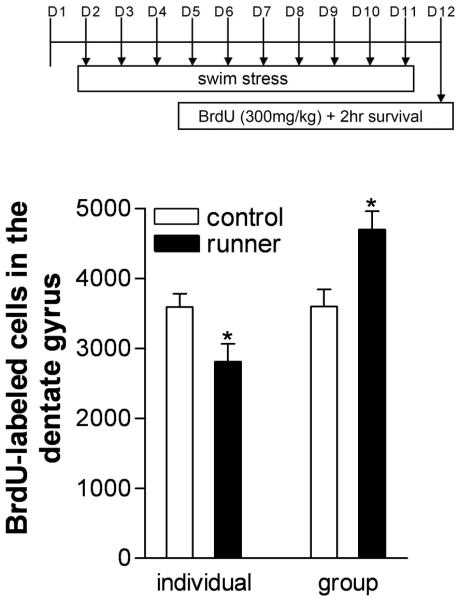
The top panel represents the experimental design for this study. Animals were subject to brief (60-90sec) daily swim stress in cold water. On the morning of the last day, animals were injected once with BrdU (300 mg/kg) and perfused 2hr later. The graph shows that daily cold swim stress resulted in a decrease in cell proliferation in individually housed runners compared to individually housed control animals. In contrast, daily cold swim stress did not prevent the enhancement of cell proliferation in group-housed runners. Asterisks equal significant difference from control following 2-way ANOVA and Tukey HSD post hoc comparisons, p<0.05.
Figure 7
Figure 7. The duration of previous isolation affects the response of cell proliferation to running alone
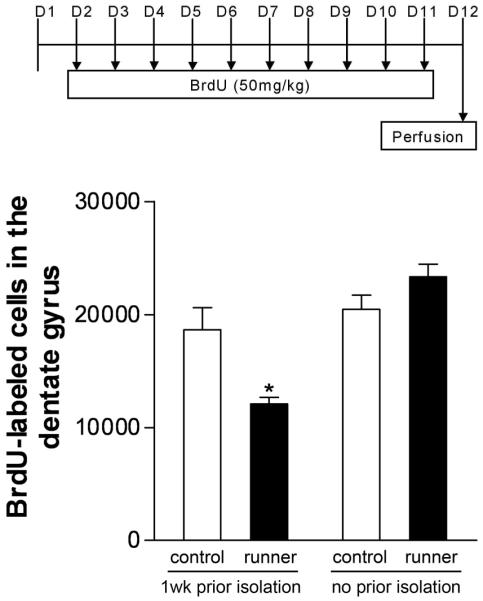
The BrdU injection protocol is identical to the one used in Figures 1 and 4. Prior to the beginning of the study, some animals were individually housed in standard cages, while other animals were housed in groups of three until the beginning of the experiment, when they were individually housed with or without a running wheel. One week of isolation prior to gaining access to the running wheel was associated with decreased cell proliferation in the dentate gyrus of runners. A shorter duration of individual housing (12 days as opposed to 19 days) resulted in a return to baseline levels of cell proliferation. This suggests a time-dependent effect of social isolation on the response of adult neurogenesis to running. Asterisk equals significant difference from control, 1 wk prior isolation – p<0.05.

References

    1. Selye H. The stress of life. McGraw-Hill; New York: 1976.
    1. Roy MP, Steptoe A, Kirschbaum C. Life events and social support as moderators of individual differences in cardiovascular and cortisol reactivity. J Pers Soc Psychol. 1998;75:1273–1281. - PubMed
    1. Weiss JM. Effects of coping behavior with and without a feedback signal on stress pathology in rats. J Comp Physiol Psychol. 1971;77:22–30. - PubMed
    1. Amat J, Baratta MV, Paul E, Bland ST, Watkins LR, Maier SF. Medial prefrontal cortex determines how stressor controllability affects behavior and dorsal raphe nucleus. Nat Neurosci. 2005;8:365–371. - PubMed
    1. Weiss IC, Pryce CR, Jongen-Relo AL, Nanz-Bahr NI, Feldon J. Effect of social isolation on stress-related behavioral and neuroendocrine state in the rat. Beh Brain Res. 2004;152:279–295. - PubMed

Publication types