. 2006 Apr;78(4):671-9.
doi: 10.1086/501028. Epub 2006 Feb 2.

Recently mobilized transposons in the human and chimpanzee genomes

Affiliations

Recently mobilized transposons in the human and chimpanzee genomes

Ryan E Mills et al. Am J Hum Genet. 2006 Apr.

Abstract

Transposable genetic elements are abundant in the genomes of most organisms, including humans. These endogenous mutagens can alter genes, promote genomic rearrangements, and may help to drive the speciation of organisms. In this study, we identified almost 11,000 transposon copies that are differentially present in the human and chimpanzee genomes. Most of these transposon copies were mobilized after the existence of a common ancestor of humans and chimpanzees, approximately 6 million years ago. Alu, L1, and SVA insertions accounted for >95% of the insertions in both species. Our data indicate that humans have supported higher levels of transposition than have chimpanzees during the past several million years and have amplified different transposon subfamilies. In both species, approximately 34% of the insertions were located within known genes. These insertions represent a form of species-specific genetic variation that may have contributed to the differential evolution of humans and chimpanzees. In addition to providing an initial overview of recently mobilized elements, our collections will be useful for assessing the impact of these insertions on their hosts and for studying the transposition mechanisms of these elements.


Figures
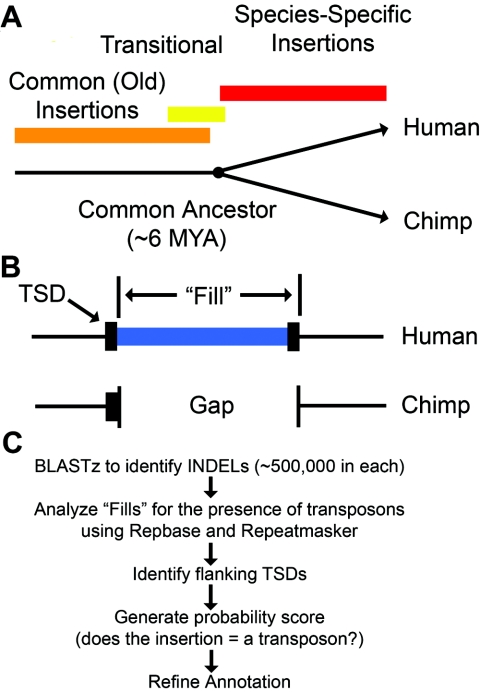
Figure  1
Figure 1
Overview of our transposon insertion–discovery pipeline. A, The time line for speciation of humans and chimpanzees is compared with the time line for the generation of transposon insertions. Common insertions occurred a very long time ago and are fixed in both species. “Species-specific” insertions are differentially present in the two species and occurred mostly during the past ∼6 million years. MYA = million years ago. B, Our strategy for identifying new transposon insertions in humans and chimpanzees. Recently mobilized transposons are flanked by TSDs and are precisely absent from one of the two genomes. One of the two copies of the TSD is actually found within the indel. Thus, the transposon plus one TSD copy equals the “fill.” C, Our computational pipeline. The five sequential steps of our computational pipeline for discovering species-specific transposon insertions in humans and chimpanzees are depicted. The draft chimpanzee-genome (build panTro1) and human-genome (build hg17) sequences were obtained from the University of California Santa Cruz browser (Kent et al. 2002). BAC clone sequences for the chimpanzee genome were obtained from GenBank (National Center for Biotechnology Information [NCBI]). BLAST programs also were obtained from NCBI. Repeatmasker was obtained from Arian Smit (Institute for Systems Biology). RepBase version 10.02 and the consensus sequence for the L1-Hs element were obtained from Jurzy Jurka (Jurka 2000). Full-length consensus sequences for L1-PA2, L1-PA3, L1-PA4, and L1-PA5 were obtained from GenBank (Boissinot et al. 2000). Custom MySQL databases and PERL scripts were generated as necessary. All analysis was performed locally on SUN SunFire v40z or Dell Power Edge 2500 servers running Linux operating systems. Our computational pipeline began with identification of all indels in humans versus chimpanzees using genomic alignments that were generated with BLASTz. Next, indels containing transposons were identified using Repeatmasker (A. Smit, unpublished material) and RepBase version 10.02 (Jurka 2000). RepBase libraries for humans and chimpanzees were modified to include full-length L1-PA2, L1-PA3, L1-PA4, L1-PA5 consensus sequences (Boissinot et al. 2000). TSDs were identified using a Smith-Waterman local alignment algorithm on the regions flanking each indel junction. The algorithm was restricted to require the optimum alignment to be located within 5 bp of the indel junction. Aligned sequences smaller than 4 bp or having an identity <90% were not scored as TSDs. A probability scoring system was developed to determine the likelihood that a given indel was caused by a single transposon insertion plus its TSD. This score was obtained by adding together the fraction of the indel that was accounted for by the transposon, its TSD, and a poly (A) tail (if present). A score of 1.0 indicated that the gap was fully accounted for by the transposon and associated sequences. We empirically determined that a lower cutoff of 0.85 provided accurate results while eliminating few, if any, true positives. SVA elements initially were annotated poorly by Repeatmasker. This program often split SVA elements into 2–3 segments (and thus counted most elements more than once). We developed a new method to reassemble these segments into a single element, where appropriate.
Figure  2
Figure 2
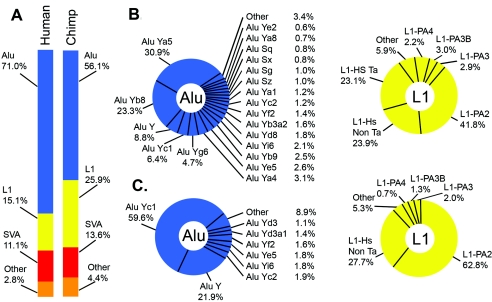
Classes of species-specific transposons in humans and chimpanzees. A, The overall composition of species-specific insertions in humans and chimpanzees. Note that 97.2% of all insertions in humans and 95.6% of all insertions in chimpanzees are Alu, L1, and SVA insertions. B, The distributions of Alu and L1 subfamilies for humans. C, The distributions of Alu and L1 subfamilies for chimpanzees. Note that different Alu and L1 subfamilies were amplified in humans (B) and chimpanzees (C).
Figure  3
Figure 3
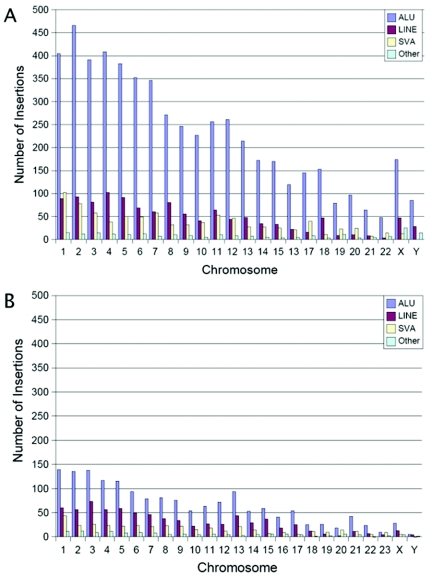
Genomic distributions of transposon insertions. A, Genomic distribution of Alu, L1, SVA, and other elements in the human genome. B, Genomic distribution of Alu, L1, SVA and other elements in the chimpanzee genome. For both genomes, the number of insertions in each chromosome is generally proportional to the amount of DNA present. Note that the Y-axis is the same for both charts. Thus, many more transposon insertions are present throughout the human genome than the chimpanzee genome (compare the number of insertions depicted in panels A and B).

References

    1. Batzer MA, Deininger PL (2002) Alu repeats and human genomic diversity. Nat Rev Genet 3:370–37910.1038/nrg798 - DOI - PubMed
    1. Bennett EA, Coleman LE, Tsui C, Pittard WS, Devine SE (2004) Natural genetic variation caused by transposable elements in humans. Genetics 168:933–95110.1534/genetics.104.031757 - DOI - PMC - PubMed
    1. Boissinot S, Chevret P, Furano A (2000) L1 (LINE-1) retrotransposon evolution and amplification in recent human history. Mol Biol Evol 17:915–928 - PubMed
    1. Boissinot S, Entezam A, Furano AV (2001) Selection against deleterious LINE-1-containing loci in the human lineage. Mol Biol Evol 18:926–935 - PubMed
    1. Brouha B, Schstak J, Badge RM, Lutz-Prigg S, Farbey AH, Moran JV, Kazazian HH (2003) Hot L1s account for the bulk of retrotransposition in the human population. Proc Natl Acad Sci USA 100:5280–528510.1073/pnas.0831042100 - DOI - PMC - PubMed

Publication types

LinkOut - more resources