Comparative Study
. 2006 Mar 20;203(3):689-97.
doi: 10.1084/jem.20051938. Epub 2006 Mar 13.

The polymerase complex genes contribute to the high virulence of the human H5N1 influenza virus isolate A/Vietnam/1203/04

Affiliations
Comparative Study

The polymerase complex genes contribute to the high virulence of the human H5N1 influenza virus isolate A/Vietnam/1203/04

Rachelle Salomon et al. J Exp Med. .

Abstract

H5N1 influenza viruses transmitted from poultry to humans in Asia cause high mortality and pose a pandemic threat. Viral genes important for cell tropism and replication efficiency must be identified to elucidate and target virulence factors. We applied reverse genetics to generate H5N1 reassortants combining genes of lethal A/Vietnam/1203/04 (VN1203), a fatal human case isolate, and nonlethal A/chicken/Vietnam/C58/04 (CH58) and tested their pathogenicity in ferrets and mice. The viruses' hemagglutinins have six amino acids differences, identical cleavage sites, and avian-like alpha-(2,3)-linked receptor specificity. Surprisingly, exchanging hemagglutinin and neuraminidase genes did not alter pathogenicity, but substituting CH58 polymerase genes completely attenuated VN1203 virulence and reduced viral polymerase activity. CH58's NS gene partially attenuated VN1203 in ferrets but not in mice. Our findings suggest that for high virulence in mammalian species an avian H5N1 virus with a cleavable hemagglutinin requires adaptive changes in polymerase genes to overcome the species barrier. Thus, novel antivirals targeting polymerase proteins should be developed.


Figures
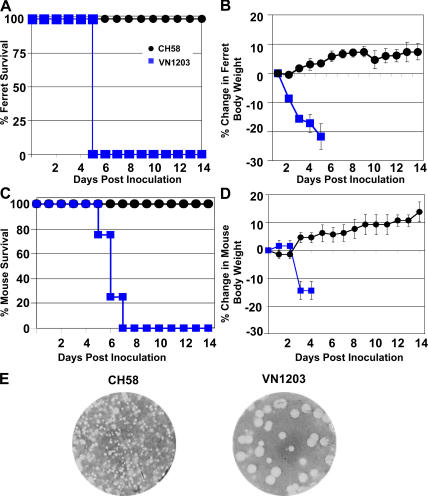
Figure 1.
Figure 1.
Effect of inoculation of ferrets and mice with VN1203 and CH58. (A) Survival rate of ferrets after intranasal inoculation with 106 EID50 of RG VN1203 (n = 3) or CH58 (n = 3) virus. (B) Mean ± SE percent weight change of groups of three ferrets after inoculation. (C) Survival rate after intranasal inoculation of groups of six mice with 103 EID50 of VN1203 or CH58. (D) Mean ± SE percent weight change of mice after inoculation. (E) Plaques on MDCK cells after titration of CH58 and VN1203 virus.
Figure 2.
Figure 2.
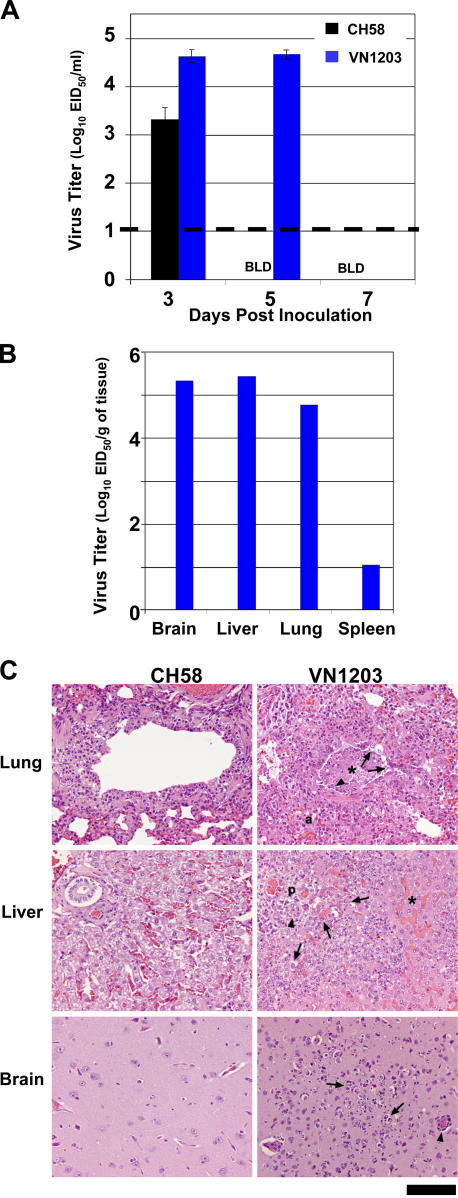
Virus titers and tissue pathology of RG VN1203 and CH58 H5N1 viruses in ferrets. (A) Mean virus titers ± in ferret nasal washes after VN1203 or CH58 inoculation. Dashed line indicates detection limit of 101 EID50/ml. BLD, below level of detection. Error bars indicate that all animals deceased at this time point. (B) Viral titers in ferret organ homogenates 4 d a.i. (C) Hematoxylin and eosin–stained sections (20X) of ferret lung, liver, and brain 4–5 d a.i. All tissues from CH58 inoculation were normal. VN1203 ferret lung shows bronchiole (*) with epithelium loss (▴) and epithelial regeneration (↑), intraluminal necrotic and inflammatory cells in bronchioles and alveoli (A). Liver shows inflammatory cell infiltrate in parenchyma and portal tract (p) with blood vessels and biliary duct. Biliary epithelium necrosis (▴) and liver cells (↑). Normal liver cells (*) surround necrotic foci with inflammatory cells. Inflammatory cell infiltrate associated with degenerating and necrotic neurons (↑) and perivascular inflammatory cells (▴). Bar, 50 μm.
Figure 3.
Figure 3.
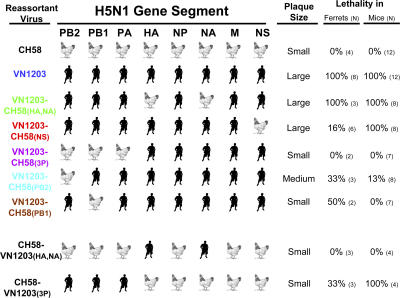
Generation of reassortant viruses with summary of plaque morphology and lethality. Human and chicken symbols denote source of gene segment (human VN1203 isolate or chicken CH58 isolate). The colors of the names of the RG reassortant viruses correspond to the colors in all data graphs of animals infected with those viruses. Mean plaque size was categorized as small (<1 mm), medium (1–2 mm), or large (>2 mm). The percent lethality caused by each RG virus and total number (N) of ferrets or mice used is indicated.
Figure 4.
Figure 4.
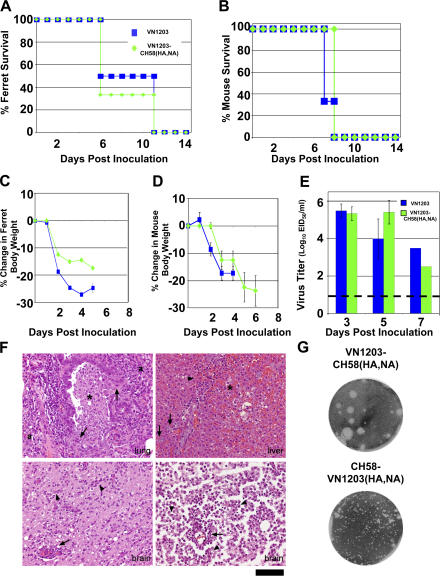
Reassortment of HA and NA does not affect lethality or pathogenicity in vivo or in cell culture. Survival (A) of ferrets and (B) mice a.i. with VN1203 (n = 2 ferrets, 8 mice) or VN1203-CH58(HA,NA) (n = 3 ferrets, 8 mice). Mean weight change (C) of ferrets and (D) mice ± SE. (E) Mean viral titers from ferret nasal washes ± SE. Dashed line indicates detection limit of 101 EID50/ml. (F) Hematoxylin and eosin–stained sections (20X) of ferret lung, liver and brain 10 d a.i. with VN1203-CH58(HA,NA). Lung (top left) shows bronchiole (*) with epithelial hyperplasia (↑), necrotic debris in lumen and inflammatory cells in alveoli (A). Liver (top right) shows disrupted parenchyma with vacuolated hepatocytes associated with hemorrhage (*). Monocytes (▴) surround parenchyma and hyperplastic biliary cells (↑) extend into parenchyma. Brain (bottom left) shows perivascular inflammatory cells (↑), hypercellular neuropil with capillary endothelial hyperplasia (▴), gliosis and monocytes. Brain region (bottom right) with liquefactive necrosis and foamy macrophages (gitter cells, ▴) and perivascular monocytes (↑). Bar, 40 μm. (G) Plaque formation after virus titration on MDCK cells.
Figure 5.
Figure 5.
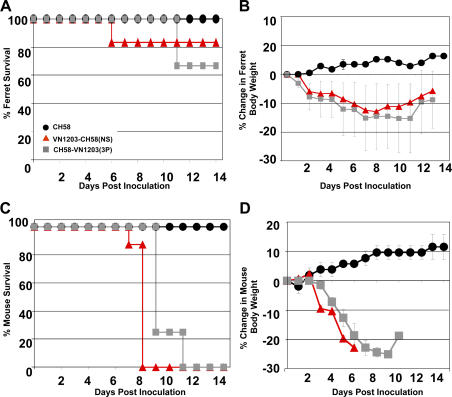
NS genes contribute to lethality of VN1203 in ferrets but not in mice. Survival rate (A), and mean weight change ± SE (B) of ferrets inoculated with CH58 (n = 3), VN1203-CH58(NS) (n = 6), or CH58-VN1203(3P) (n = 3) reassortant virus. Survival rate (C) and mean weight change ± SE (D) of mice (n = 8) inoculated with CH58 (n = 8), VN1203-CH58(NS) (n = 8), or CH58-VN1203(3P) (n = 4).
Figure 6.
Figure 6.
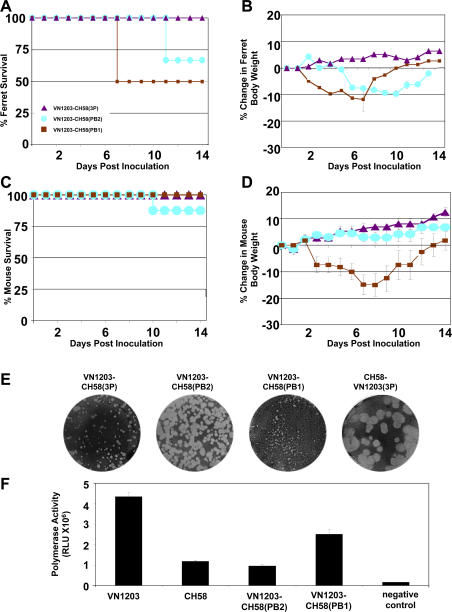
Polymerase complex genes contribute to lethality of VN1203. Survival rate (A) and mean weight change ± SE (B) of ferrets inoculated with polymerase gene–reassortant viruses. Survival rate (C) and mean weight change ± SE (D) of mice inoculated with polymerase gene–reassortant viruses. (E) Plaque formation in MDCK cells after virus titration. (F) Polymerase activity assayed by viral UTR-driven luciferase reporter gene. 293T cells transfected with plasmids containing VN1203 or CH58 PB2, PB1, PA, and NP genes plus a luciferase reporter plasmid, or with only VN1203 NP and the reporter plasmid (negative control). After 24 h, luciferase activity was assayed in cell extracts. Results are mean ± SE of triplicate transfections.

References

    1. Horimoto, T., and Y. Kawaoka. 2005. Influenza: lessons from past pandemics, warnings from current incidents. Nat. Rev. Microbiol. 3:591–600. - PubMed
    1. Li, K.S., Y. Guan, J. Wang, G.J. Smith, K.M. Xu, L. Duan, A.P. Rahardjo, P. Puthavathana, C. Buranathai, T.D. Nguyen, et al. 2004. Genesis of a highly pathogenic and potentially pandemic H5N1 influenza virus in eastern Asia. Nature. 430:209–213. - PubMed
    1. Sturm-Ramirez, K.M., T. Ellis, B. Bousfield, L. Bissett, K. Dyrting, J.E. Rehg, L. Poon, Y. Guan, M. Peiris, and R.G. Webster. 2004. Reemerging H5N1 influenza viruses in Hong Kong in 2002 are highly pathogenic to ducks. J. Virol. 78:4892–4901. - PMC - PubMed
    1. Keawcharoen, J., K. Oraveerakul, T. Kuiken, R.A. Fouchier, A. Amonsin, S. Payungporn, S. Noppornpanth, S. Wattanodorn, A. Theambooniers, R. Tantilertcharoen, et al. 2004. Avian influenza H5N1 in tigers and leopards. Emerg. Infect. Dis. 10:2189–2191. - PMC - PubMed
    1. Kuiken, T., G. Rimmelzwaan, D. van Riel, G. van Amerongen, M. Baars, R. Fouchier, and A. Osterhaus. 2004. Avian H5N1 influenza in cats. Science. 306:241. - PubMed

Publication types

MeSH terms