. 2006 Mar 14;103(11):4152-6.
doi: 10.1073/pnas.0508915103. Epub 2006 Mar 3.

Cannibal crickets on a forced march for protein and salt

Affiliations

Cannibal crickets on a forced march for protein and salt

Stephen J Simpson et al. Proc Natl Acad Sci U S A. .

Abstract

Swarming and mass migration are spectacular and sometimes devastating features of the biology of various animal species. These phenomena are typically associated with actual or anticipated depletion of food resources after an increase in population density, but the mechanisms driving such collective movements are poorly understood. Here we reveal that insects in large, coordinated migratory bands consisting of millions of Mormon crickets in western North America were deprived of two essential nutritional resources: protein and salt. The insects themselves provided a major source of these nutrients, and cannibalism was rife. We show that protein and salt satiation reduced cannibalism and that protein satiation inhibited walking. Additionally, experimentally reducing the motility or mobility of crickets substantially increased their risk of being cannibalized by other band members. As a result, the availability of protein and salt in the habitat will influence the extent to which bands march, both through the direct effect of nutrient state on locomotion and indirectly through the threat of cannibalism by resource-deprived crickets approaching from the rear. The crickets are, in effect, on a forced march. Migratory band formation and subsequent mass movement, therefore, are manifestations of specific tradeoffs between the costs and benefits of group living. Bands afford antipredator benefits to individual group members. Group movement then mitigates the resulting costs of intraspecific competition, namely local depletion of nutritional resources and the associated increased risk of cannibalism.


Conflict of interest statement

Conflict of interest statement: No conflicts declared.

Figures
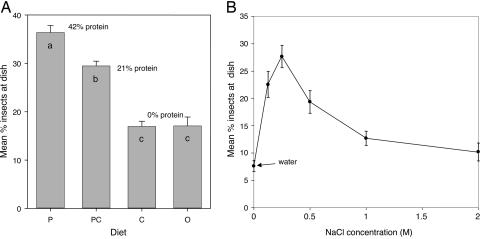
Fig. 1.
Fig. 1.
Response of Mormon crickets to nutrient resources placed in the path of the marching band. (A) Mean + SE numbers of crickets that were at each of four diet dishes throughout 10-min observation periods (see Materials and Methods). The number of crickets arrested at each dish was a function of the protein content of the diet, with no indication of responsiveness to carbohydrate. Bars marked with different letters differ in a least significant difference post hoc test at P < 0.0005, after ANOVA in which the effect of treatment was highly significant (F3,28 = 51.3, P < 0.0005; Levene’s test of equality of variances, F3,28 = 1.57, P = 0.218). (B) As for A, but showing responses to a graded series of NaCl concentrations placed in front of the marching band. There was a strong preference for 0.25 M NaCl, with numbers falling at lower and higher concentrations. ANOVA results, F5,54 = 18.64, P < 0.0005; Levene’s test of equality of variances, F5,54 = 1.12, P = 0.359.
Fig. 2.
Fig. 2.
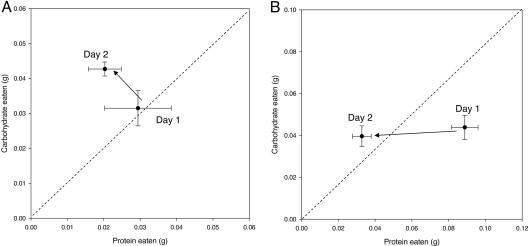
Means ± bivariate SEs for daily intake of protein and carbohydrate. (A) Six field-collected Mormon cricket nymphs (three male, three female) confined for 48 h with P and C diets. Protein intake declined somewhat across the 2 days, whereas carbohydrate intake increased, indicating compensation for prior protein deficiency. The C/P intake ratio increased significantly from day 1 to day 2 [two-tailed, one-sample t test with test value of 0 (no change between days 1 and 2), t = 2.80, df = 5, P = 0.038]. (B) Twenty field-collected Mormon cricket adults (10 male, 10 female) from a different band assayed as above 25 days later. The C/P intake ratio increased significantly from day 1 to day 2 (t = 4.82, df = 19, P < 0.0005). The diagonal dashed lines in A and B indicate a 1:1 C/P ratio.
Fig. 3.
Fig. 3.
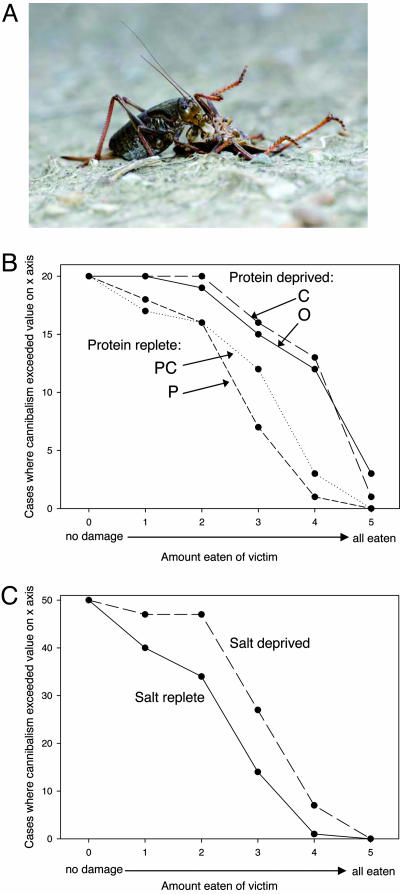
State-dependent changes in cannibalism (A) in field-collected Mormon cricket nymphs after 5 h of pretreatment on either one of four synthetic diets (P, C, PC, or O; n = 20) (B) or grass seed heads with or without a separate source of 0.25 M NaCl (n = 50) (C). Plots indicate the cumulative frequency of damage to the victim (see Materials and Methods) after a 50-min exposure, with more steeply declining curves indicating less cannibalism. (B) Cannibalism data are pooled within diets across treatments in which crickets had access to or were deprived of water during the pretreatment (n = 10). ANOVA results: effect of pretreatment diet, F3,72 = 8.64, P < 0.0005; effect of water, F1,72 = 0.262, P = 0.610; diet by water interaction, F3,72 = 1.21, P = 0.312; Levene’s test of equality of variances, F7,72 = 1.14, P = 0.349. Means for P- and PC-pretreated crickets did not differ, nor did those from C- and O-prefed insects, whereas the former two differed from both of the latter two treatments at P < 0.003 (least significant difference post hoc test). Although the artificial diets all included 1.8% salt, these differences were due to protein consumed in the pretreatment and not to differences in salt intake between the diets. Thus, in a generalized linear model with diet treatment as a main effect (excluding water) and no covariates, F3,76 = 8.66 for the diet pretreatment effect (P < 0.0005). When salt eaten during the pretreatment (calculated from the mass difference in the food dish and the known level of salt in the diet) was included as a covariate, the effect of diet remained significant (F3,75 = 5.875, P = 0.001). However, when protein eaten was also included in the model, having corrected for differences in salt eaten, the effect of diet became nonsignificant (F3,74 = 2.467, P = 0.069). (C) There was a strong effect of salt status on propensity to cannibalize in the absence of variation in dietary protein. ANOVA results, F1,98 = 14.21, P < 0.0005; Levene’s test of equality of variances, F7,72 = 1.41, P = 0.237.
Fig. 4.
Fig. 4.
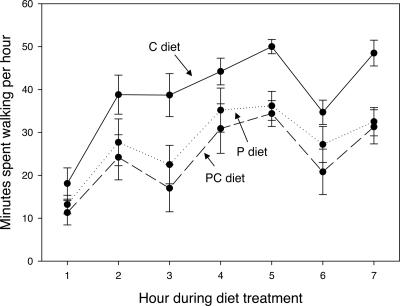
Protein satiety inhibits locomotion. Crickets were fed one of three diets (P, C, or PC), and their level of locomotory activity was recorded over the next 7 h. ANOVA results (totals across 7 h) for the effect of diet were as follows: F2,27 = 6.28, P = 0.006. Levene’s test of equality of variances, F2,27 = 0.903, P = 0.417. Means for diets P and PC did not differ (P = 0.425), although both were significantly lower than diet C (P = 0.016 and 0.002, respectively, least significant difference post hoc test). That the effect was due specifically to protein intake is indicated by the fact that including protein consumption by each insect during the assay as a covariate in the model removed the significance of diet treatment (diet effect, F2,26 = 2.16, P = 0.135), whereas including either carbohydrate intake (F2,26 = 8.95, P = 0.001) or salt intake (F2,26 = 4.64, P = 0.019) did not.

References

    1. Krause J., Ruxton G. D. Living in Groups. Oxford: Oxford Univ. Press; 2002.
    1. Conradt L., Roper T. J. Trends Ecol. Evol. 2005;20:449–456. - PubMed
    1. Gwynne D. T. Katydids and Bush-Crickets: Reproductive Behavior and Evolution of the Tettigoniidae. Ithaca, NY: Cornell Univ. Press; 2001.
    1. Lorch P. D., Sword G. A., Gwynne D. T., Anderson G. A. Ecol. Entomol. 2005;30:548–555.
    1. Sword G. A., Lorch P. D., Gwynne G. T. Nature. 2005;433:703. - PubMed

Publication types