. 2006 Mar 14;103(11):4293-8.
doi: 10.1073/pnas.0600410103. Epub 2006 Mar 8.

Inadvertent social information and the avoidance of parasitized male mice: a role for oxytocin

Affiliations

Inadvertent social information and the avoidance of parasitized male mice: a role for oxytocin

Martin Kavaliers et al. Proc Natl Acad Sci U S A. .

Abstract

Social information can be acquired either directly or indirectly from cues inadvertently produced by individuals with similar interests and requirements ("inadvertent social information," ISI). These inadvertent cues provide "public information" that other individuals can use to guide their behavior. We show here that female mice use olfactory ISI to determine their choice of, and responses to, males and that the use of this ISI involves the gene for oxytocin (OT). Female mice (OT wild type and CF-1 strain) displayed a significant interest in, and choice of, the odors of uninfected males of varying sexual status that were associated with the odors of an another estrous female. This recognition of, and choices for, specific, individual male odors was evident 24 h later. Female mice also distinguished between males subclinically infected with the gastrointestinal nematode parasite, Heligimosomoides polygyrus, and nonparasitized males, displaying aversive responses (analgesia, increased corticosterone) to, and avoidance of, the odors of infected males. The presence of the odors of another estrous female with that of the infected male, which are indicative of potential mate interests, attenuated these aversive responses and resulted in a choice for the odors of infected male. OT gene-deficient (knockout) females were impaired in their use of this ISI to modulate their responses to either uninfected males of differing sexual states or infected males. These findings suggest that OT genes are necessary for the processing of inadvertent social information and likely the integration of both direct and indirect social information.


Conflict of interest statement

Conflict of interest statement: No conflicts declared.

Figures
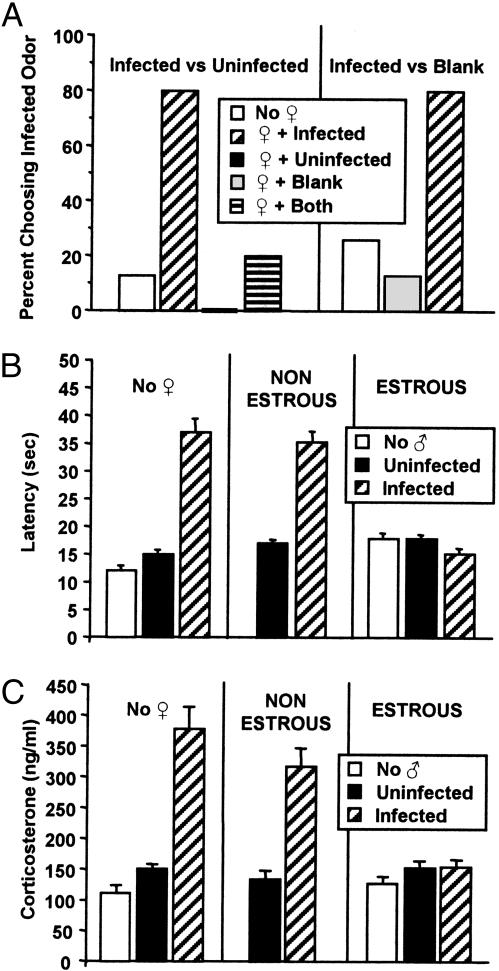
Fig. 1.
Fig. 1.
Effects of a 1 min exposure to the urine odors of male mice. (A) Initial odor choices of CF-1 females (n = 15) provided with either infected male − uninfected male or infected male − blank stimulus odor combinations. The stimulus odors presented were: (i) no female (♀) odor, (ii) estrous female + infected male, (iii) estrous female + uninfected male, (iii) estrous female + infected and uninfected male, (iv) estrous female + blank. (B) Effects of a 1-min exposure to the urine odors of either infected or uninfected males on the nociceptive responses of CF-1 female mice (n = 10). Male odors were presented either by themselves (no female, ♀) or in association with the odor of either an estrous or nonestrous female. Nociceptive responses recorded in the absence of male odors (no male, ♂) are also shown. Vertical lines denote a standard error of the mean. (C) Effects of a 1-min exposure to the urine odors of either infected or uninfected male mice on the plasma corticosterone levels of female mice (n = 10). Male odors were presented either by themselves (no female, ♀) or in association with the odor of either an estrous or nonestrous female. Corticosterone levels of females in the absence of male odors (no male, ♂) are also shown. Vertical lines denote a standard error of the mean.
Fig. 2.
Fig. 2.
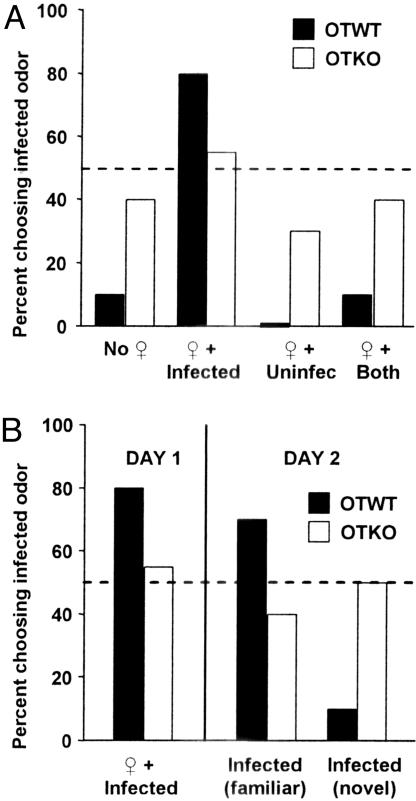
Effects of a 1-min exposure to the urine odors of male mice. (A) Initial day 1 odor choices of OTWT and OTKO females (n = 30) provided with H. polygyrus-infected male − uninfected male stimulus odor combinations. The stimulus odors were presented either in association with the odor of an estrous females (female, ♀) or without a female odor (no female). (B) On day 2, the females (n = 15) were retested and given a choice between the odors of an unfamiliar infected male (infected novel) and uninfected male, or the odors of an uninfected male and a familiar infected male (male that had on day 1 been associated with a female odor).
Fig. 3.
Fig. 3.
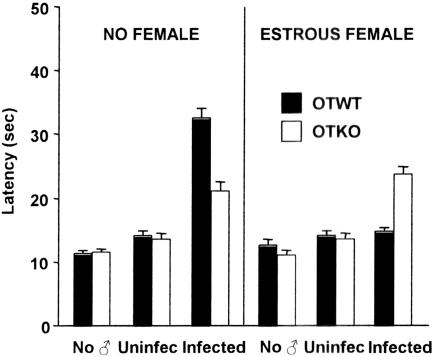
Effects of a 1-min exposure to the urine odors of either infected or uninfected male mice on the nociceptive responses of OTWT and OTKO female mice (n = 10). Male odors were presented either by themselves (no female) or in association with the odor of an estrous female. Nociceptive responses recorded in the absence of male odors (no male, ♂) are also shown. Vertical lines denote a standard error of the mean.

References

    1. Danchlin E., Giraldeau L.-A., Valone T. J., Wagner R. H. Science. 2004;305:487–491. - PubMed
    1. Valone T. J., Templeton J. T. Philos. Trans. R. Soc. London B. 2002;357:1549–1553. - PMC - PubMed
    1. Gibson R. M., Hoglund J. Trends Ecol. Evol. 1992;7:229–232. - PubMed
    1. Pruett-Jones S. G. Am. Nat. 1992;42:10000–10009. - PubMed
    1. Dugatkin L. A. Proc. Natl. Acad. Sci. USA. 1996;93:2770–2773. - PMC - PubMed

Publication types

LinkOut - more resources