


The diversity of the liquid ordered (Lo) phase of phosphatidylcholine/cholesterol membranes: a variable temperature multinuclear solid-state NMR and x-ray diffraction study
- PMID: 16537550
- PMCID: PMC1403185
- DOI: 10.1529/biophysj.104.056499
The diversity of the liquid ordered (Lo) phase of phosphatidylcholine/cholesterol membranes: a variable temperature multinuclear solid-state NMR and x-ray diffraction study
Abstract
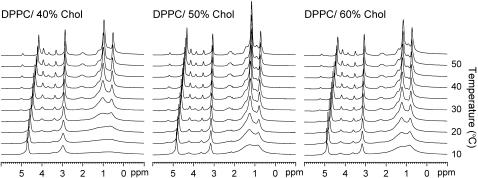
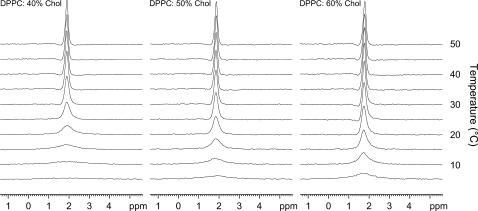
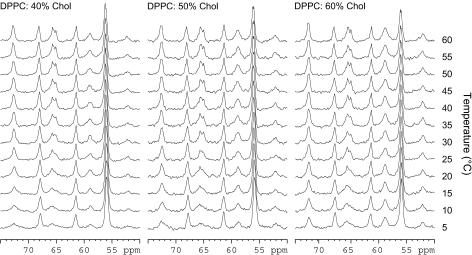
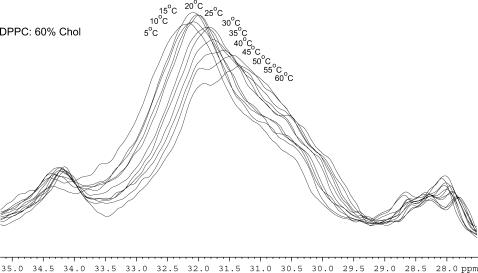
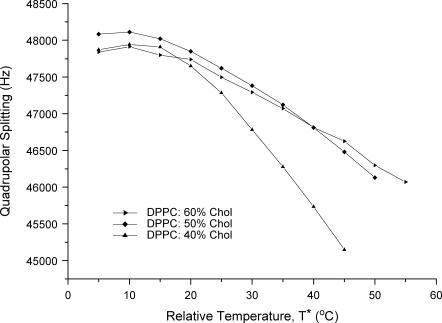
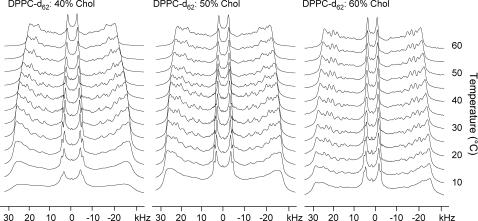
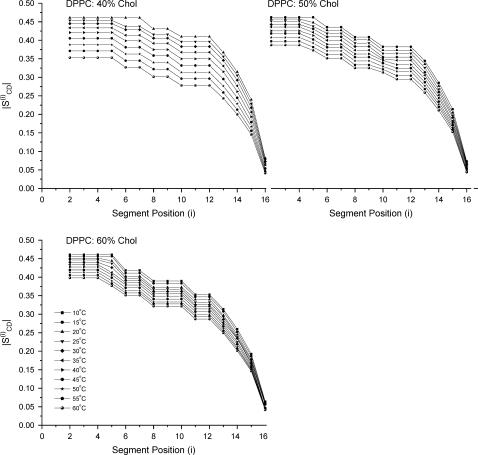
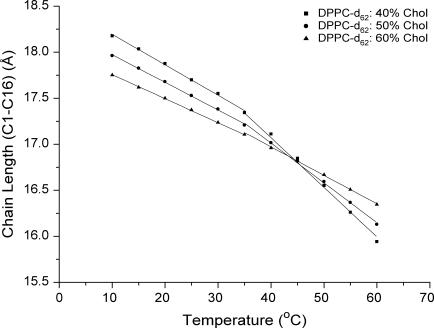
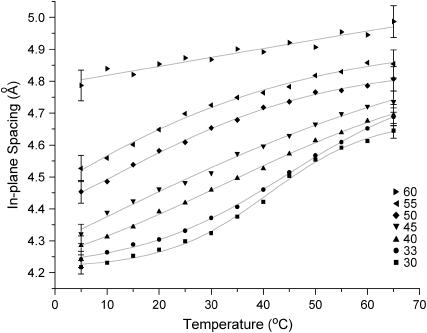
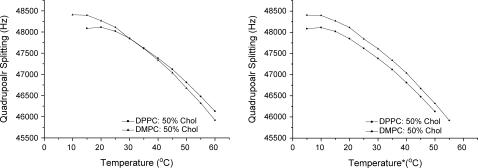
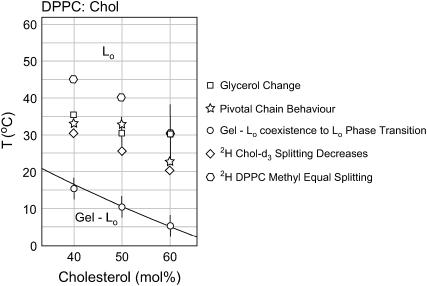
To investigate the properties of a pure liquid ordered (Lo) phase in a model membrane system, a series of saturated phosphatidylcholines combined with cholesterol were examined by variable temperature multinuclear (1H, 2H, 13C, 31P) solid-state NMR spectroscopy and x-ray scattering. Compositions with cholesterol concentrations>or=40 mol %, well within the Lo phase region, are shown to exhibit changes in properties as a function of temperature and cholesterol content. The 2H-NMR data of both cholesterol and phospholipids were used to more accurately map the Lo phase boundary. It has been established that the gel-Lo phase coexistence extends to 60 mol % cholesterol and a modified phase diagram is presented. Combined 1H-, 2H-, 13C-NMR, and x-ray scattering data indicate that there are large changes within the Lo phase region, in particular, 1H-magic angle spinning NMR and wide-angle x-ray scattering were used to examine the in-plane intermolecular spacing, which approaches that of a fluid Lalpha phase at high temperature and high cholesterol concentrations. Although it is well known for cholesterol to broaden the gel-to-fluid transition temperature, we have observed, from the 13C magic angle spinning NMR data, that the glycerol region can still undergo a "melting", though this is broadened with increasing cholesterol content and changes with phospholipid chain length. Also from 2H-NMR order parameter data it was observed that the effect of temperature on chain length became smaller with increasing cholesterol content. Finally, from the cholesterol order parameter, it has been previously suggested that it is possible to determine the degree to which cholesterol associates with different phospholipids. However, we have found that by taking into account the relative temperature above the phase boundary this relationship may not be correct.
Figures
References
-
- Bloch, K. 1965. The biological synthesis of cholesterol. Science. 150:19–28. - PubMed
-
- Bloch, K. 1983. Sterol structure and membrane function. CRC Crit. Reviews. 14:47–92. - PubMed
-
- Haines, T. H. 2001. Do sterols reduce proton and sodium leaks through lipid bilayers? Prog. Lipid Res. 40:299–324. - PubMed
-
- Brown, D. A., and E. London. 1998. Structure and origin of ordered lipid domains in biological membranes. J. Membr. Biol. 164:103–114. - PubMed
-
- Edidin, M. 2003. The state of lipid rafts: from model membranes to cells. Annu. Rev. Biophys. Biomol. Struct. 32:257–283. - PubMed
Publication types
MeSH terms
Substances
LinkOut - more resources
Full Text Sources
Medical
