Comparative Study
. 2006 Apr;80(7):3259-72.
doi: 10.1128/JVI.80.7.3259-3272.2006.

Modulation of poliovirus replicative fitness in HeLa cells by deoptimization of synonymous codon usage in the capsid region

Affiliations
Comparative Study

Modulation of poliovirus replicative fitness in HeLa cells by deoptimization of synonymous codon usage in the capsid region

Cara Carthel Burns et al. J Virol. 2006 Apr.

Abstract

We replaced degenerate codons for nine amino acids within the capsid region of the Sabin type 2 oral poliovirus vaccine strain with corresponding nonpreferred synonymous codons. Codon replacements were introduced into four contiguous intervals spanning 97% of the capsid region. In the capsid region of the most highly modified virus construct, the effective number of codons used (N(C)) fell from 56.2 to 29.8, the number of CG dinucleotides rose from 97 to 302, and the G+C content increased from 48.4% to 56.4%. Replicative fitness in HeLa cells, measured by plaque areas and virus yields in single-step growth experiments, decreased in proportion to the number of replacement codons. Plaque areas decreased over an approximately 10-fold range, and virus yields decreased over an approximately 65-fold range. Perhaps unexpectedly, the synthesis and processing of viral proteins appeared to be largely unaltered by the restriction in codon usage. In contrast, total yields of viral RNA in infected cells were reduced approximately 3-fold and specific infectivities of purified virions (measured by particle/PFU ratios) decreased approximately 18-fold in the most highly modified virus. The replicative fitness of both codon replacement viruses and unmodified viruses increased with the passage number in HeLa cells. After 25 serial passages (approximately 50 replication cycles), most codon replacements were retained, and the relative fitness of the modified viruses remained well below that of the unmodified virus. The increased replicative fitness of high-passage modified virus was associated with the elimination of several CG dinucleotides. Potential applications for the systematic modulation of poliovirus replicative fitness by deoptimization of codon usage are discussed.


Figures
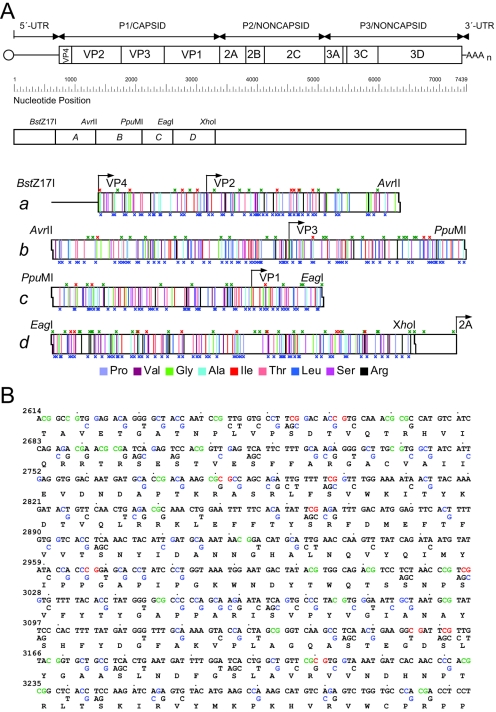
FIG. 1.
FIG. 1.
(A) Locations of codon replacement cassettes A to D in the infectious Sabin 2 (S2R9) full-length cDNA clone. In the schematic of the poliovirus genome (top), the single ORF is represented by an open rectangle flanked by the 5′ and 3′ UTRs, represented by lines. The locations along the genome of cassettes A to D and of the restriction sites used for construction of the codon replacement cDNAs are shown in the rectangle (middle). In the blocks representing codon replacement cassettes a to d (bottom), colored bars show positions of codon deoptimization. The locations of CG dinucleotides are indicated by x's above (green, originally present and retained during codon replacement; red, originally present and lost during codon replacement) and below (blue, generated by codon replacement) the cassette blocks. (B) Replacement codons of cassette D. Original S2R9 Sabin 2 triplets (top of each alignment) are aligned with the codon replacement residues (middle) and the shared deduced amino acids for both the D and d cassettes (bottom). Original CG dinucleotides are shown in green, new CG dinucleotides are shown in blue, and CG dinucleotides lost during codon replacement are shown in red.
FIG. 2.
FIG. 2.
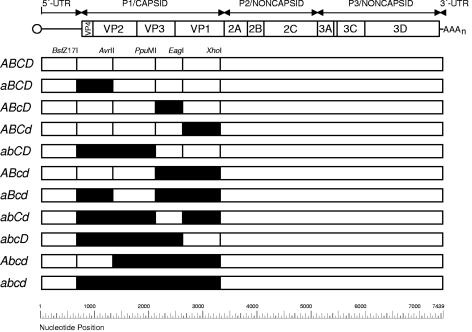
Sabin 2 codon replacement constructs aligned with a schematic of the poliovirus genome. White rectangles indicate unmodified cassettes (identified by capital letters), and black rectangles indicate cassettes with replacement codons (identified by lowercase letters).
FIG. 3.
FIG. 3.
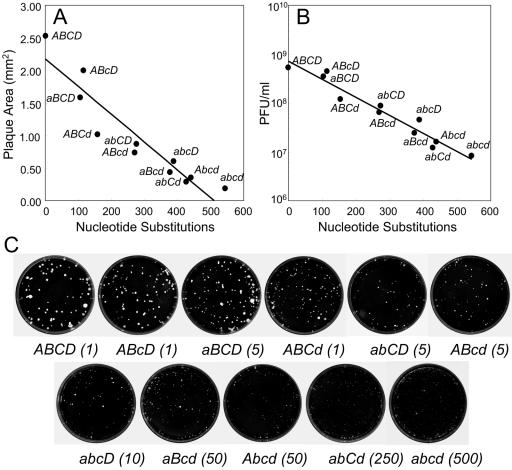
(A) Mean plaque areas on HeLa cells versus numbers of nucleotide substitutions in the capsid region. Mean plaque areas were determined for plaques on HeLa cell monolayers after incubation at 35°C for 60 h. The coefficient of determination (R2) for the regression line was 0.88. (B) Virus yields (at 12 h postinfection) in a single-step growth experiment with HeLa S3 cells versus numbers of nucleotide substitutions in the capsid region. Plaque assays (35°C, 72 h) were performed on HEp-2C cells. Plaque morphologies were similar for HEp-2C and HeLa cell monolayers, but plaque yields were ∼2.5-fold lower on HEp-2C cells. The coefficient of determination (R2) for the regression line was 0.94. (C) Plaque morphologies on HeLa cells (35°C, 60 h). Numbers in parentheses indicate relative amounts of infected cell culture lysates yielding the plaques shown in the dishes.
FIG. 4.
FIG. 4.
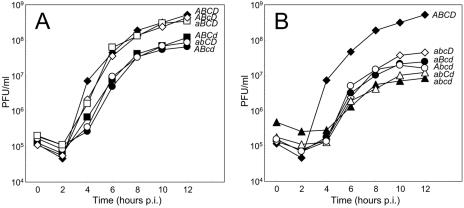
Growth properties of different virus constructs in single-step growth experiments in HeLa S3 cells at 35°C. Virus constructs with one or two modified cassettes (A) or two to four modified cassettes (B) were compared with the unmodified ABCD construct. Single-step growth experiments were performed as described in Materials and Methods, and virus yields were determined by plaque assay on HEp-2C cells (35°C, 72 h). One milliliter of culture contained 4 × 10⁶ HeLa S3 cells.
FIG. 5.
FIG. 5.
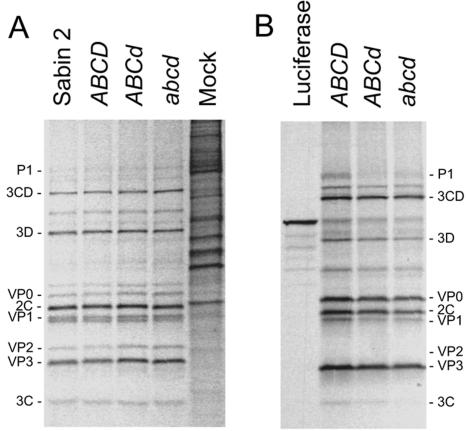
Poliovirus-specific proteins produced by ABCD, ABCd, and abcd viruses in vivo and in vitro. (A) Lysates of infected HeLa cells (MOI = 25 PFU/cell) labeled with [35S]methionine at 4 to 7 h postinfection. (B) In vitro translation products from rabbit reticulocyte lysates programmed with 250 ng of RNA transcripts from ABCD, ABCd, and abcd cDNAs. Noncapsid proteins were identified by their electrophoretic mobilities and band intensities; capsid proteins were identified by their comigration with proteins from purified virions.
FIG. 6.
FIG. 6.
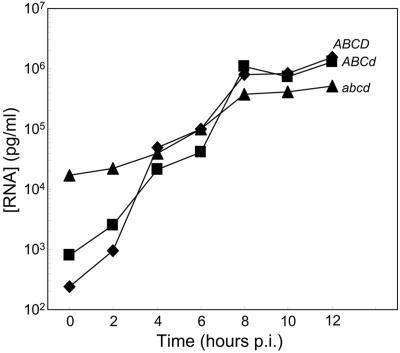
RNA yields from ABCD, ABCd, and abcd viruses obtained in the single-step growth experiments described in the legend to Fig. 4. RNA levels were determined by quantitative PCRs, using primers and a probe targeting 3Dpol region sequences that were identical for all three viruses. One picogram of poliovirus RNA corresponds to ∼250,000 genomes.
FIG. 7.
FIG. 7.
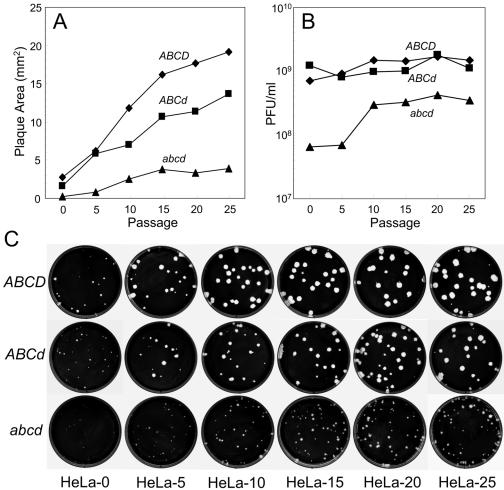
Virus passage in HeLa monolayer cells at 35°C. (A) Mean plaque areas of evolving viruses were determined by plaque assay on HeLa cells (35°C, 60 h). (B) Virus titers were determined by plaque assay on HeLa cells at 35°C on every fifth passage. (C) Plaque morphologies on HeLa cells (35°C, 60 h).

References

    1. Akashi, H. 2001. Gene expression and molecular evolution. Curr. Opin. Genet. Dev. 11:660-666. - PubMed
    1. Akashi, H., and A. Eyre-Walker. 1998. Translational selection and molecular evolution. Curr. Opin. Genet. Dev. 8:688-693. - PubMed
    1. André, S., B. Seed, J. Eberle, W. Schraut, A. Bültmann, and J. Haas. 1998. Increased immune response elicited by DNA vaccination with a synthetic gp120 sequence with optimized codon usage. J. Virol. 72:1497-1503. - PMC - PubMed
    1. Barak, Z., D. Lindsley, and J. Gallant. 1996. On the mechanism of leftward frameshifting at several hungry codons. J. Mol. Biol. 256:676-684. - PubMed
    1. Bennetzen, J., and B. Hall. 1982. Codon selection in yeast. J. Biol. Chem. 257:3026-3031. - PubMed

Publication types

LinkOut - more resources