


doi: 10.1128/JVI.80.7.3666-3669.2006.
Phylogenetic evidence for the rapid evolution of human B19 erythrovirus
Affiliations
- PMID: 16537636
- PMCID: PMC1440363
- DOI: 10.1128/JVI.80.7.3666-3669.2006
Item in Clipboard
Phylogenetic evidence for the rapid evolution of human B19 erythrovirus
J Virol.
2006 Apr.
Abstract
Human B19 erythrovirus is a ubiquitous viral pathogen, commonly infecting individuals before adulthood. As with all autonomous parvoviruses, its small single-stranded DNA genome is replicated with host cell machinery. While the mechanism of parvovirus genome replication has been studied in detail, the rate at which B19 virus evolves is unknown. By inferring the phylogenetic history and evolutionary dynamics of temporally sampled B19 sequences, we observed a surprisingly high rate of evolutionary change, at approximately 10(-4) nucleotide substitutions per site per year. This rate is more typical of RNA viruses and suggests that high mutation rates are characteristic of the Parvoviridae.
Figures
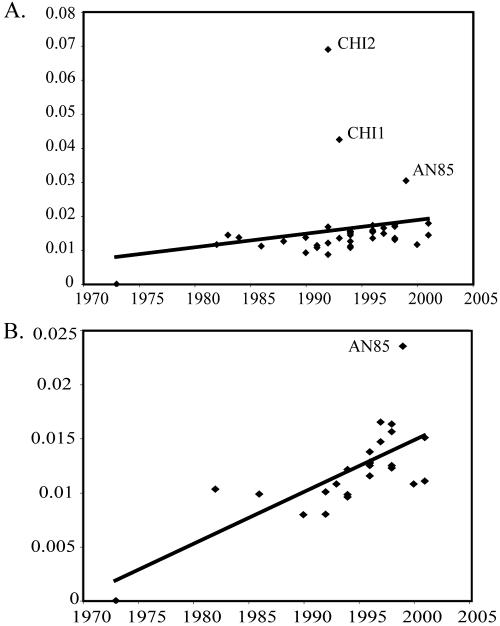
Linear regression plots depicting the relationship between the isolation date (year) of each B19 sequence and its distance from the root of the phylogeny (given as number of substitutions per site) for 41 VP1 sequences (A) and 25 coding region sequences (B). Outliers are labeled.
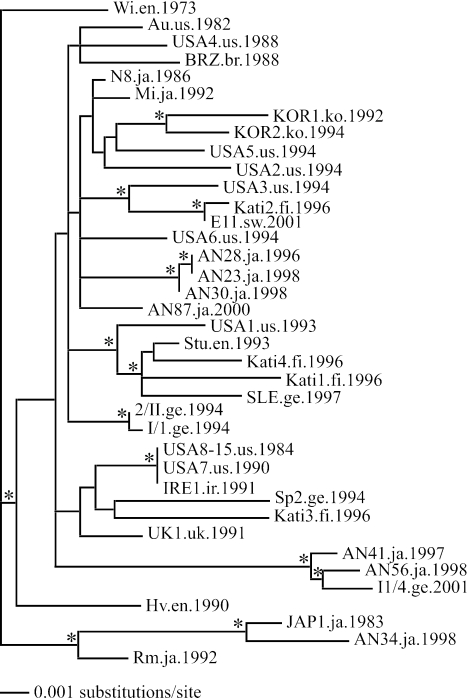
Phylogeny of the 38 B19 VP1 sequences used in the analyses of substitution rates. The tree is rooted with the oldest sampled isolate, and branch lengths are drawn to scale, with nodes showing >70% bootstrap support marked with an asterisk. Names of sequences are given along with the location and date of isolation. Abbreviations: en, England; us, United States; br, Brazil; ir, Ireland; ge, Germany; fi, Finland; uk, United Kingdom; ja, Japan; ko, Korea; sw, Sweden; ch, China.
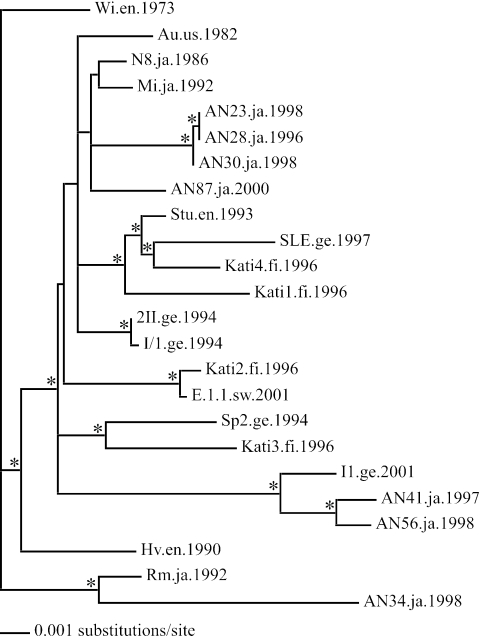
Phylogeny of 24 B19 virus coding regions used in the substitution rate analyses. The tree is rooted with the oldest isolate. Branch lengths are drawn to scale, and nodes with >70% bootstrap support are marked with an asterisk. Names of sequences are given along with the location and date of isolation. Abbreviations are as described in the legend for Fig. 2.
References
-
- Bernard, H. 1994. Coevolution of papillomaviruses with human populations. Trends Microbiol. 2:140-143. - PubMed
-
- Brown, K. E. 2004. Variants of B19. Dev. Biol. 118:71-77. - PubMed
-
- Cossart, Y. E., B. Cant, A. M. Field, and D. Widdows. 1975. Parvovirus-like particles in human sera. Lancet i:72-73. - PubMed
-
- Drummond, A. J., A. Rambaut, B. Shapiro, and O. G. Pybus. 2005. Bayesian coalescent inference of past population dynamics from molecular sequences. Mol. Biol. Evol. 22:1185-1192. - PubMed
Publication types
MeSH terms
Substances
LinkOut - more resources
Full Text Sources
