


Regulatory T-cell compartmentalization and trafficking
- PMID: 16537800
- PMCID: PMC1895488
- DOI: 10.1182/blood-2006-01-0177
Regulatory T-cell compartmentalization and trafficking
Abstract
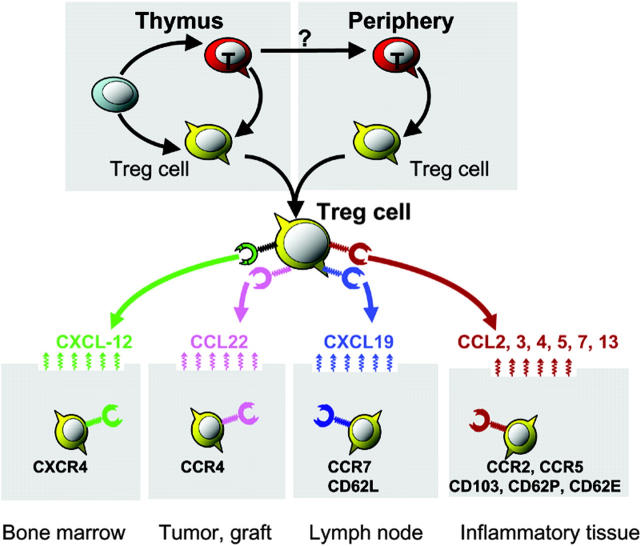
CD4(+)CD25(+)FOXP3(+) regulatory T cells (CD4(+) Treg cells) are thought to differentiate in the thymus and immigrate from the thymus to the periphery. Treg cells can regulate both acquired and innate immunity through multiple modes of suppression. The cross-talk between Treg cells and targeted cells, such as antigen-presenting cells (APCs) and T cells, is crucial for ensuring suppression by Treg cells in the appropriate microenvironment. Emerging evidence suggests that Treg compartmentalization and trafficking may be tissue or/and organ specific and that distinct chemokine receptor and integrin expression may contribute to selective retention and trafficking of Treg cells at sites where regulation is required. In this review, the cellular and molecular signals that control specialized migration and retention of Treg cells are discussed.
Figures
References
-
- Luster AD. The role of chemokines in linking innate and adaptive immunity. Curr Opin Immunol. 2002;14: 129-135. - PubMed
-
- Wood KJ, Sakaguchi S. Regulatory lymphocytes: regulatory T cells in transplantation tolerance. Nat Rev Immunol. 2003;3: 199-210. - PubMed
-
- Von Herrath MG, Harrison LC. Regulatory lymphocytes: antigen-induced regulatory T cells in autoimmunity. Nat Rev Immunol. 2003;3: 223-232. - PubMed
-
- Shevach EM. CD4+ CD25+ suppressor T cells: more questions than answers. Nat Rev Immunol. 2002;2: 389-400. - PubMed
-
- Francois Bach J. Regulatory lymphocytes: regulatory T cells under scrutiny. Nat Rev Immunol. 2003;3: 189-198. - PubMed
Publication types
MeSH terms
Substances
Grants and funding
LinkOut - more resources
Full Text Sources
Other Literature Sources
Research Materials
Miscellaneous
