. 2006 Apr;26(7):2490-500.
doi: 10.1128/MCB.26.7.2490-2500.2006.

Evidence suggesting that Pif1 helicase functions in DNA replication with the Dna2 helicase/nuclease and DNA polymerase delta

Affiliations

Evidence suggesting that Pif1 helicase functions in DNA replication with the Dna2 helicase/nuclease and DNA polymerase delta

Martin E Budd et al. Mol Cell Biol. 2006 Apr.

Abstract

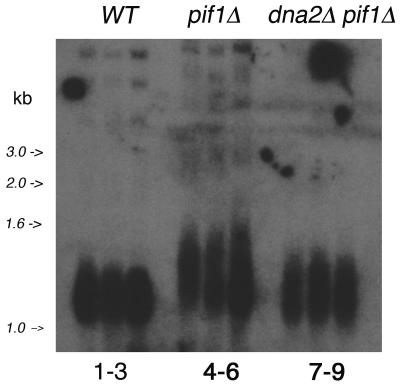
The precise machineries required for two aspects of eukaryotic DNA replication, Okazaki fragment processing (OFP) and telomere maintenance, are poorly understood. In this work, we present evidence that Saccharomyces cerevisiae Pif1 helicase plays a wider role in DNA replication than previously appreciated and that it likely functions in conjunction with Dna2 helicase/nuclease as a component of the OFP machinery. In addition, we show that Dna2, which is known to associate with telomeres in a cell-cycle-specific manner, may be a new component of the telomere replication apparatus. Specifically, we show that deletion of PIF1 suppresses the lethality of a DNA2-null mutant. The pif1delta dna2delta strain remains methylmethane sulfonate sensitive and temperature sensitive; however, these phenotypes can be suppressed by further deletion of a subunit of pol delta, POL32. Deletion of PIF1 also suppresses the cold-sensitive lethality and hydroxyurea sensitivity of the pol32delta strain. Dna2 is thought to function by cleaving long flaps that arise during OFP due to excessive strand displacement by pol delta and/or by an as yet unidentified helicase. Thus, suppression of dna2delta can be rationalized if deletion of POL32 and/or PIF1 results in a reduction in long flaps that require Dna2 for processing. We further show that deletion of DNA2 suppresses the long-telomere phenotype and the high rate of formation of gross chromosomal rearrangements in pif1Delta mutants, suggesting a role for Dna2 in telomere elongation in the absence of Pif1.


Figures
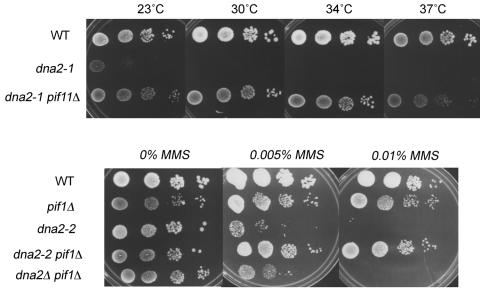
FIG. 1.
FIG. 1.
Suppression of dna2 mutant phenotypes by deletion of PIF1. (A) Serial dilutions of identical numbers of cells were carried out at the temperatures indicated. The following strains were used: W303, WT; MB90-7A, dna2-1; MB91, dna2-1 pif1Δ. (B) Serial dilutions of identical numbers of each strain were plated on medium containing the indicated amounts of MMS. Relevant genotypes are indicated. The following strains were used: BY4741, WT; 10509, pif1Δ; 4741dna2-2, dna2-2; MB208, dna2-2 pif1Δ; and MB203, dna2Δ pif1Δ (Table 1).
FIG. 2.
FIG. 2.
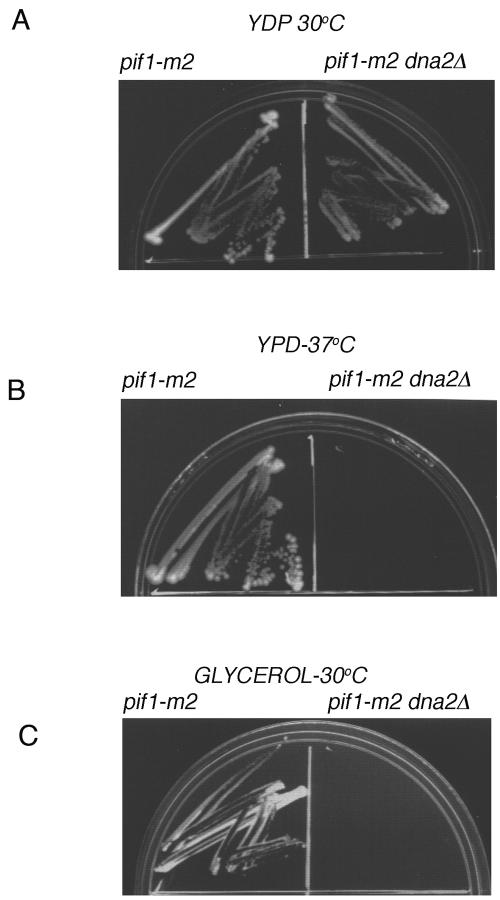
Suppression of dna2Δ lethality by inactivation of Pif1 nuclear function but not by inactivation of Pif1 mitochondrial function. The following strains were used: 4344, pif1-m2; and 4344dna2Δ, pif1-m2 dna2Δ. (A and B) Growth on glucose-containing medium. (C) Growth on nonfermentable glycerol medium.
FIG. 3.
FIG. 3.
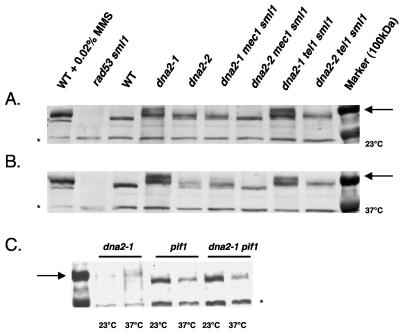
Reduced DNA damage in dna2-1 pif1Δ. The strains used are isogenic derivatives of strain W303—MB90-7A, MB91, U953-61, MB92-M, SPY40, MB92-31C, MB92-35A, and U960-5C (Table 1)—with one exception, the pif1Δ strain MB509. The relevant genotypes are indicated in the figure. Strains were grown to approximately 1 × 10⁷ per ml. Extracts were prepared and Western blots performed using antibody against Rad53 (gift of John Diffley, Clare Hall, England) as described previously (16). Wild-type W303 was also treated with 0.02% MMS where indicated to show phosphorylated Rad53. (A) Rad53 is phosphorylated in dna2-1 and dna2-2 strains at 23°C in a MEC1-dependent and TEL1-independent fashion. The 100-kDa marker runs with fully phosphorylated Rad53 and is indicated by the arrow in the figure. The asterisk denotes a nonspecific, cross-reacting species. (B) Rad53 is phosphorylated in dna2-1 and dna2-2 strains at 37°C in a MEC1-dependent and TEL1-independent manner. (C) pif1Δ suppresses Rad53 phosphorylation in the dna2-1 strain.
FIG. 4.
FIG. 4.
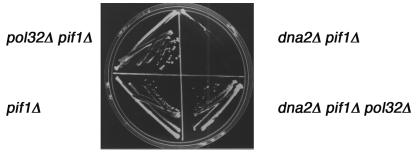
Suppression of the temperature sensitivity of the dna2Δ pif1Δ strain by pol32Δ. The following strains were incubated on a YPD plate at 37°C for 3 days: MB202, pif1Δ; MB203.6, dna2Δ pif1Δ; MB206, pif1Δ pol32Δ; and MB207, dna2Δ pif1Δ pol32Δ.
FIG. 5.
FIG. 5.
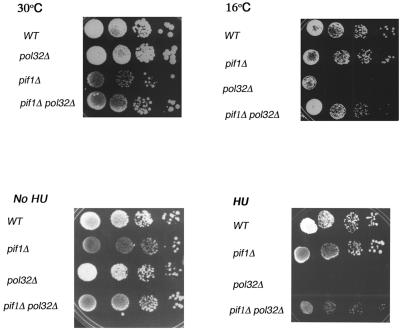
Suppression of the cold sensitivity and HU sensitivity of the pol32Δ strain by pif1Δ. The following BY4741 isogenic strains were used: BY4741, WT; MB205, pol32Δ; MB201, pif1Δ; and MB206, pol32Δ pif1Δ. YPD plates were spotted with these strains and incubated at 30°C for 2 days (top, left panel) or at 16°C for 7 days (top right panel) as indicated. YPD plates were spotted with the same strains in the absence (lower left) or presence (lower right) of 38 mM HU and incubated at 23°C.
FIG. 6.
FIG. 6.
Deletion of DNA2 reduces telomere length in pif1Δ strains. Lanes 1, 2, and 3, WT strains 47421, BY4741, and BY4742, respectively. Lanes 4, 5, and 6, three colonies of pif1Δ strain 10509. Lanes 7, 8, and 9, dna2Δ pif1Δ strains MB203.3, MB203.5, and MB203.6, respectively. MB203.3, MB203.5, and MB203.6 are three independent pif1Δ transformants of MB110.
FIG. 7.
FIG. 7.
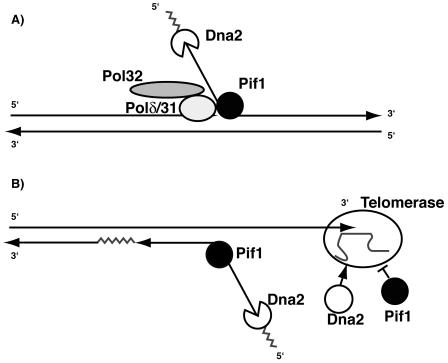
Interpretation of genetic interactions between PIF1 and DNA2. (A) Pif1 may help to make a flap during RNA removal by Dna2 during OFP. (B) Dna2 may be required for optimum elongation of telomeres by telomerase, whereas Pif1 has been shown to inhibit telomerase processivity (5). Pif1 may have a second role at telomeres in which it aids Dna2 in removal of RNA from the Okazaki fragments at the telomere. The last Okazaki fragment might have a special requirement for Pif1 helicase as there is no pol δ/PCNA present to strand displace and to recruit FEN1.

References

    1. Ayyagari, R., X. V. Gomes, D. A. Gordenin, and P. M. J. Burgers. 2003. Okazaki fragment maturation in yeast. I. Distribution of functions between Fen1 and Dna2. J. Biol. Chem. 278:1618-1625. - PubMed
    1. Bae, S. H., K.-H. Bae, J. A. Kim, and Y. S. Seo. 2001. RPA governs endonuclease switching during processing of Okazaki fragments in eukaryotes. Nature 412:456-461. - PubMed
    1. Bessler, J. B., J. Z. Torre, and V. A. Zakian. 2001. The Pif1p subfamily of helicases: region-specific DNA helicases? Trends Cell Biol. 11:60. - PubMed
    1. Bessler, J. B., and V. A. Zakian. 2004. The amino terminus of the Saccharomyces cerevisiae DNA helicase Rrm3p modulates protein function altering replication and checkpoint activity. Genetics 168:1205-1218. - PMC - PubMed
    1. Boule, J.-B., L. R. Vega, and V. A. Zakian. 2005. The yeast Pif1p helicase removes telomerase from telomeric DNA. Nature 438:57-61. (First published 3 November 2005; doi:10.1038/nature04091.) - DOI - PubMed

Publication types

MeSH terms