Screening rates and characteristics of health plan members who respond to screening reminders
- PMID: 16539797
- PMCID: PMC1563981
Screening rates and characteristics of health plan members who respond to screening reminders
Abstract
Introduction: Preventive screening is widely recognized as a key component of cost-effective, high-quality health care. Even so, national screening for cancer, diabetes, and cholesterol falls far short of U.S. Preventive Services Task Force recommendations. Although evidence has shown that reminder programs improve preventive screening rates, this study is one of the first to examine the characteristics of health plan members who respond to screening reminders.
Methods: The study sample included active members of a large health plan in Hawaii who were identified by an algorithm as not having received one or more recommended screenings based on age and sex criteria (2000-2003) for breast cancer (n = 44,331), cervical cancer (n = 73,875), colon cancer (n = 131,860), diabetes (n = 86,216), and cholesterol (n = 54,843). Statistical analyses were conducted using Cox proportional hazard and logistic regression models. In the proportional hazard models, reminder letters were treated as time-varying exposures. Hazard ratios, or rate ratios, were used to examine the relationship between health plan member and physician characteristics and the likelihood of responding to the reminders. The effects of additional or multiple reminders among health plan members receiving more than one reminder were examined in multivariable regression models.
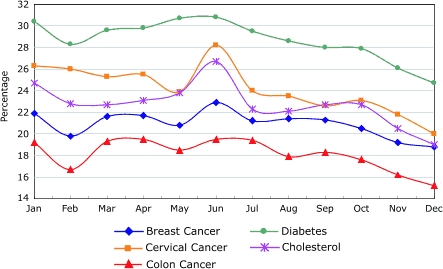
Results: The impact of health plan member characteristics and number of office visits on the response to reminders varied among the five health-screening types. Health plan members responded better to reminders for diabetes screening than for colon cancer screening. Members sent their second annual reminders were less likely to obtain screening than members sent their first reminder. Members receiving their third (or more) annual reminder were especially recalcitrant.
Conclusion: Our findings suggest that the response to reminders differs according to patient characteristics. In particular, targeted interventions may be needed to encourage screening for younger and healthier members whose response rate to reminders was low. Further research is needed to determine how health plans can best reach members who do not respond to patient reminders.
Figures
References
-
- U.S. Preventive Services Task Force. Guide to clinical preventive services, periodic updates. Rockville (MD): Agency for Healthcare Research and Quality; 2003.
-
- Liang SY, Phillips KA, Tye S, Haas JS, Sakowski J. Does patient cost sharing matter? Its impact on recommended versus controversial cancer screening services. Am J Manag Care. 2004;10(2 Pt 1):99–107. - PubMed
-
- Hsia J, Kemper E, Kiefe C, Zapka J, Sofaer S, Pettinger M, et al. The importance of health insurance as a determinant of cancer screening: evidence from the Women's Health Initiative. Prev Med. 2000;31(3):261–270. - PubMed
Publication types
MeSH terms
LinkOut - more resources
Full Text Sources