Origin and funding of the most frequently cited papers in medicine: database analysis
- PMID: 16547014
- PMCID: PMC1458565
- DOI: 10.1136/bmj.38768.420139.80
Origin and funding of the most frequently cited papers in medicine: database analysis
Abstract
Objective: To evaluate changes in the role of academics and the sources of funding for the medical research cited most frequently over the past decade.
Design: Database analysis.
Data sources: Web of Knowledge database.
Methods: For each year from 1994 to 2003, articles in the domain of clinical medicine that had been cited most often by the end of 2004 were identified. Changes in authors' affiliations and funding sources were evaluated.
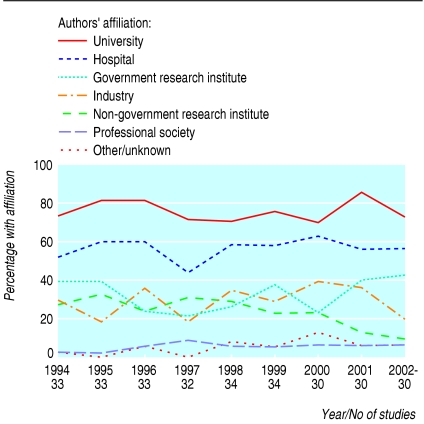
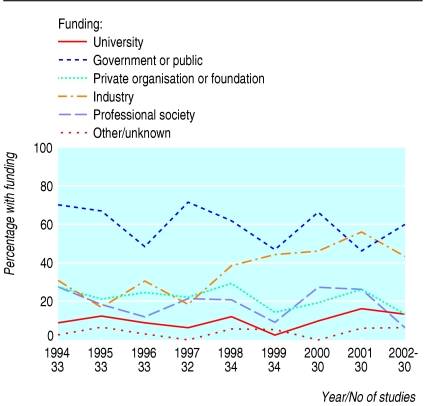
Results: Of the 289 frequently cited articles, most had at least one author with a university (76%) or hospital (57%) affiliation, and the proportion of articles with each type of affiliation was constant over time. Government or public funding was most common (60% of articles), followed by industry (36%). The proportion of most frequently cited articles funded by industry increased over time (odds ratio 1.17 per year, P = 0.001) and was equal to the proportion funded by government or public sources by 2001. 65 of the 77 most cited randomised controlled trials received funding from industry, and the proportion increased significantly over time (odds ratio 1.59 per year, P = 0.003). 18 of the 32 most cited trials published after 1999 were funded by industry alone.
Conclusion: Academic affiliations remain prominent among the authors of the most frequently cited medical research. Such research is increasingly funded by industry, often exclusively so. Academics may be losing control of the clinical research agenda.
Figures
Comment in
-
Is society losing control of the medical research agenda?BMJ. 2006 May 6;332(7549):1063-4. doi: 10.1136/bmj.38771.471563.80. Epub 2006 Mar 17. BMJ. 2006. PMID: 16547013 Free PMC article. No abstract available.
References
-
- Crowley WF Jr, Sherwood L, Salber P, Scheinberg D, Slavkin H, Tilson H, et al. Clinical research in the United States at a crossroads: proposal for a novel public-private partnership to establish a national clinical research enterprise. JAMA 2004;291: 1120-6. - PubMed
-
- Johns MM, Barnes M, Florencio PS. Restoring balance to industry-academia relationships in an era of institutional financial conflicts of interest: promoting research while maintaining trust. JAMA 2003;289: 741-6. - PubMed
MeSH terms
LinkOut - more resources
Full Text Sources
Miscellaneous