Procalcitonin in preterm infants during the first few days of life: introducing an age related nomogram
- PMID: 16547079
- PMCID: PMC2672732
- DOI: 10.1136/adc.2005.085449
Procalcitonin in preterm infants during the first few days of life: introducing an age related nomogram
Abstract
Objective: To determine normal concentrations of procalcitonin in preterm infants shortly after birth and to assess its accuracy in detecting bacterial infection.
Methods: Blood samples of 100 preterm infants were prospectively drawn during the first 4 days of life for determination of procalcitonin concentration. Infants were classified into four groups according to their sepsis status.
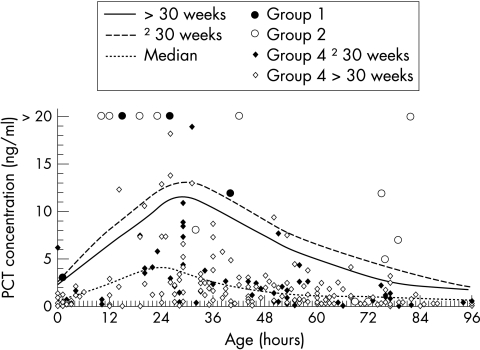
Results: Mean (SD) gestational age and birth weight were 32 (2.9) weeks and 1682 (500) g respectively. A total of 283 procalcitonin concentrations from healthy infants were plotted to construct nomograms of physiologically raised procalcitonin concentration after birth, stratified by two groups to 24-30 and 31-36 weeks gestation. The peak 95th centile procalcitonin concentration was plotted at 28 hours of age; values return to normal after 4 days of life. Only 12 infants were infected, and 13 of their 16 procalcitonin concentrations after birth were higher than the 95th centile, whereas samples taken at birth were lower. In a multivariable analysis, gestational age, premature rupture of membrane, and sepsis status influenced procalcitonin concentration independently, but maternal infection status did not.
Conclusions: The suggested neonatal nomograms of preterm infants are different from those of term infants. Procalcitonin concentrations exceeding the 95th centile may be helpful in detecting congenital infection, but not at birth.
Conflict of interest statement
Competing interests: none declared
References
-
- van Rossum A M, Wulkan R W, Oudesluys‐Murphy A M. Procalcitonin as an early marker of infection in neonates and children. Lancet Infect Dis 20044620–630. - PubMed
Publication types
MeSH terms
Substances
LinkOut - more resources
Full Text Sources
Medical