


Increase of the spontaneous mutation rate in a long-term experiment with Drosophila melanogaster
- PMID: 16547099
- PMCID: PMC1461422
- DOI: 10.1534/genetics.106.056200
Increase of the spontaneous mutation rate in a long-term experiment with Drosophila melanogaster
Abstract
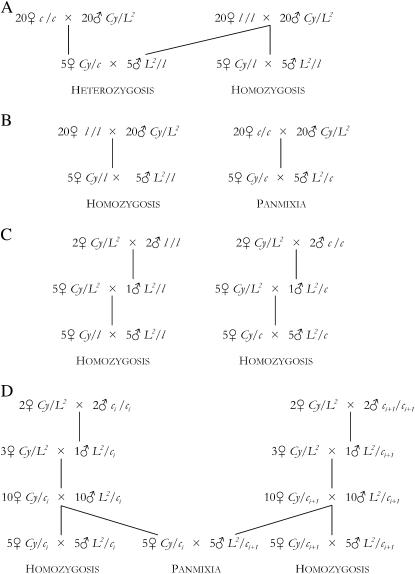
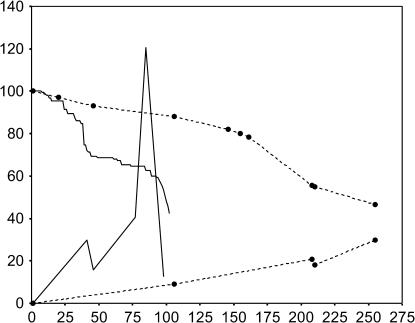
In a previous experiment, the effect of 255 generations of mutation accumulation (MA) on the second chromosome viability of Drosophila melanogaster was studied using 200 full-sib MA1 lines and a large C1 control, both derived from a genetically homogeneous base population. At generation 265, one of those MA1 lines was expanded to start 150 new full-sib MA2 lines and a new C2 large control. After 46 generations, the rate of decline in mean viability in MA2 was approximately 2.5 times that estimated in MA1, while the average degree of dominance of mutations was small and nonsignificant by generation 40 and moderate by generation 80. In parallel, the inbreeding depression rate for viability and the amount of additive variance for two bristle traits in C2 were 2-3 times larger than those in C1. The results are consistent with a mutation rate in the line from which MA2 and C2 were derived about 2.5 times larger than that in MA1. The mean viability of C2 remained roughly similar to that of C1, but the rate of MA2 line extinction increased progressively, leading to mutational collapse, which can be ascribed to accelerated mutation and/or synergy after important deleterious accumulation.
Figures
References
-
- Ávila, V., and A. García-Dorado, 2002. The effects of spontaneous mutation on competitive fitness in Drosophila melanogaster. J. Evol. Biol. 15 561–566.
-
- Caballero, A., E. Cusi, C. García and A. García-Dorado, 2002. Accumulation of deleterious mutations: additional Drosophila melanogaster estimates and a simulation of the effects of selection. Evolution 56 1150–1159. - PubMed
Publication types
MeSH terms
LinkOut - more resources
Full Text Sources
Molecular Biology Databases
Miscellaneous
