


International multi-centre survivorship analysis of mobile bearing total knee arthroplasty
- PMID: 16547718
- PMCID: PMC2532087
- DOI: 10.1007/s00264-005-0053-z
International multi-centre survivorship analysis of mobile bearing total knee arthroplasty
Abstract
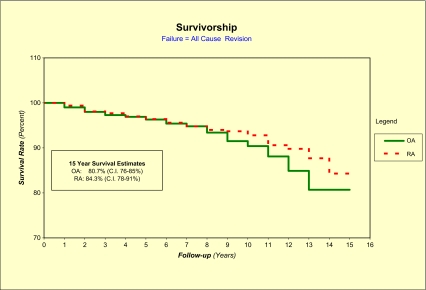
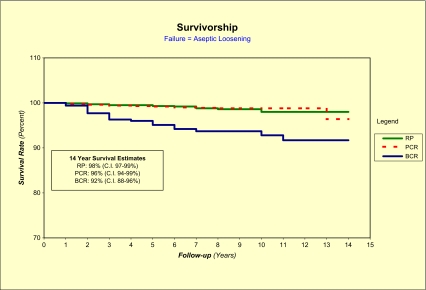
We retrospectively reviewed the experience of a large international multi-centre study of primary total knee arthroplasty with mobile bearing design and modifications of the tibial component to allow for bicruciate preservation, posterior cruciate retention, or sacrifice. Twenty-seven surgeons performed 4,743 total knee replacements between 1981 and 1997. Implants inserted were 324 that retained both cruciate ligaments, 2,165 that retained the posterior cruciate, and 2,254 that sacrificed both cruciates. The patella was resurfaced in 2,838 and unresurfaced in 1,905. With failure defined as revision or reoperation for any reason, the overall survivorship was 79% at 16 years' follow-up. Revision occurred in 259 (5.4%) knees out of the entire cohort. The risk adjusted rates of failure were higher in females, younger patients, osteoarthritis, post-traumatic arthritis, and in patients who had a meniscal bearing prosthesis or patellar resurfacing. The most common cause of revision was bearing-related issues including chronic instability, bearing subluxation, bearing dislocation, or bearing wear in 2.3%.
Nous avons revu rétrospectivement une série multicentrique de prothèses totales primaires de genoux avec plateaux mobiles et pièce tibiale permettant le sacrifice ou la conservation d’un ou des deux ligaments croisés. Entre 1981 et 1997, 4743 prothèses ont été faite par 27 chirugiens. Les implants utilisés étaient pour 2254 sans ligaments croisés, pour 2165 avec croisé postérieur et pour 324 avec conservation des 2 croisés. La rotule a été resurfacée 2838 fois. Avec l’échec défini par la reprise chirurgicale, la survie était de 79% à 16 ans de recul. Une reprise a été faite 259 fois (5,4%). Le risque d’échec était plus grand chez les femmes, les patients jeunes, en cas d’arthrose primaire ou post traumatique et chez les patients avec une prothèse à ménisques mobiles ou avec une rotule prothèsée. Les causes les plus fréquentes de révision étaient l’instabilité chronique, la subluxation ou la luxation des plateaux mobiles et leur usure.
Figures

References
-
- Argenson J-N, O’Connor JJ (1992) Polyethylene wear in meniscal knee replacement. A one to nine-year retrieval analysis of the Oxford knee. J Bone Joint Surg 74-B:228–232 - PubMed
-
- Bartel DL, Bicknell VL, Wright TM (1986) The effect of conformity, thickness, and material on stresses in ultra-high molecular weight components for total joint replacement. J Bone Joint Surg 68-A:1041–1051 - PubMed
-
- Bayley JC, Scott RD, Ewald FC, Holmes GB (1988) Failure of the metal-backed patellar component after total knee replacement. J Bone Joint Surg 70A:668–674 - PubMed
-
- Becker MW, Insall JN, Faris PM (1991) Bilateral total knee arthropalsty. One cruciate retaining and once cruciate substituting. Clin Orthop 271:122–124 - PubMed
Publication types
MeSH terms
Substances
LinkOut - more resources
Full Text Sources
Medical
