


Assessing the effect of HAART on change in quality of life among HIV-infected women
- PMID: 16549012
- PMCID: PMC1459186
- DOI: 10.1186/1742-6405-3-6
Assessing the effect of HAART on change in quality of life among HIV-infected women
Abstract
Background: The impact of highly active antiretroviral therapy (HAART) on health-related quality of life (QOL) of HIV-1 infected individuals in large prospective cohorts has not been well studied.
Objective: To assess the effect of HAART on QOL by comparing HIV-infected women using HAART with HIV-infected women remaining HAART naïve in the Women's Interagency HIV Study (WIHS), a multicenter prospective cohort study begun in 1994 in the US.
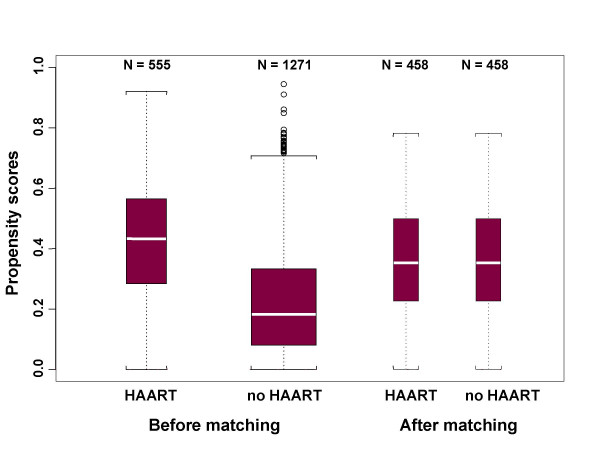
Methods: A 1:1 matching with equivalent (<or= 0.1%) propensity scores for predicting HAART initiation was implemented and 458 pairs were obtained. HAART effects were assessed using pattern mixture models. The changes of nine QOL domain scores and one summary score derived from a shortened version of the MOS-HIV from initial values were used as study outcomes.
Results: The background covariates of the treatment groups were well-balanced after propensity score matching. The 916 matched subjects had a mean age of 38.5 years and 42% had a history of AIDS diagnosis. The participants contributed a total of 4,292 person visits with a median follow-up time of 4 years. In the bivariate analyses with only HAART use and time as covariates, HAART was associated with short-term improvements of 4 QOL domains: role functioning, social functioning, pain and perceived health index. After adjusting for demographic, socioeconomic, biological and clinical variables, HAART had small but significant short-term improvements on changes in summary QOL (mean change: 3.25; P = 0.02), role functioning (6.99; P < 0.01), social functioning (5.74; P < 0.01), cognitive functioning (3.59; P = 0.03), pain (6.73; P < 0.01), health perception (3.67; P = 0.03) and perceived health index (4.87; P < 0.01). These QOL scores typically remained stable or declined over additional follow-up and there was no indication that HAART modified these trends.
Conclusion: Our study demonstrated significant short-term HAART effects on most QOL domains, but additional use of HAART did not modify long-term trends. These changes could be attributed to the direct effect of HAART and indirect HAART effect mediated through clinical changes.
Figures
References
-
- Hays RD, Cunningham WE, Sherbourne CD, Wilson IB, Wu AW, Cleary PD, McCaffrey DF, Fleishman JA, Crystal S, Collins R, Eggan F, Shapiro MF, Bozzette SA. Health-related quality of life in patients with human immunodeficiency virus infection in the United States: results from the HIV Cost and Services Utilization Study. Am J Med. 2000;108:714–722. doi: 10.1016/S0002-9343(00)00387-9. - DOI - PubMed
-
- Detels R, Munoz A, McFarlane G, Kingsley LA, Margolick JB, Giorgi J, Schrager LK, Phair JP. Effectiveness of potent antiretroviral therapy on time to AIDS and death in men with known HIV infection duration. Multicenter AIDS Cohort Study Investigators. Jama. 1998;280:1497–1503. doi: 10.1001/jama.280.17.1497. - DOI - PubMed
-
- Palella FJJ, Delaney KM, Moorman AC, Loveless MO, Fuhrer J, Satten GA, Aschman DJ, Holmberg SD. Declining morbidity and mortality among patients with advanced human immunodeficiency virus infection. HIV Outpatient Study Investigators. N Engl J Med. 1998;338:853–860. doi: 10.1056/NEJM199803263381301. - DOI - PubMed
-
- Carrieri P, Spire B, Duran S, Katlama C, Peyramond D, Francois C, Chene G, Lang JM, Moatti JP, Leport C. Health-related quality of life after 1 year of highly active antiretroviral therapy. J Acquir Immune Defic Syndr. 2003;32:38–47. - PubMed
Grants and funding
LinkOut - more resources
Full Text Sources
Medical
