A diagnostic formulation for anosognosia in Alzheimer's disease
- PMID: 16549411
- PMCID: PMC2077477
- DOI: 10.1136/jnnp.2005.085373
A diagnostic formulation for anosognosia in Alzheimer's disease
Abstract
Objective: To determine the earliest symptoms of anosognosia in people with Alzheimer's disease and to validate a criteria-guided strategy to diagnose anosognosia in dementia.
Methods: A consecutive series of 750 patients with very mild or probable Alzheimer's disease attending a memory clinic, as well as their respective care givers, was assessed using a comprehensive psychiatric evaluation.
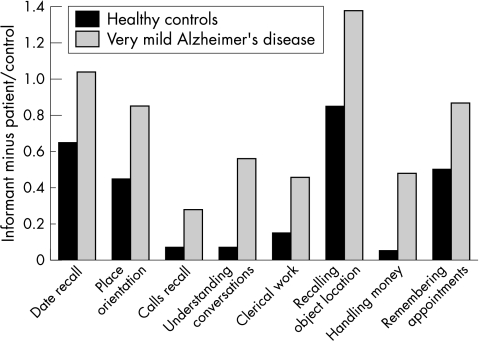
Results: The factors of anosognosia for (1) basic activities of daily living (bADL), (2) instrumental activities of daily living (iADL), (3) depression and (4) disinhibition were produced by a principal component analysis on the differential scores (ie, caregiver score minus patient score) on the anosognosia questionnaire for dementia. A discrepancy of two or more points in the anosognosia-iADL factor was found to have a high sensitivity and specificity to identify clinically diagnosed anosognosia in people with Alzheimer's disease. By logistic regression analysis, the severity of dementia and apathy were both shown to be noticeably associated with anosognosia in people with Alzheimer's disease.
Conclusion: Anosognosia in those with Alzheimer's disease is manifested as poor awareness of deficits in iADL and bADL, depressive changes and behavioural disinhibition. The frequency of anosognosia is found to increase considerably with the severity of dementia. The validity of a specific set of criteria to diagnose anosognosia in people with Alzheimer's disease was shown, which may contribute to the early identification of this condition.
Conflict of interest statement
Competing interests: None declared.
References
-
- Babinski J. Reflexes de defense. Brain 192245149–184. - PubMed
-
- Clare L. The construction of awareness in early‐stage Alzheimer's disease: a review of concepts and models. Br J Clin Psychol 200443155–175. - PubMed
-
- Clare L. Awareness in early‐stage Alzheimer's disease: a review of methods and evidence. Br J Clin Psychol 200443177–196. - PubMed
Publication types
MeSH terms
LinkOut - more resources
Full Text Sources
Medical