. 2006 Mar;3(1):31-8; discussion 133-7.
doi: 10.1093/ecam/nek010. Epub 2006 Jan 30.

Role of Toll-like receptors in adjuvant-augmented immune therapies

Affiliations

Role of Toll-like receptors in adjuvant-augmented immune therapies

Tsukasa Seya et al. Evid Based Complement Alternat Med. 2006 Mar.

Abstract

Effective therapeutic vaccines contain two primary constituents, antigen and adjuvant. Adjuvants consisting of microbial pattern molecules play a central role in vaccination. Successful vaccine requires efficient induction of antibody (Ab), type I interferons (IFN), cytokines/chemokines, cytotoxic T lymphocytes (CTL) and/or NK cells. Toll-like receptors (TLRs) in myeloid dendritic cells (mDC) essentially act as adjuvant receptors and sustain the molecular basis of adjuvant activity. Current consensus is that TLRs and their adapters introduce signals to preferentially induce IFN-alpha/beta, chemokines and proinflammatory cytokines, and mature mDC to augment antigen presentation. Although most of these data were obtained with mice, the results are presumed to be adaptable to humans. Whenever TLR pathway is activated in mDC, NK and/or CTL activation is promoted. For induction of antigen-specific CTL toward phagocytosed material, cross-priming must be induced in mDC, which is also sustained by TLR signaling in mDC. Since the TLR responses vary with different adjuvants, mDC functions are skewed depending on adjuvant-specific direction of mDC maturation. It appears that the directed maturation of mDC largely relies on selection of appropriate sets of TLRs and their adapter signaling pathways. Synthetic chimera molecules consisting of TLR agonists and target antigens are found to be effective in induction of CTL to eliminate target cells in vivo. Here, we review the role of human TLRs and adapters in a variety of host immune responses. We will also describe the relevance of adjuvants in the manipulation of receptors and adapters in vaccine therapy.


Figures
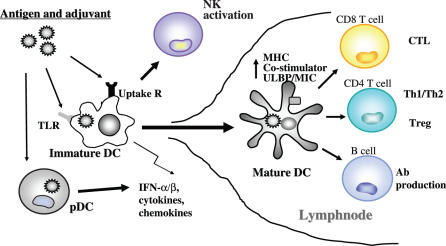
Figure 1
Figure 1
Role of human TLRs in mDC maturation followed by activation of various lymphocytes. Immature dendritic cells (mDC) residing in local tissue phagocytose exogenous antigen (Ag) and pattern molecule (namely adjuant) and initiate the maturation process. During maturation mDC induce IFNs, cytokines and chemokines, allow the upregulation of co-stimulators, NK-activating ligands (ULBP, MIC, etc) and MHC, and activate a variety of lymphocytes. These maturation events are largely dependent on adjuvant properties. Also, adjuvant may participate in switching on of some unknown mechanisms which are essential in induction of CD8+ CTL by mDCs.
Figure 2
Figure 2
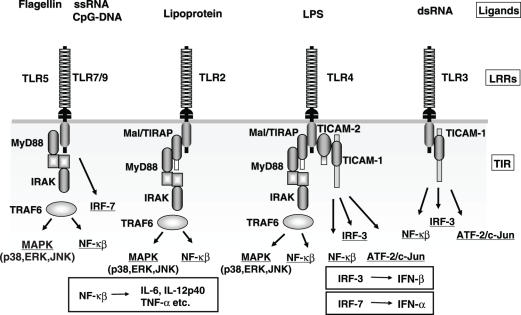
Association between human TLRs and adaptors determine each TLR-specific signaling pathway. Topology of the adaptor proteins in the TIR domains of TLR2, TLR3 and TLR4 is shown in the schema. The complex consisting of each TIR and adaptors delivers TLR signaling to activate NF-κB and the IFN-β promoter (IRF-3). In pDC, activation of TLR7 or 9 happens to activate IRF-7 in a MyD88-dependent way followed by induction of IFN-α. Representative ligands of TLRs are shown on the top.
Figure 3
Figure 3
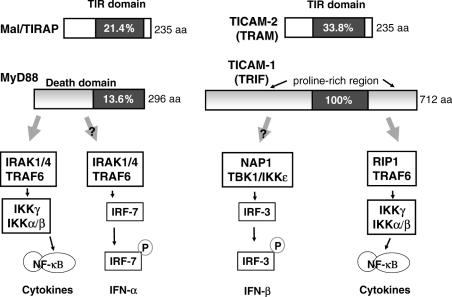
TLR adapters and possible signals induced in human DCs. MyD88 and TICAM-1 are functional adapters that activate both NF-κB and type I IFN promoters. Important downstream molecules currently identified are shown in the figure. Plasmacytoid DC (pDC) predominantly expresses TLR7 and TLR9 which recognize nucleotide derivatives. MyD88 activates IRF-7 in pDCs. Activation of different pathways is elicited in mDC.
Figure 4
Figure 4
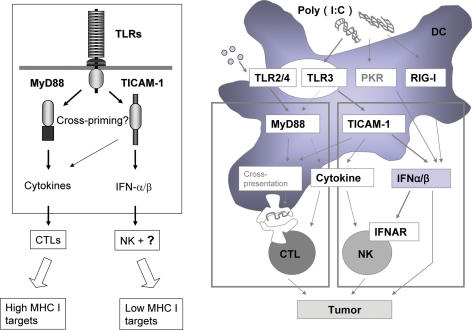
The two distinct TLR pathways of myeloid DCs. NK and CTL are induced as effecter cells for killing of targets secondary to activation of TLRs in mDCs (left panel). Myeloid DCs express TLR2, TLR3 and TLR4, and mature in response to BCG-CWS (TLR2/4 agonist) or dsRNA (TLR3 agonist). In general, TLR2/4 preferentially activates NF-κB via MyD88. TLR3 induces type 1 interferon (IFN). Both CTL and NK are then activated as indicated. In activation of CTL by mDC, exogenously-added antigen must be presented on MHC class I while the antigen are usually mounts on class II. This, named cross-priming, actually occurs if TLR signaling simultaneously enters (right panel). Either MyD88 or TICAM-1-mediated signal can induce cross-priming. Although the exact mechanism remains unknown, many factors are expected to be involved in switch on of cross-priming.
Figure 5
Figure 5
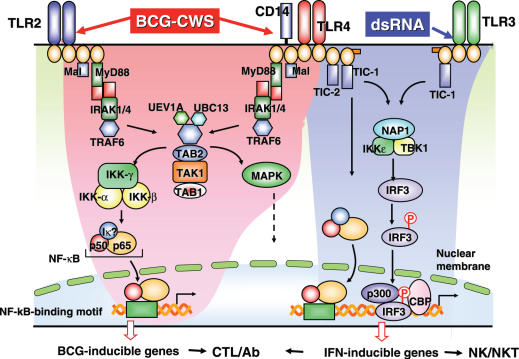
The two signaling pathways of TLR in myeloid DCs. MyD88-dependent pathway are indicated to the left and TICAM-1 pathway are shown to the right in blue. Many signaling molecules are involved in the two pathways leading to different outputs. NK and CTL are generated by the resultant mDC activation. In particular, cross-priming must occur in mDC to induce CTL, the molecular mechanism of which are largely unknown.

References

    1. Freund J. The mode of action of immunopharmacological adjuvants. Adv Tuberc Res. 1956;1:130–48. (review) - PubMed
    1. Seya T, Akazawa T, Uehori J, Matsumoto M, Azuma I, Toyoshima K. Role of toll-like receptors and their adaptors in adjuvant immunotherapy for cancer. Anticancer Res. 2003;23:4369–76. (review) - PubMed
    1. Takeda K, Kaisho T, Akira S. Toll-like receptors. Annu Rev Immunol. 2003;21:335–76. (review) - PubMed
    1. Medzhitov R, Janeway CA., Jr Innate immunity: the virtues of a nonclonal system of recognition. Cell. 1997;91:295–8. (review) - PubMed
    1. Medzhitov R, Preston-Hurlburt P, Janeway CA. A human homologue of the Drosophila Toll protein signals activation of adaptive immunity. Nature. 1997;388:394–7. - PubMed

LinkOut - more resources