The clinical relevance of stromal matrix metalloproteinase expression in ovarian cancer
- PMID: 16551853
- PMCID: PMC3202606
- DOI: 10.1158/1078-0432.CCR-05-2338
The clinical relevance of stromal matrix metalloproteinase expression in ovarian cancer
Expression of concern in
-
Editor's Note: The Clinical Relevance of Stromal Matrix Metalloproteinase Expression in Ovarian Cancer.Clin Cancer Res. 2021 Aug 1;27(15):4455. doi: 10.1158/1078-0432.CCR-21-2121. Clin Cancer Res. 2021. PMID: 34341060 No abstract available.
Abstract
Purpose: Matrix metalloproteinases (MMP) are proteolytic enzymes implicated in cancer progression and metastasis. We sought to determine the role of epithelial (tumor cell-derived) and stromal (host-derived) expression of MMPs in predicting the clinical outcome of patients with epithelial ovarian cancer (EOC).
Experimental design: MMP-2, MMP-9, and membrane type 1 (MT1)-MMP expression was evaluated using immunohistochemistry in 90 invasive EOCs, and samples were scored for epithelial and stromal staining. Results were correlated with clinicopathologic characteristics using univariate and multivariate analyses.
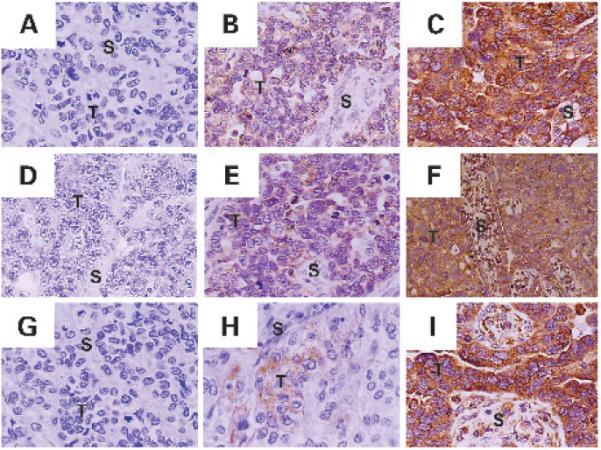
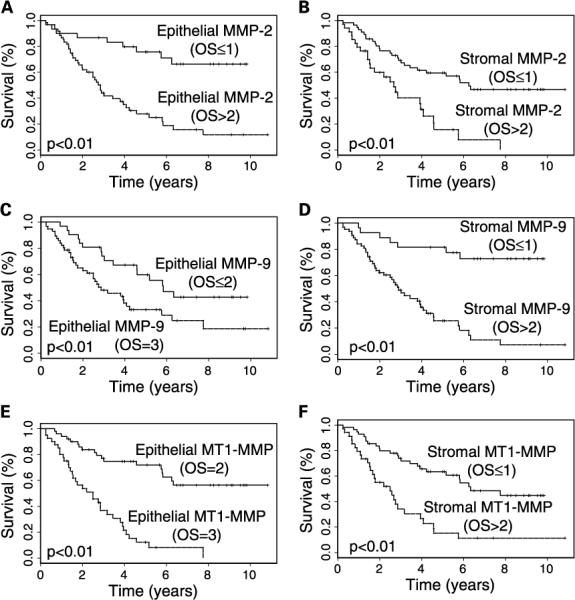
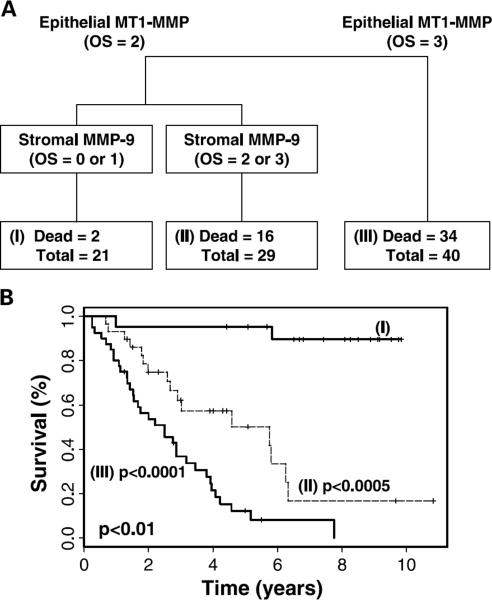
Results: High expression of MMP-2, MMP-9, and MT1-MMP in tumor epithelium was detected in 54%, 97%, and 100% of cases, and in stromal compartments, in 38%, 70%, and 38% of cases, respectively. High stromal expression of MMP-2, MMP-9, and MT1-MMP was significantly associated with aggressive features such as high stage, high grade ascites, and positive lymph node status. Kaplan-Meier analysis showed that high epithelial and stromal expression of MMP-2, MMP-9, and MT1-MMP were each significantly associated with shorter disease-specific survival (DSS; P < 0.01). On tree-structured survival analysis, patients with strong epithelial MT1-MMP expression had the shortest DSS, whereas patients with moderate epithelial MT1-MMP and low stromal MMP-9 expression had the longest DSS (P < 0.01). On multivariate analysis, high stromal expression of MMP-9 (P = 0.01) and MT1-MMP (P = 0.04), strong epithelial MT1-MMP (P = 0.01) and high stage (P = 0.04) were independent predictors of poor DSS.
Conclusions: Overexpression of stromal MMP-9 and MT1-MMP is independently associated with shorter DSS in EOC. Thus, host-derived MMPs are valuable predictors of clinical outcome in EOC.
Figures
References
-
- Jemal A, Murray T, Ward E, et al. Cancer statistics, 2005. CA Cancer J Clin. 2005;55:10–30. - PubMed
-
- Ahmed FY, Wiltshaw E, A'Hern RP, et al. Natural history and prognosis of untreated stage I epithelial ovarian carcinoma. J Clin Oncol. 1996;14:2968–75. - PubMed
-
- Liotta LA, Rao CN, Barsky SH. Tumor invasion and the extracellular matrix. Lab Invest. 1983;49:636–49. - PubMed
-
- Werb Z. ECM and cell surface proteolysis: regulating cellular oncology. Cell. 1997;91:439–42. - PubMed
-
- Yurchenco PD, Schittny JC. Molecular architecture of basement membranes. FASEB J. 1990;4:1577–90. - PubMed
Publication types
MeSH terms
Substances
Grants and funding
LinkOut - more resources
Full Text Sources
Other Literature Sources
Medical
Miscellaneous