


Predictive value of 18-fluoro-deoxy-glucose-positron emission tomography (18F-FDG-PET) in the identification of responders to chemoradiation therapy for the treatment of locally advanced esophageal cancer
- PMID: 16552197
- PMCID: PMC1448953
- DOI: 10.1097/01.sla.0000208430.07050.61
Predictive value of 18-fluoro-deoxy-glucose-positron emission tomography (18F-FDG-PET) in the identification of responders to chemoradiation therapy for the treatment of locally advanced esophageal cancer
Abstract
Objective: To evaluate the utility of F-FDG-PET in predicting response to concomitant chemoradiation in locally-advanced esophageal cancer.
Summary background data: Approximately 25% of esophageal cancer patients experience a pathologic complete response (pCR) to preoperative chemoradiation therapy. Computed tomography, endoscopy, and endoscopic ultrasound are unable to identify patients experiencing a pCR. Growing evidence supports the use of F-FDG-PET in the staging of esophageal cancer in its ability to detect occult metastatic and lymph nodal disease. The identification of patients with a pCR to chemoradiation could potentially spare those patients the morbidity associated with a resection.
Methods: Eligibility criteria included T3-T4N0M0 or T1-T4N1M0 esophageal cancer. Patients underwent an initial F-FDG-PET before treatment and then repeated 4 to 6 weeks after chemoradiation, prior to the esophagectomy. Chemoradiation consisted of: cisplatinum, 5-fluorouracil, and radiation to a median dose of 50.4 Gy. Pathologic response was determined from a systematic review of the esophagectomy specimens.
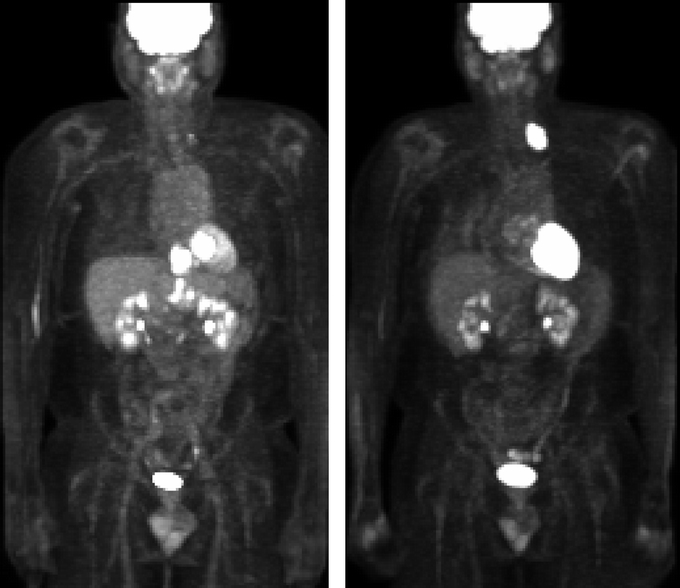
Results: Sixty-four patients have completed therapy to date. Response was as follows: pCR 27%, pathologic residual microscopic (pCRmicro) 14.5%, partial response 19%, and stable or progressive disease 39.5%. A pretreatment standardized uptake value (SUVmax1hour) > or = 15 was associated with an observed 77.8% significant response (pCR + pCRmicro) compared with 24.2% for patients with a pretreatment SUVmax1hour < 15 (P = 0.005). Significant response was observed in 71.4% of patients with a decrease in SUVmax1hour > or = 10 compared with 33.3% when the SUVmax1hour decreased <10 (P = 0.004).
Conclusions: Pretreatment and posttreatment F-FDG-PET can be useful for predicting significant response to chemoradiation in esophageal cancer. These data should be considered in evaluation of patients for esophagectomy after chemoradiation.
Figures
References
-
- Ancona E, Ruol A, Santi S, et al. Only pathologic complete response to neoadjuvant chemotherapy improves significantly the long-term survival of patients with resectable esophageal squamous cell carcinoma: final report of a randomized, controlled trial of preoperative chemotherapy versus surgery alone. Cancer. 2001;91:2165–2174. - PubMed
-
- Apinop C, Puttisak P, Preecha N. A prospective study of combined therapy in esophageal cancer. Hepatogastroenterology. 1994;41:391–393. - PubMed
-
- Burmeister BH, Smithers BM, Fitzgerald L, et al. A randomized phase III trial of preoperative chemoradiation followed by surgery (CR-S) versus surgery alone (S) for localized resectable cancer of the esophagus. Prog Proc Am Soc Clin Oncol. 2002;21:130a.
-
- Le PE, Etienne PL, Meunier B, et al. A randomized study of chemotherapy, radiation therapy, and surgery versus surgery for localized squamous cell carcinoma of the esophagus. Cancer. 1994;73:1779–1784. - PubMed
-
- Urba SG, Orringer MB, Turrisi A, et al. Randomized trial of preoperative chemoradiation versus surgery alone in patients with locoregional esophageal carcinoma. J Clin Oncol. 2001;19:305–313. - PubMed
Publication types
MeSH terms
Substances
Grants and funding
LinkOut - more resources
Full Text Sources
Medical
