


The main sequence of saccades optimizes speed-accuracy trade-off
- PMID: 16555070
- PMCID: PMC2637438
- DOI: 10.1007/s00422-006-0064-x
The main sequence of saccades optimizes speed-accuracy trade-off
Abstract
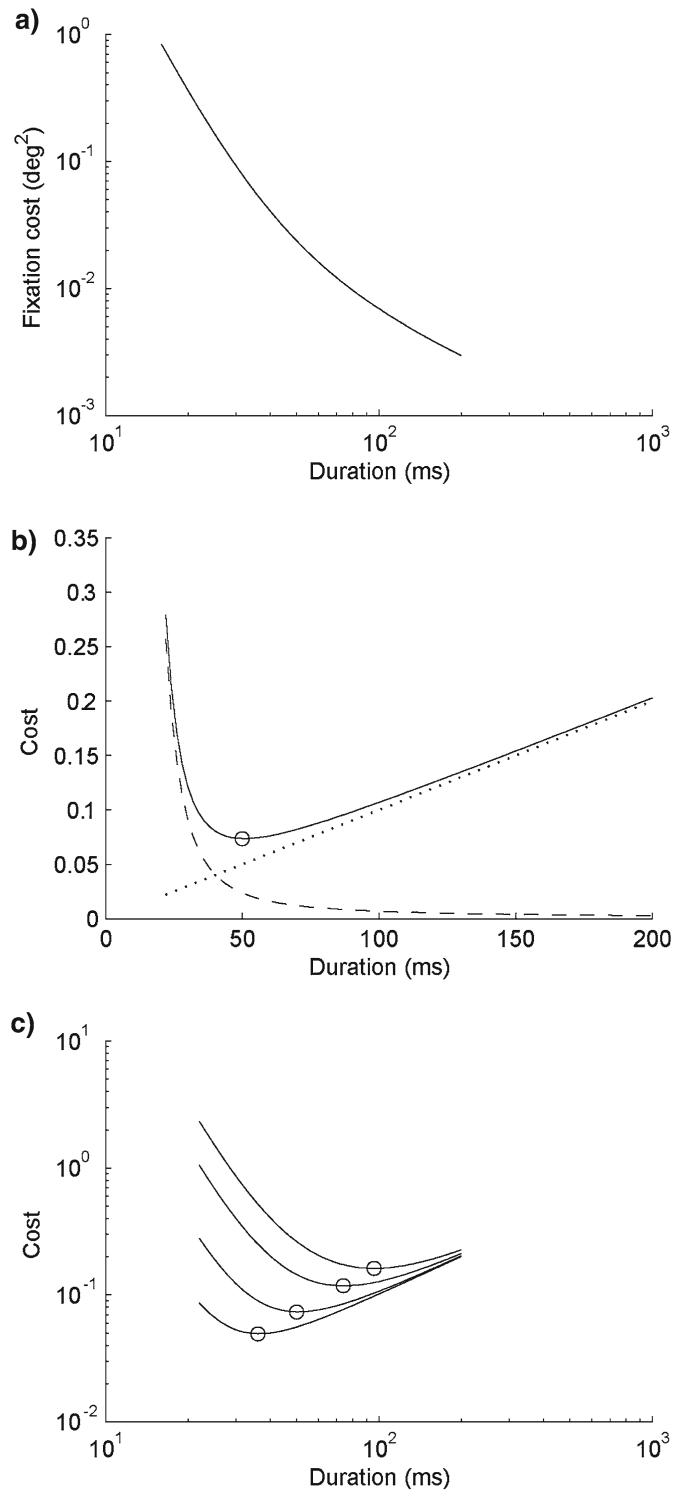
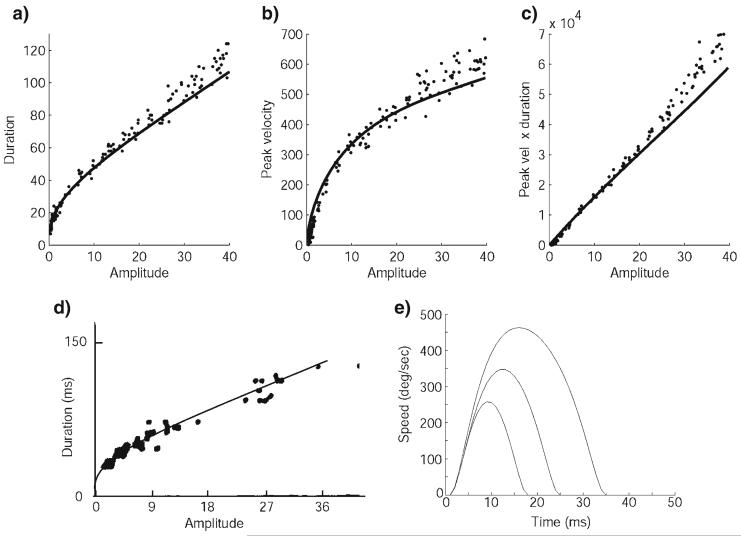
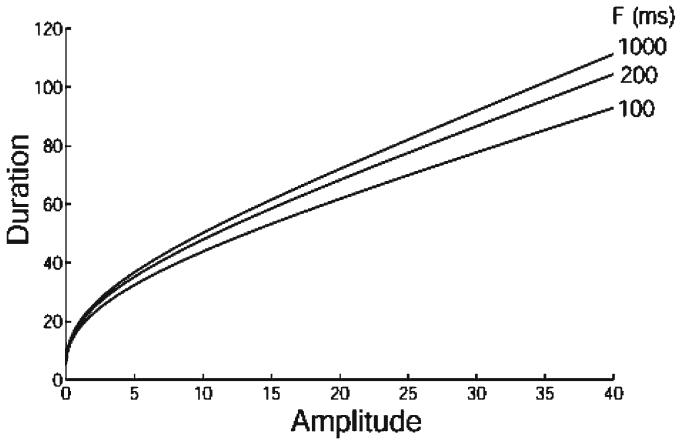
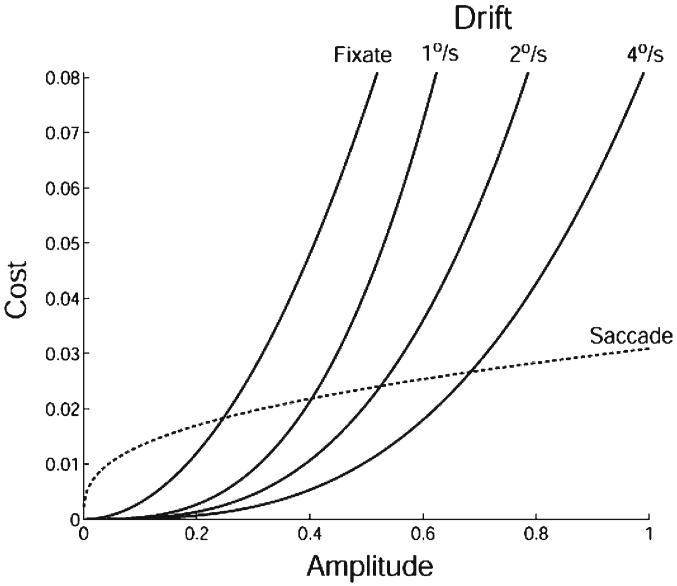
In primates, it is well known that there is a consistent relationship between the duration, peak velocity and amplitude of saccadic eye movements, known as the 'main sequence'. The reason why such a stereotyped relationship evolved is unknown. We propose that a fundamental constraint on the deployment of foveal vision lies in the motor system that is perturbed by signal-dependent noise (proportional noise) on the motor command. This noise imposes a compromise between the speed and accuracy of an eye movement. We propose that saccade trajectories have evolved to optimize a trade-off between the accuracy and duration of the movement. Taking a semi-analytical approach we use Pontryagin's minimum principle to show that there is an optimal trajectory for a given amplitude and duration; and that there is an optimal duration for a given amplitude. It follows that the peak velocity is also fixed for a given amplitude. These predictions are in good agreement with observed saccade trajectories and the main sequence. Moreover, this model predicts a small saccadic dead-zone in which it is better to stay eccentric of target than make a saccade onto target. We conclude that the main sequence has evolved as a strategy to optimize the trade-off between accuracy and speed.
Figures
References
-
- Bahill AT, Clark MR, Stark L. Dynamic overshoot in saccadic eye movements is caused by neurological control signal reversals. Exp Neurol. 1975;48:107–122. - PubMed
-
- Baloh RW, Sills AW, Kumley WE, Honrubia V. Quantitative measurement of saccade amplitude, duration, and velocity. Neurology. 1975;25:1065–1070. - PubMed
-
- Becker W. Metrics. In: Wurtz R, Goldberg M, editors. The neurobiology of saccadic eye movements. Elsevier; Amsterdam: 1989. pp. 13–67. - PubMed
-
- van Beers RJ. The origin of variability in eye position during visual fixation. Society for Neuroscience; Washington: 2003. Program No. 187-188.
Publication types
MeSH terms
Grants and funding
LinkOut - more resources
Full Text Sources
Other Literature Sources
