


Impairment of the intestinal barrier by ethanol involves enteric microflora and mast cell activation in rodents
- PMID: 16565490
- PMCID: PMC1606551
- DOI: 10.2353/ajpath.2006.050617
Impairment of the intestinal barrier by ethanol involves enteric microflora and mast cell activation in rodents
Abstract
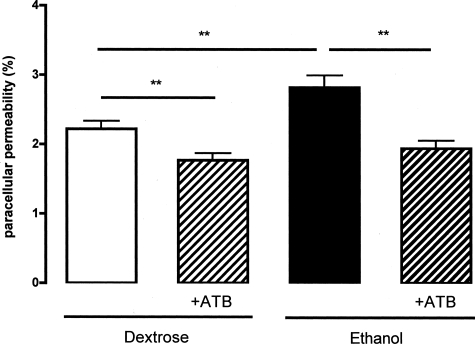
Alcohol hepatic toxicity in heavy drinkers is associated with high endotoxin blood levels and increased intestinal permeability. Because endotoxins can cross damaged mucosa, we investigated the mechanisms through which ethanol impairs the colonic epithelium of rats submitted to acute alcohol intake. Colonic permeability to (51)Cr-ethylenediamintetraacetic acid was increased 24 hours after 3.0 g/kg ethanol intake (3.2 +/- 0.2% versus 2.2 +/- 0.2%) and was associated with significant endotoxemia. Antibiotics and doxantrazole (a mast cell membrane stabilizer) significantly inhibited the effect of ethanol. Two hours after intake, plasma concentrations of ethanol were twofold higher in antibiotic-treated rats than in controls (155.8 +/- 9.3 mg/dl versus 75.7 +/- 7.6 mg/dl, P < 0.001). Lumenal concentrations of acetaldehyde were markedly increased after ethanol intake (132.6 +/- 31.6 micromol/L versus 20.8 +/- 1.4 micromol/L, P < 0.05) and antibiotics diminished this increase (86.2 +/- 10.9 micromol/L). In colonic samples mounted in Ussing chambers, acetaldehyde but not ethanol increased dextran flux across the mucosa by 54%. Doxantrazole inhibited the effect of acetaldehyde. This study demonstrates that an acute and moderate ethanol intake alters the epithelial barrier through ethanol oxidation into acetaldehyde by the colonic microflora and downstream mast cell activation. Such alterations that remain for longer periods could result in excessive endotoxin passage, which could explain the subsequent endotoxemia frequently observed in patients with alcoholic liver disease.
Figures



References
-
- Willis MS, Klassen LW, Tuma DJ, Sorrell MF, Thiele GM. Adduction of soluble proteins with malondialdehyde-acetaldehyde (MAA) induces antibody production and enhances T-cell proliferation. Alcohol Clin Exp Res. 2002;26:94–106. - PubMed
-
- Arteel G, Marsano L, Mendez C, Bentley F, McClain CJ. Advances in alcoholic liver disease. Best Pract Res Clin Gastroenterol. 2003;17:625–647. - PubMed
-
- Pascual S, Such J, Esteban A, Zapater P, Casellas JA, Aparicio JR, Girona E, Gutierrez A, Carnices F, Palazon JM, Sola-Vera J, Perez-Mateo M. Intestinal permeability is increased in patients with advanced cirrhosis. Hepatogastroenterology. 2003;50:1482–1486. - PubMed
-
- Rao RK, Seth A, Sheth P. Recent advances in alcoholic liver disease I. Role of intestinal permeability and endotoxemia in alcoholic liver disease. Am J Physiol. 2004;286:G881–G884. - PubMed
Publication types
MeSH terms
Substances
LinkOut - more resources
Full Text Sources
Other Literature Sources
