


Association between human fetuin-A and the metabolic syndrome: data from the Heart and Soul Study
- PMID: 16567568
- PMCID: PMC2776669
- DOI: 10.1161/CIRCULATIONAHA.105.588723
Association between human fetuin-A and the metabolic syndrome: data from the Heart and Soul Study
Abstract
Background: Fetuin-A is a multifunctional hepatic secretory protein that inhibits the action of insulin in experimental animals. We evaluated the association between human serum fetuin-A and the metabolic syndrome (MetS) in a cohort of persons with coronary artery disease.
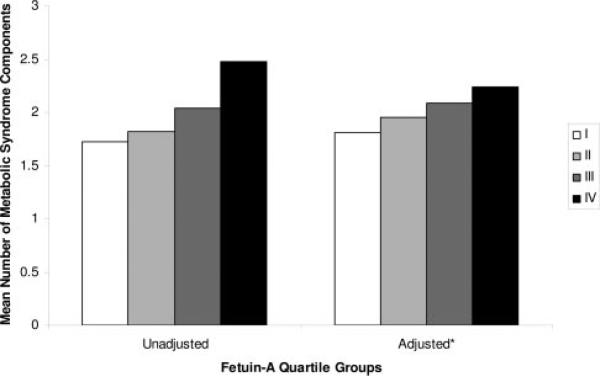
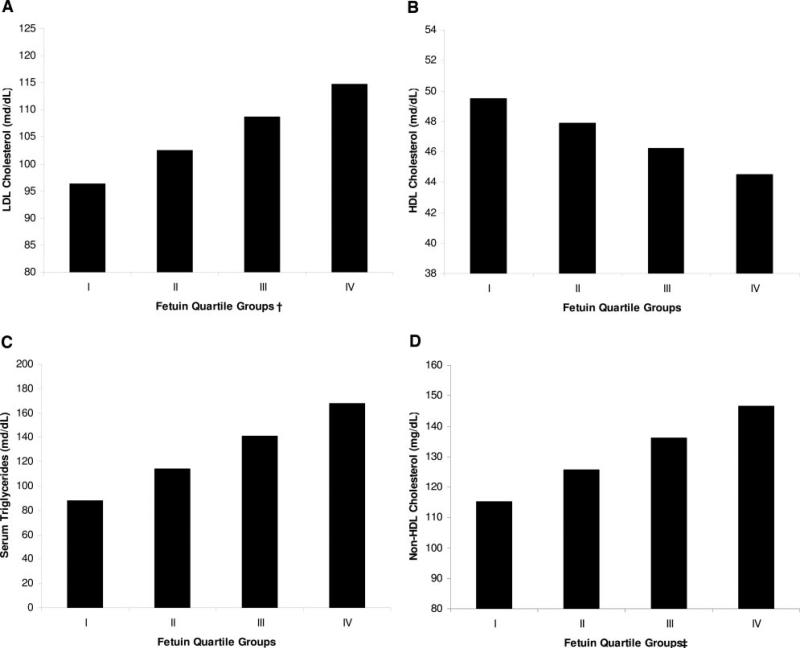
Methods and results: We defined MetS by the National Cholesterol Education Program criteria among 711 nondiabetic outpatients with coronary artery disease. The mean age was 67 years, and 82% were male. We divided participants into quartiles by serum fetuin-A concentrations. A total of 45% of participants (80 of 177) in the highest quartile of fetuin-A had MetS compared with 24% of participants (42 of 177) in the lowest quartile (odds ratio, 2.7; 95% confidence interval, 1.7 to 4.2; P<0.001). This association persisted after adjustment for potential confounding variables, including hypertension, body mass index, and inflammatory biomarkers (adjusted odds ratio, 2.0; 95% confidence interval, 1.1 to 3.5; P=0.02). Higher fetuin-A quartiles were also strongly and independently associated with higher low-density lipoprotein, non-high-density lipoprotein (HDL), and triglyceride concentrations and lower HDL concentrations (all P<0.01).
Conclusions: Higher human fetuin-A concentrations are strongly associated with MetS and an atherogenic lipid profile. Future studies should evaluate whether fetuin-A predicts coronary artery disease risk.
Figures
References
-
- Executive Summary of the Third Report of the National Cholesterol Education Program (NCEP) Expert Panel on Detection, Evaluation, and Treatment of High Blood Cholesterol in Adults (Adult Treatment Panel III). JAMA. 2001;285:2486–2497. - PubMed
-
- Klein BE, Klein R, Lee KE. Components of the metabolic syndrome and risk of cardiovascular disease and diabetes in beaver dam. Diabetes Care. 2002;25:1790–1794. - PubMed
-
- Lakka HM, Laaksonen DE, Lakka TA, Niskanen LK, Kumpusalo E, Tuomilehto J, Salonen JT. The metabolic syndrome and total and cardiovascular disease mortality in middle-aged men. JAMA. 2002;288:2709–2716. - PubMed
-
- Ford ES, Giles WH, Dietz WH. Prevalence of the metabolic syndrome among US adults: findings from the Third National Health and Nutrition Examination Survey. JAMA. 2002;287:356–359. - PubMed
-
- Deedwania PC. Metabolic syndrome and vascular disease: is nature or nurture leading the new epidemic of cardiovascular disease? Circulation. 2004;109:2–4. - PubMed
Publication types
MeSH terms
Substances
Grants and funding
LinkOut - more resources
Full Text Sources
Medical
Miscellaneous
