


Apolipoprotein E4: a causative factor and therapeutic target in neuropathology, including Alzheimer's disease
- PMID: 16567625
- PMCID: PMC1414631
- DOI: 10.1073/pnas.0600549103
Apolipoprotein E4: a causative factor and therapeutic target in neuropathology, including Alzheimer's disease
Abstract
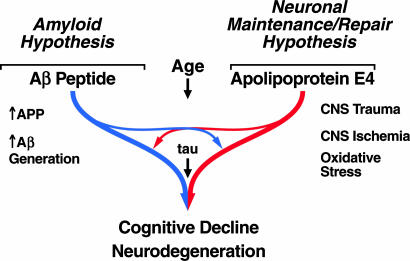
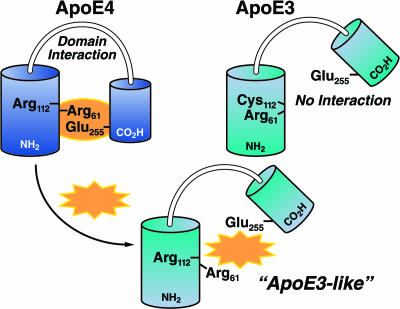
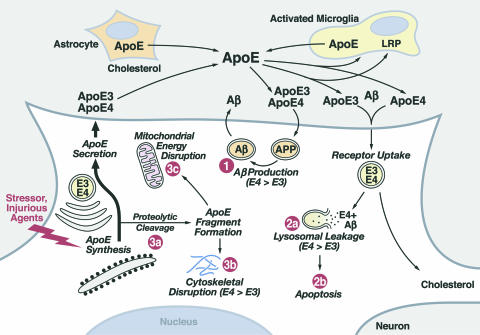
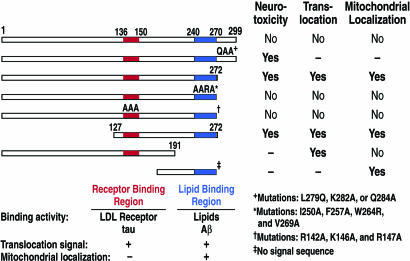
The premise of this review is that apolipoprotein (apo) E4 is much more than a contributing factor to neurodegeneration. ApoE has critical functions in redistributing lipids among CNS cells for normal lipid homeostasis, repairing injured neurons, maintaining synapto-dendritic connections, and scavenging toxins. In multiple pathways affecting neuropathology, including Alzheimer's disease, apoE acts directly or in concert with age, head injury, oxidative stress, ischemia, inflammation, and excess amyloid beta peptide production to cause neurological disorders, accelerating progression, altering prognosis, or lowering age of onset. We envision that unique structural features of apoE4 are responsible for apoE4-associated neuropathology. Although the structures of apoE2, apoE3, and apoE4 are in dynamic equilibrium, apoE4, which is detrimental in a variety of neurological disorders, is more likely to assume a pathological conformation. Importantly, apoE4 displays domain interaction (an interaction between the N- and C-terminal domains of the protein that results in a compact structure) and molten globule formation (the formation of stable, reactive intermediates with potentially pathological activities). In response to CNS stress or injury, neurons can synthesize apoE. ApoE4 uniquely undergoes neuron-specific proteolysis, resulting in bioactive toxic fragments that enter the cytosol, alter the cytoskeleton, disrupt mitochondrial energy balance, and cause cell death. Our findings suggest potential therapeutic strategies, including the use of "structure correctors" to convert apoE4 to an "apoE3-like" molecule, protease inhibitors to prevent the generation of toxic apoE4 fragments, and "mitochondrial protectors" to prevent cellular energy disruption.
Conflict of interest statement
Conflict of interest statement: No conflicts declared.
Figures
Comment in
-
Profile of Robert W. Mahley.Proc Natl Acad Sci U S A. 2006 Apr 11;103(15):5641-3. doi: 10.1073/pnas.0601981103. Epub 2006 Apr 3. Proc Natl Acad Sci U S A. 2006. PMID: 16585500 Free PMC article. No abstract available.
References
-
- Mahley R. W. Science. 1988;240:622–630. - PubMed
-
- Weisgraber K. H. Adv. Protein Chem. 1994;45:249–302. - PubMed
-
- Mahley R. W., Rall S. C., Jr. Annu. Rev. Genomics Hum. Genet. 2000;1:507–537. - PubMed
-
- Corder E. H., Saunders A. M., Risch N. J., Strittmatter W. J., Schmechel D. E., Gaskell P. C., Jr., Rimmler J. B., Locke P. A., Conneally P. M., Schmader K. E., et al. Nat. Genet. 1994;7:180–184. - PubMed
-
- Lippa C. F., Smith T. W., Saunders A. M., Hulette C., Pulaski-Salo D., Roses A. D. Neurology. 1997;48:515–519. - PubMed
Publication types
MeSH terms
Substances
Grants and funding
LinkOut - more resources
Full Text Sources
Other Literature Sources
Medical
Miscellaneous
