Structure-activity relationships of aminocoumarin-type gyrase and topoisomerase IV inhibitors obtained by combinatorial biosynthesis
- PMID: 16569821
- PMCID: PMC1426943
- DOI: 10.1128/AAC.50.4.1136-1142.2006
Structure-activity relationships of aminocoumarin-type gyrase and topoisomerase IV inhibitors obtained by combinatorial biosynthesis
Abstract
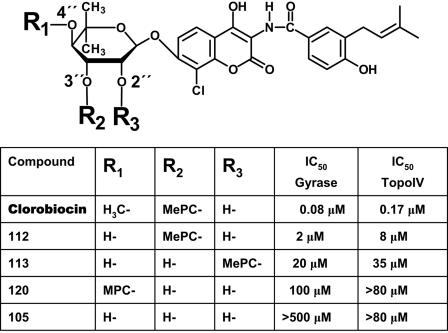
Novobiocin and clorobiocin are gyrase inhibitors produced by Streptomyces strains. Structurally, the two compounds differ only by substitution at two positions: CH3 versus Cl at position 8' of the aminocoumarin ring and carbamoyl versus 5-methyl-pyrrol-2-carbonyl (MePC) at the 3"-OH of noviose. Using genetic engineering, we generated a series of analogs carrying H, CH3, or Cl at 8' and H, carbamoyl, or MePC at 3"-OH. Comparison of the gyrase inhibitory activities of all nine structural permutations confirmed that acylation of 3"-OH is essential for activity, with MePC being more effective than carbamoyl. Substitution at 8' further enhanced activity, but the effect of CH3 or Cl depended on the nature of the acyl group at 3": in the presence of carbamoyl at 3", CH3 resulted in higher activity; in the presence of MePC at 3", Cl resulted in higher activity. This suggests that the structures of both natural compounds are highly evolved for optimal interaction with gyrase. In a second series of experiments, clorobiocin derivatives with and without the methyl group at 4"-OH of noviose, and with different positions of the MePC group of noviose, were tested. Again clorobiocin was superior to all of its analogs. The activities of all compounds were also tested against topoisomerase IV (topo IV). Clorobiocin stood out as a remarkably effective topo IV inhibitor. The relative activities of the different compounds toward topo IV showed a pattern similar to that of the relative gyrase-inhibitory activities. This is the first report of a systematic evaluation of a series of aminocoumarins against both gyrase and topo IV. The results give further insight into the structure-activity relationships of aminocoumarin antibiotics.
Figures



References
-
- Drlica, K., and M. Malik. 2003. Fluoroquinolones: action and resistance. Curr. Top. Med. Chem. 3:249-282. - PubMed
-
- Eustaquio, A. S., B. Gust, S. M. Li, S. Pelzer, W. Wohlleben, K. F. Chater, and L. Heide. 2004. Production of 8′-halogenated and 8′-unsubstituted novobiocin derivatives in genetically engineered Streptomyces coelicolor strains. Chem. Biol. 11:1561-1572. - PubMed
-
- Eustaquio, A. S., B. Gust, T. Luft, S. M. Li, K. F. Chater, and L. Heide. 2003. Clorobiocin biosynthesis in Streptomyces. Identification of the halogenase and generation of structural analogs. Chem. Biol. 10:279-288. - PubMed
-
- Freitag, A., H. Rapp, L. Heide, and S. M. Li. 2005. Metabolic engineering of aminocoumarins: inactivation of the methyltransferase gene cloP and generation of new clorobiocin derivatives in a heterologous host. Chembiochem 6:1411-1418. - PubMed
Publication types
MeSH terms
Substances
Grants and funding
LinkOut - more resources
Full Text Sources
Other Literature Sources
Medical