


Evaluation of amphotericin B interpretive breakpoints for Candida bloodstream isolates by correlation with therapeutic outcome
- PMID: 16569842
- PMCID: PMC1426914
- DOI: 10.1128/AAC.50.4.1287-1292.2006
Evaluation of amphotericin B interpretive breakpoints for Candida bloodstream isolates by correlation with therapeutic outcome
Abstract
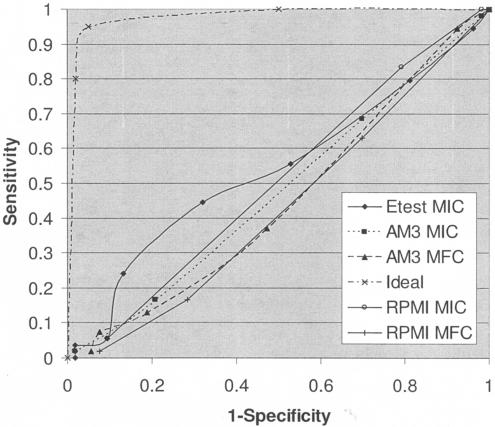
One hundred seven Candida bloodstream isolates (51 C. albicans, 24 C. glabrata, 13 C. parapsilosis, 13 C. tropicalis, 2 C. dubliniensis, 2 C. krusei, and 2 C. lusitaniae strains) from patients treated with amphotericin B alone underwent in vitro susceptibility testing against amphotericin B using five different methods. Fifty-four isolates were from patients who failed treatment, defined as death 7 to 14 days after the incident candidemia episode, having persistent fever of >or=5 days' duration after the date of the incident candidemia, or the recurrence of fever after two consecutive afebrile days while on antifungal treatment. MICs were determined by using the Clinical Laboratory Standards Institute (formally National Committee for Clinical Laboratory Standards) broth microdilution procedure with two media and by using Etest. Minimum fungicidal concentrations (MFCs) were also measured in two media. Broth microdilution tests with RPMI 1640 medium generated a restricted range of MICs (0.125 to 1 microg/ml); the corresponding MFC values ranged from 0.5 to 4 microg/ml. Broth microdilution tests with antibiotic medium 3 produced a broader distribution of MIC and MFC results (0.015 to 0.25 microg/ml and 0.06 to 2 microg/ml, respectively). Etest produced the widest distribution of MICs (0.094 to 2 microg/ml). However, none of the test formats studied generated results that significantly correlated with therapeutic success or failure.
Figures
References
-
- Antoniadou, A., H. A. Torres, R. E. Lewis, J. Thornby, G. P. Bodey, J. J. Tarrand, X. Y. Han, K. V. I. Rolston, A. Safdar, I. I. Raad, and D. P. Kontoyiannis. 2003. Candidemia in a tertiary care cancer center: in vitro susceptibility and its association with outcome of initial antifungal therapy. Medicine 82:309-321. - PubMed
-
- Arendrup, M., B. Lundgren, I. M. Jensen, B. S. Hansen, and N. Frimodt-Moller. 2001. Comparison of Etest and a tablet diffusion test with the NCCLS broth microdilution method for fluconazole and amphotericin B susceptibility testing of Candida isolates. J. Antimicrob. Chemother. 47:521-526. - PubMed
-
- Conly, J., R. Rennie, J. Johnson, S. Farah, and L. Hellman. 1992. Disseminated candidiasis due to amphotericin B-resistant Candida albicans. J. Infect. Dis. 165:761-764. - PubMed
MeSH terms
Substances
LinkOut - more resources
Full Text Sources
Other Literature Sources
Medical
