


Remission from Kaposi's sarcoma on HAART is associated with suppression of HIV replication and is independent of protease inhibitor therapy
- PMID: 16570046
- PMCID: PMC2361239
- DOI: 10.1038/sj.bjc.6603056
Remission from Kaposi's sarcoma on HAART is associated with suppression of HIV replication and is independent of protease inhibitor therapy
Abstract
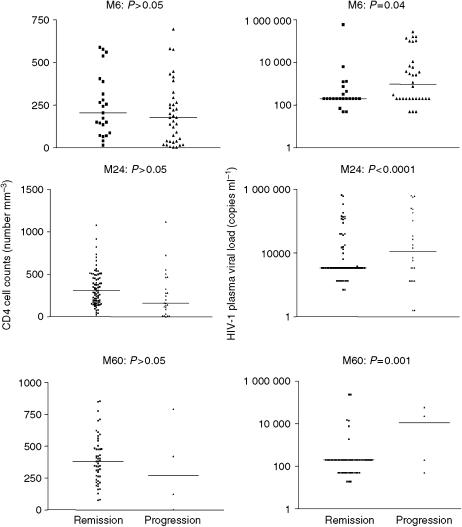
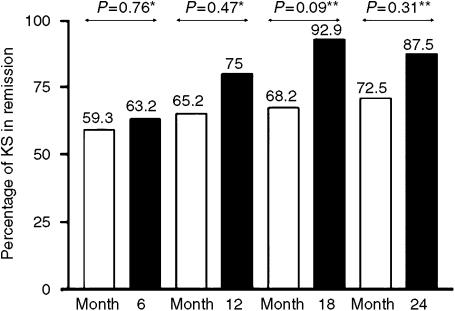
Highly active antiretroviral therapy (HAART) reduces the incidence and improves the prognosis of Kaposi's sarcoma (KS). This study was designed to identify factors associated with KS clinical responses in HIV-infected patients during HAART. We reviewed the files of 138 HIV-1-infected patients with KS. Epidemiologic and HIV-related clinical and biological parameters were recorded at KS diagnosis (baseline) and every 6 months thereafter. In a subset of 73 antiretroviral-naive patients, we compared the clinical outcome of KS according to the use or nonuse of protease inhibitors (PI). After 6 months of follow-up, KS remission was more frequent in patients who were naive of HAART and who were at ACTG stage S0 at baseline (P = 0.03 and 0.02). Undetectable HIV viral load was strongly associated with KS remission (P< or = 0.004 at all time points), while CD4 cell count was not. Among the 73 antiretroviral-naive patients at baseline, and who were studied for 24 months, KS outcome did not differ between patients who were prescribed PI-containing and PI-sparing regimens. Intercurrent multicentric Castleman's disease was associated with poor outcome after 60 months of follow-up (P< or = 0.0001). Fourteen deaths occurred after a median follow-up of 37.5 months, eight of which were KS related. Suppression of HIV replication appears to be crucial to control KS. Non-PI-based regimens were equivalent to PI-based regimens as regards the clinical and virological outcome of antiretroviral-naive HIV-infected patients with KS.
Figures
References
-
- Aboulafia DM (1998) Regression of acquired immunodeficiency syndrome-related pulmonary Kaposi's sarcoma after highly active antiretroviral therapy. Mayo Clin Proc 73: 439–443 - PubMed
-
- Aoki Y, Tosato G (2004) HIV-1 Tat enhances Kaposi sarcoma-associated herpesvirus (KSHV) infectivity. Blood 104: 810–814 - PubMed
-
- Bani-Sadr F, Fournier S, Molina JM (2003) Relapse of Kaposi's sarcoma in HIV-infected patients switching from a protease inhibitor to a non-nucleoside reverse transcriptase inhibitor-based highly active antiretroviral therapy regimen. AIDS 17: 1580–1581 - PubMed
-
- Baril L, Jouan M, Agher R, Cambau E, Caumes E, Bricaire F, Katlama C (2000) Impact of highly active antiretroviral therapy on onset of Mycobacterium avium complex infection and cytomegalovirus disease in patients with AIDS. AIDS 14: 2593–2596 - PubMed
MeSH terms
Substances
LinkOut - more resources
Full Text Sources
Medical
Research Materials
Miscellaneous
