


doi: 10.1016/0002-9610(75)90323-2.
Alopecia, ascites, and incomplete regeneration after 85 to 90 per cent liver resection
- PMID: 165736
- PMCID: PMC2963027
- DOI: 10.1016/0002-9610(75)90323-2
Item in Clipboard
Alopecia, ascites, and incomplete regeneration after 85 to 90 per cent liver resection
Am J Surg.
1975 May.
Abstract
A nineteen year old female underwent 85 to 90 per cent partial hepatectomy to treat a minimal deviation hepatoma. Observations afterwards suggested that the limit of resection compatible with survival had been reached. She recovered perfect health after many months, although liver regeneration was not complete. Severe but eventually reversible alopecia and ascites developed postoperatively, undoubtedly as a complication of the massive hepatic resection.
Figures
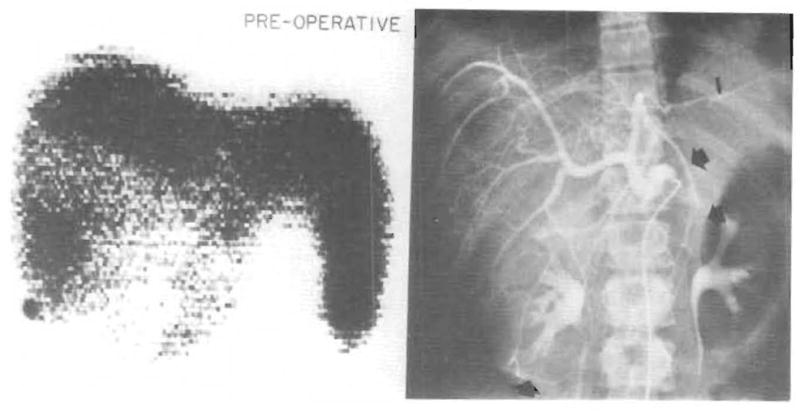
Preoperative radiographic studies. Left, 99m technetium liver scan (anteroposterior projection) showing the very large filling detect. Right, selective common hepatlc arteriogram. The broad arrows Indicate the extent of the tumor as outlined by the abnormal configuration of vessels. The thin arrow points to the dorsolateral branch of the left hepatic artery. This vessel, supplying the lateral segment of the left lobe, was the only hepatic arterial branch preserved.
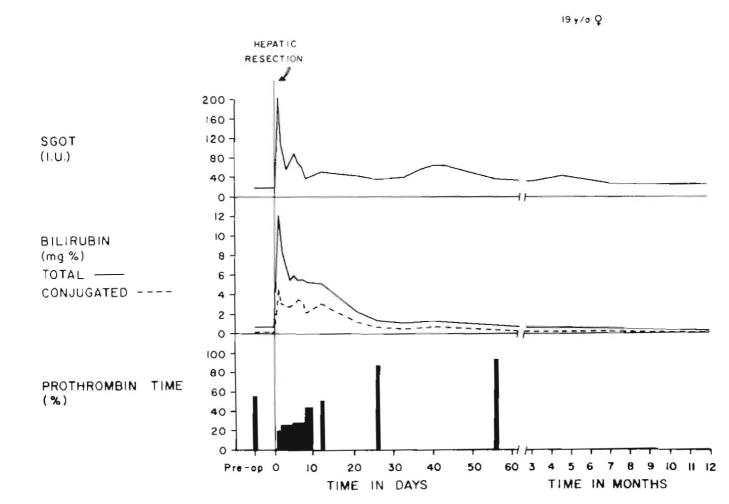
Postoperative course. The hyperbilirubinemia and the depressed prothrombin time returned to normal in about a month.
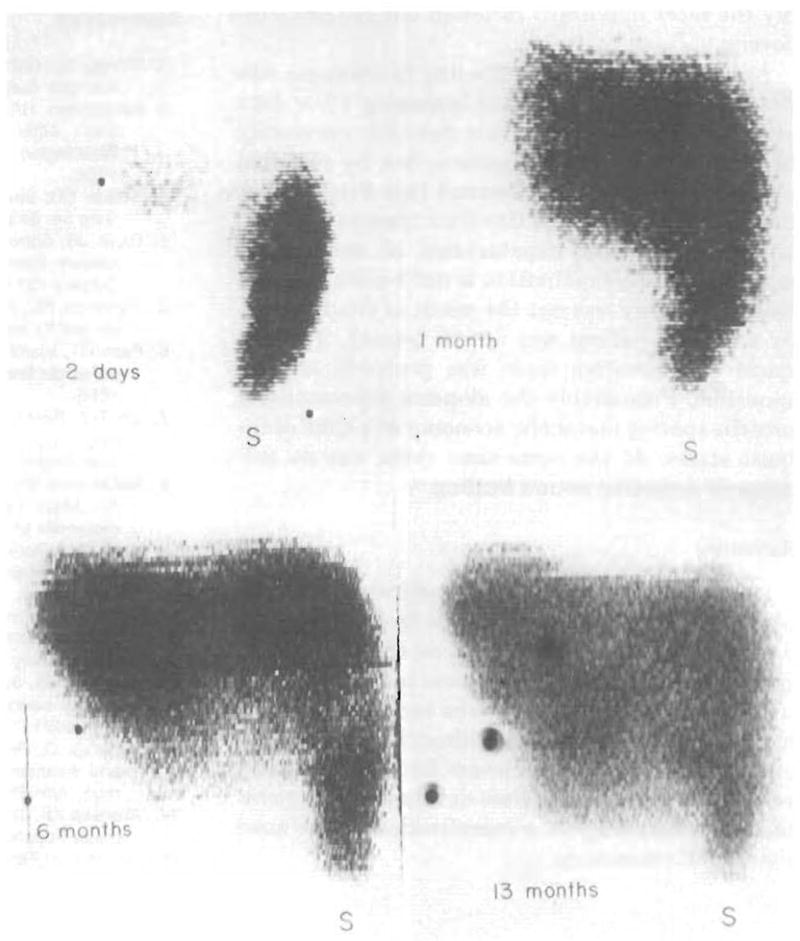
Serial postoperative 99m technetium liver scans. Two days, only a tiny fragment of the liver is visualized; the spleen (S) has enlarged in comparison with the pre-operative study. One month, regeneration has begun. Six months, further regeneration has occurred. Thirteen months, the hepatic mass has increased slightly in the intervening seven months, but regeneration remains incomplete.
References
-
- Motsay GJ, Gamble WG. Clinical experience with hepatic adenomas. Surg Gynecol Obstet. 1972;134:415. - PubMed
-
- Edmonston HA. Atlas of Tumor Pathology. fascicle 25. section VII. Washington, DC: Armed Forces Institute of Pathology; 1958. Tumors of the liver and intrahepatic bile ducts.
-
- Scorer CG. Spontaneous rupture of hepatic adenoma. Br J Surg. 1969;56:633. - PubMed
-
- Davis JB, Schenken JR, Zimmerman O. Massive hemoperitoneum from rupture of benign hepatocellular adenoma. Surgery. 1973;73:181. - PubMed
-
- Hermann RE, David TE. Spontaneous rupture of the liver caused by hepatomas. Surgery. 1973;74:715. - PubMed
Publication types
MeSH terms
Grants and funding
LinkOut - more resources
Full Text Sources
