. 2006 Jun;173(2):611-20.
doi: 10.1534/genetics.106.056820. Epub 2006 Apr 2.

N-terminal domain of yeast Hsp104 chaperone is dispensable for thermotolerance and prion propagation but necessary for curing prions by Hsp104 overexpression

Affiliations

N-terminal domain of yeast Hsp104 chaperone is dispensable for thermotolerance and prion propagation but necessary for curing prions by Hsp104 overexpression

Guo-Chiuan Hung et al. Genetics. 2006 Jun.

Abstract

Hsp104 is a hexameric protein chaperone that resolubilizes stress-damaged proteins from aggregates. Hsp104 promotes [PSI(+)] prion propagation by breaking prion aggregates, which propagate as amyloid fibers, into more numerous prion "seeds." Inactivating Hsp104 cures cells of [PSI(+)] and other amyloid-like yeast prions. Overexpressing Hsp104 also eliminates [PSI(+)], presumably by completely resolubilizing prion aggregates. Inexplicably, however, excess Hsp104 does not cure the other prions. Here we identify missense mutations in Hsp104's amino-terminal domain (NTD), which is conserved among Hsp100 proteins but whose function is unknown, that improve [PSI(+)] propagation. Hsp104Delta147, engineered to lack the NTD, supported [PSI(+)] and functioned normally in thermotolerance and protein disaggregation. Hsp104Delta147 failed to cure [PSI(+)] when overexpressed, however, implying that excess Hsp104 does not eliminate [PSI(+)] by direct dissolution of prion aggregates. Curing of [PSI(+)] by overexpressing catalytically inactive Hsp104 (Hsp104KT), which interferes with endogenous Hsp104, did not require the NTD. We further found that Hsp104 mutants defective in threading peptides through the hexamer pore had reduced ability to support [PSI(+)] in proportion to protein resolubilization defects, suggesting that [PSI(+)] propagation depends on this threading and that Hsp104 "breaks" prion aggregates by extracting protein monomers from the amyloid fibers.


Figures

Figure 1.
Figure 1.
Hsp104 structure and location of mutations that improve [PSI+] propagation. (A) Hsp104 coding region with indicated domains: NTD, N-terminal domain with repeats R1 and R2 shown in red; NBD, nucleotide-binding domains (1 and 2); MR, middle region; CTD, C-terminal domain. Numbers indicate amino acid positions, and substitutions that improve [PSI+] are indicated. (Bottom) Mutants with multiple alterations, each color representing substitutions in a single protein, are shown. (Top) Mutants with single substitutions are shown. (B) Western analysis of Hsp104 abundance. Abundance of wild-type (wt) and three mutant Hsp104 proteins (top) were assessed in five strains of different Hsp70 genotype (bottom). (Top, Hsp104) The blot probed with Hsp104 antibody is shown. (Bottom, load) A region of the same blots subsequently stained with amido black as a loading and transfer control is shown. The wild-type sample on the far left was run with molecular weight markers so the band in the center should be used as the loading control. (C) Similar blot as in B, except strains are also hsp104Δ and express either Hsp104 or Hsp104Δ147, as indicated, from single-copy plasmids. The sample to the right of the vertical line is the parental hsp104Δ strain with empty plasmid. Asterisk indicates Hsp104 degradation product.
Figure 2.
Figure 2.
[PSI+] phenotypes of SSA1-21 strains with (SSA2, top) or without (ssa2Δ, bottom) Ssa2p, expressing wild-type (WT) and mutant (as indicated) Hsp104. Patches of cells grown on YPAD at 30° were replica plated onto medium lacking adenine and grown for 2 days at 30°. Relative strength of [PSI+] is reflected in extent of growth and in degree of pigmentation. As strength of [PSI+] increases, growth becomes denser and pigmentation decreases. SSA1-21 SSA2 cells expressing Hsp104T160M have a wild-type [PSI+] phenotype and SSA1-21 ssa2Δ cells expressing wild-type Hsp104 cannot support [PSI+] and represent a [psi] phenotype.
Figure 3.
Figure 3.
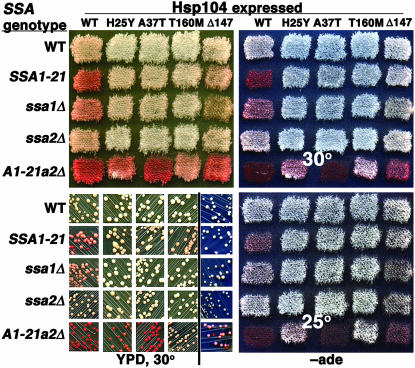
[PSI+] phenotypes of wild-type and SSA mutant strains expressing different Hsp104 proteins. Strains with Hsp70 genotype indicated on left express the Hsp104 protein indicated at top from the chromosomal HSP104 locus. Patches of cells were replica plated from an original YPD master plate onto YPD (top left) and −ade (right) plates. Cells streaked for colonies (bottom left quadrant) are from the same YPD master plate and strains are arranged in the same pattern. Cells indicated Δ147 are hsp104Δ strains expressing Hsp104Δ147 from a plasmid. Colonies of these cells (right of the line in bottom left quadrant) were grown on medium that lacks leucine to maintain selection for the plasmid, and contains limiting adenine, which allows pigmentation. YPD plates (left) were incubated for 2 days (top) or 3 days (bottom) at 30°. Cells on −ade plates (right) were grown for 2 days at 30° (top) or 25° (bottom). A1-21 a2Δ is abbreviation for SSA1-21 ssa2Δ.
Figure 4.
Figure 4.
Thermotolerance and protein resolubilization mediated by mutant Hsp104's. (A–D) Thermotolerance. Cells grown in YPAD at 30° were shifted to 39° for 30 min and then shifted to 52°. The percentage of viable cells is plotted as a function of time exposed to 52°. Wild-type and hsp104Δ cells are shown as filled circles and X's, respectively. Mutant proteins Hsp104H25Y, Hsp104A37T, and Hsp104T160M are represented as squares, triangles, and diamonds, respectively. SSA genotype of strains assayed is indicated in the bottom left corner of A–H. (E–H) Protein resolubilization. Cells expressing a thermolabile form of bacterial luciferase were heat-shocked to cause luciferase aggregation. Resolubilization of the aggregates by Hsp104 was monitored as restoration of luciferase activity during a recovery period at 25°. The same symbols as in A–D are used to represent the different Hsp104 proteins.
Figure 5.
Figure 5.
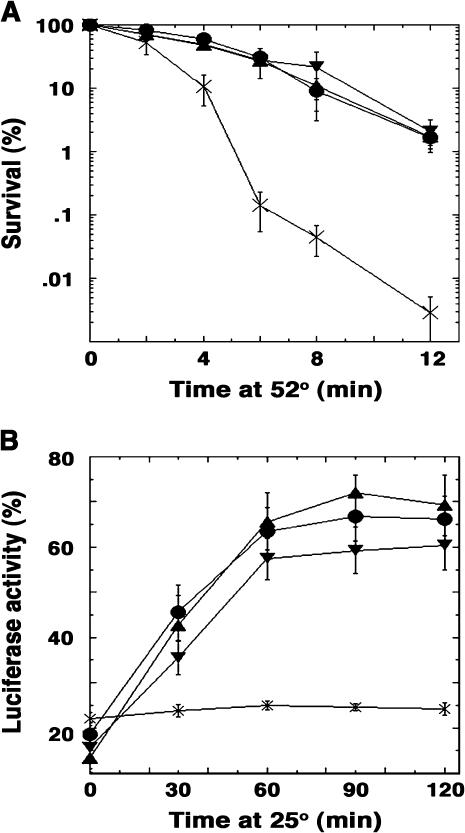
Thermotolerance and protein resolubilization mediated by Hsp104Δ147. (A) Thermotolerance was assayed as described in Figure 4, A–D. (B) Protein resolubilization was assayed as described in Figure 4, E–H. In A and B HSP104 wild type and hsp104Δ cells are indicated as filled circles and X's, respectively. SSA wild type and SSA1-21 cells (both hsp104Δ) expressing Hsp104Δ147 from a plasmid are indicated by triangles and inverted triangles, respectively.
Figure 6.
Figure 6.
Effects of Hsp104 substrate threading mutations on [PSI+] propagation. Strains are hsp104Δ and express Hsp104, with amino acid substitutions as indicated at top, from LEU2-based plasmids. WT, plasmid has wild type HSP104; Δ104, cells carry empty plasmid. (Top) Western analysis as described in Figure 1B is shown. (Bottom) [PSI+] phenotype is shown. Cells were grown on medium lacking leucine (−leu) to select for the plasmids and then replica plated onto −leu plates with limiting adenine (low ade). The latter plates (shown) were incubated at 30° for 2 days. Colonies (bottom) were grown on similar plates for 2 days at 30° and 1 day at 25°.

References

    1. Barnett, M. E., M. Nagy, S. Kedzierska and M. Zolkiewski, 2005. The amino-terminal domain of ClpB supports binding to strongly aggregated proteins. J. Biol. Chem. 280: 34940–34945. - PubMed
    1. Beinker, P., S. Schlee, Y. Groemping, R. Seidel and J. Reinstein, 2002. The N terminus of ClpB from Thermus thermophilus is not essential for the chaperone activity. J. Biol. Chem. 277: 47160–47166. - PubMed
    1. Borchsenius, A. S., R. D. Wegrzyn, G. P. Newnam, S. G. Inge-Vechtomov and Y. O. Chernoff, 2001. Yeast prion protein derivative defective in aggregate shearing and production of new ‘seeds’. EMBO J. 20: 6683–6691. - PMC - PubMed
    1. Cashikar, A. G., E. C. Schirmer, D. A. Hattendorf, J. R. Glover, M. S. Ramakrishnan et al., 2002. Defining a pathway of communication from the C-terminal peptide binding domain to the N-terminal ATPase domain in a AAA protein. Mol. Cell 9: 751–760. - PubMed
    1. Chernoff, Y. O., S. L. Lindquist, B. Ono, S. G. Inge-Vechtomov and S. W. Liebman, 1995. Role of the chaperone protein Hsp104 in propagation of the yeast prion-like factor. [psi+] Science 268: 880–884. - PubMed

Publication types

MeSH terms