


TGF beta-induced cartilage repair is maintained but fibrosis is blocked in the presence of Smad7
- PMID: 16584530
- PMCID: PMC1526625
- DOI: 10.1186/ar1931
TGF beta-induced cartilage repair is maintained but fibrosis is blocked in the presence of Smad7
Abstract
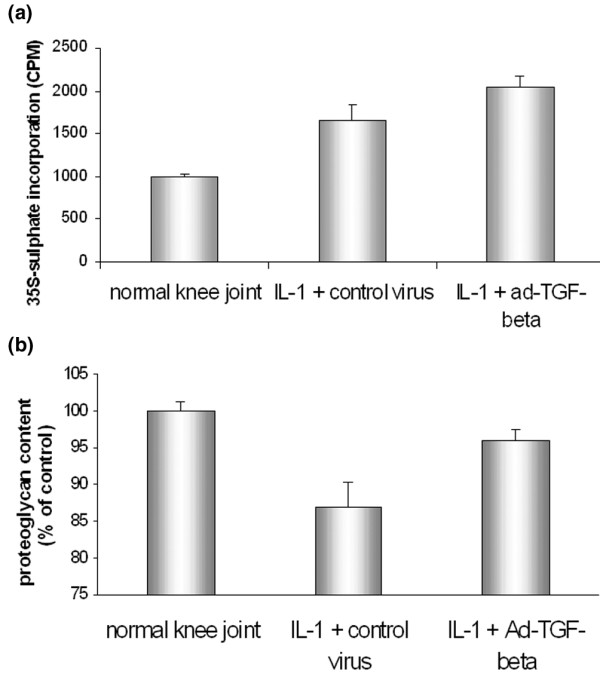
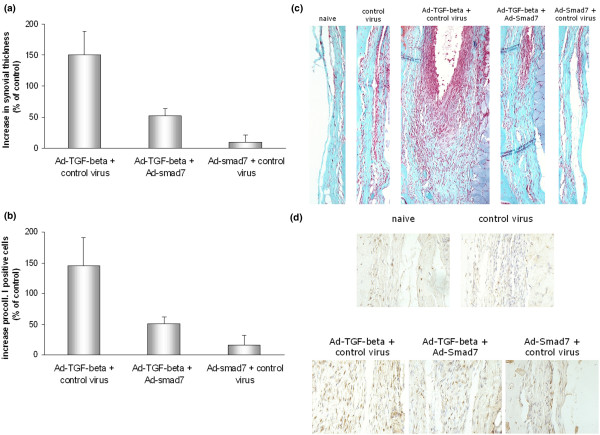
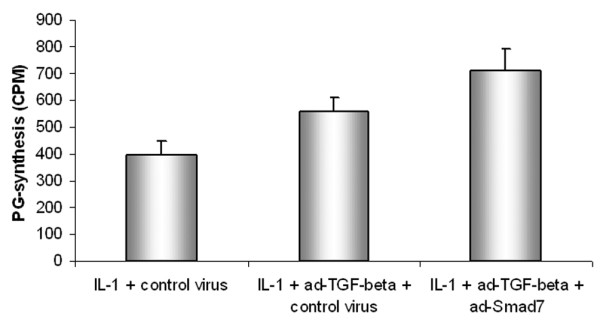
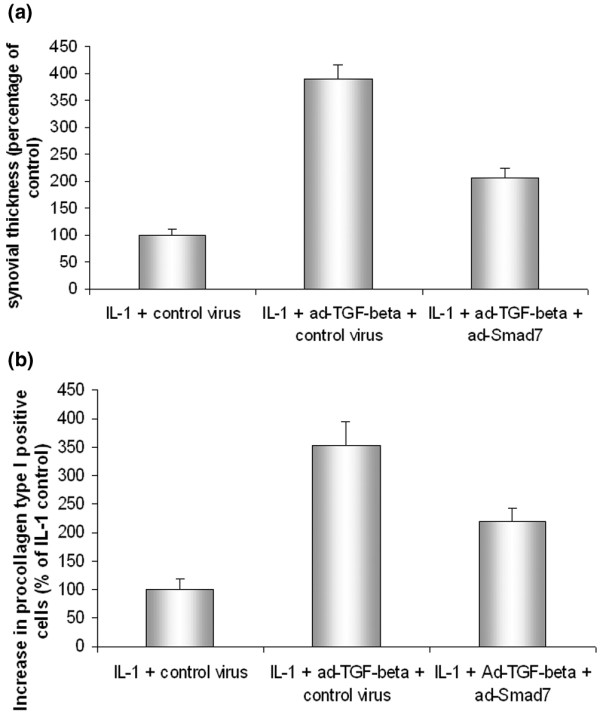
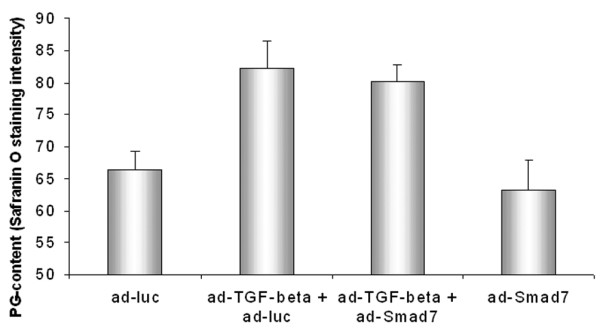
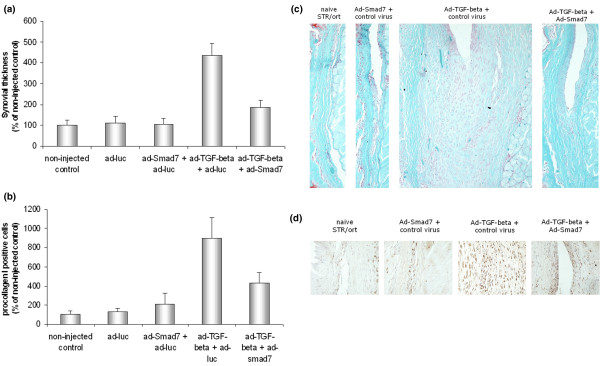
Cartilage damage in osteoarthritis (OA) is considered an imbalance between catabolic and anabolic factors, favoring the catabolic side. We assessed whether adenoviral overexpression of transforming growth factor-beta (TGFbeta) enhanced cartilage repair and whether TGFbeta-induced fibrosis was blocked by local expression of the intracellular TGFbeta inhibitor Smad7. We inflicted cartilage damage by injection of interleukin-1 (IL-1) into murine knee joints. After 2 days, we injected an adenovirus encoding TGFbeta. On day 4, we measured proteoglycan (PG) synthesis and content. To examine whether we could block TGFbeta-induced fibrosis and stimulate cartilage repair simultaneously, we injected Ad-TGFbeta and Ad-Smad7. This was performed both after IL-1-induced damage and in a model of primary OA. In addition to PG in cartilage, synovial fibrosis was measured by determining the synovial width and the number of procollagen I-expressing cells. Adenoviral overexpression of TGFbeta restored the IL-1-induced reduction in PG content and increased PG synthesis. TGFbeta-induced an elevation in PG content in cartilage of the OA model. TGFbeta-induced synovial fibrosis was strongly diminished by simultaneous synovial overexpression of Smad7 in the synovial lining. Of great interest, overexpression of Smad7 did not reduce the repair-stimulating effect of TGFbeta on cartilage. Adenoviral overexpression of TGFbeta stimulated repair of IL-1- and OA-damaged cartilage. TGFbeta-induced synovial fibrosis was blocked by locally inhibiting TGFbeta signaling in the synovial lining by simultaneously transfecting it with an adenovirus overexpressing Smad7.
Figures
References
-
- Pedrozo HA, Schwartz Z, Gomez R, Ornoy A, Xin SW, Dallas SL, Bonewald LF, Dean DD, Boyan BD. Growth plate chondrocytes store latent transforming growth factor (TGF)-beta 1 in their matrix through latent TGF-beta 1 binding protein-1. J Cell Physiol. 1998;177:343–354. doi: 10.1002/(SICI)1097-4652(199811)177:2<343::AID-JCP16>3.0.CO;2-A. - DOI - PubMed
-
- Redini F, Min W, Demoor FM, Boittin M, Pujol JP. Differential expression of membrane-anchored proteoglycans in rabbit articular chondrocytes cultured in monolayers and in alginate beads. Effect of transforming growth factor-beta 1. Biochim Biophys Acta. 1997;1355:20–32. doi: 10.1016/S0167-4889(96)00115-2. - DOI - PubMed
Publication types
MeSH terms
Substances
LinkOut - more resources
Full Text Sources
