


Activation of protein kinase C in the spinal cord produces mechanical hyperalgesia by activating glutamate receptors, but does not mediate chronic muscle-induced hyperalgesia
- PMID: 16584564
- PMCID: PMC1482680
- DOI: 10.1186/1744-8069-2-13
Activation of protein kinase C in the spinal cord produces mechanical hyperalgesia by activating glutamate receptors, but does not mediate chronic muscle-induced hyperalgesia
Abstract
Background: Protein kinase C (PKC) in the spinal cord appears to mediate chronic injury-induced pain, but not acute nociceptive pain. Muscle insult results in increased release of glutamate spinally, and hyperalgesia that is reversed by spinal blockade of NMDA and non-NMDA glutamate receptors. Therefore, we hypothesized that spinal activation of PKC 1) mediates the late phase of hyperalgesia 1 week after muscle insult, and 2) produces mechanical hyperalgesia through activation of NMDA and non-NMDA glutamate receptors.
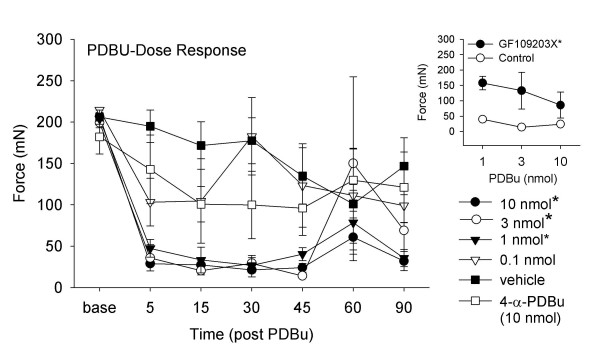
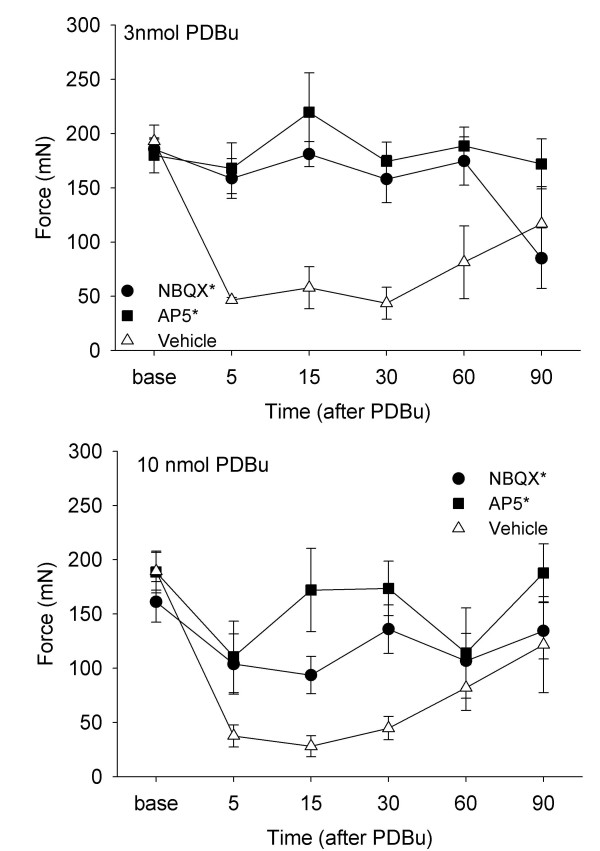
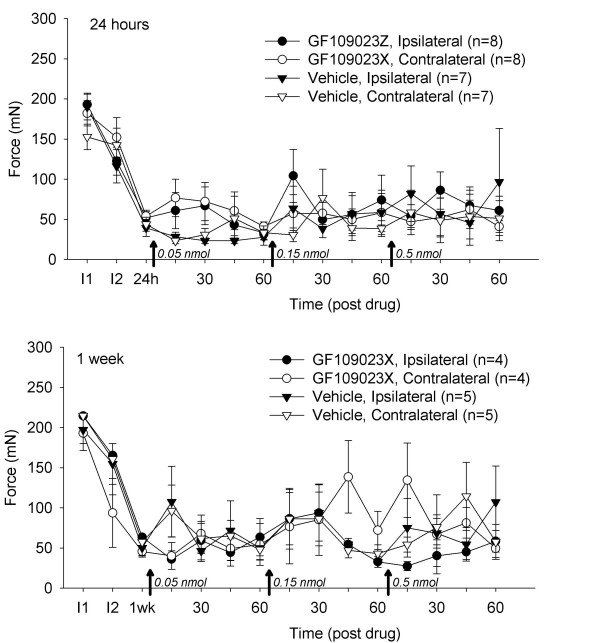
Results: Rats were implanted with intrathecal catheters for delivery of drugs directly to the spinal cord. Mechanical withdrawal thresholds of the paw were determined using von Frey filaments. Intrathecal phorbol 12,13 dibutyrate (PDBu) produced a dose-dependent decrease in the mechanical withdrawal threshold of the paw that was prevented by pretreatment with the PKC inhibitor, GF109203X. Pretreatment with an NMDA receptor antagonist (AP5) or a AMPA/kainate receptor antagonist (NBQX) prevented the decrease in mechanical withdrawal threshold by PDBu. Two injections of acidic saline in the gastrocnemius muscle decreased the mechanical withdrawal thresholds of the paw bilaterally 24 h and 1 week after the second injection. However, blockade PKC in the spinal cord had no effect on the decreased withdrawal thresholds of the paw when compared to vehicle controls.
Conclusion: Spinal activation of PKC produces mechanical hyperalgesia of the paw that depends on activation of NMDA and non-NMDA receptors. Chronic muscle-induced mechanical hyperalgesia, on the other hand, does not utilize spinal PKC.
Figures
References
-
- Igwe OJ, Chronwall BM. Hyperalgesia induced by peripheral inflammation is mediated by protein kinase C betaII isozyme in the rat spinal cord. N S. 2001;104:875–890. - PubMed
-
- Kaczmarek LK. The role of protein kinase C in the regulation of ion channels and neurotransmitter release. TINS. 1987;10:30–34.
-
- Tingley WG, Ehlers MD, Kameyama K, Doherty C, Ptak JB, Riley CT, Huganir RL. Characterization of protein kinase A and protein kinase C phosphorylation of the N-methyl-D-aspartate receptor NR1 subunit using phosphorylation site-specific antibodies. J Biol Chem. 1997;272:5157–5166. doi: 10.1074/jbc.272.8.5157. - DOI - PubMed
Publication types
MeSH terms
Substances
Grants and funding
LinkOut - more resources
Full Text Sources
