


Measuring change in activities of daily living in nursing home residents with moderate to severe cognitive impairment
- PMID: 16584565
- PMCID: PMC1522014
- DOI: 10.1186/1471-2318-6-7
Measuring change in activities of daily living in nursing home residents with moderate to severe cognitive impairment
Abstract
Background: The objective of this study was to assess the responsiveness of the Minimum Data Set Activities of Daily Living (MDS-ADL) Scale to change over time by examining the change in physical function in adults with moderate to severe dementia with no comorbid illness who had been resident in a nursing home for over 90 days.
Methods: Longitudinal data were collected on nursing home residents with moderate (n = 7001) or severe (n = 4616) dementia in one US state from the US national Minimum Data Set (MDS). Severity of dementia was determined by the MDS Cognitive Performance Scale (CPS). Physical function was assessed by summing the seven items (bed mobility, transfer, locomotion, dressing, eating, toilet use, personal hygiene) on the MDS activities of daily living (ADL) Long Form scale. Mean change over time of MDS-ADL scores were estimated at three and six months for residents with moderate (CPS score of 3) and severe (CPS score of 4 or 5) dementia.
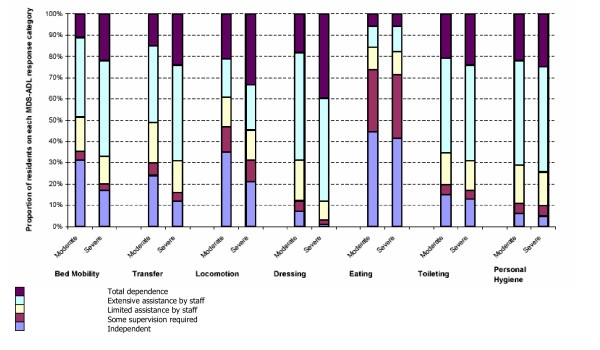
Results: Physical function in residents with moderate cognitive impairment deteriorated over six months by an average of 1.78 points on the MDS-ADL Long Form scale, while those with severe cognitive impairment declined by an average of 1.70 points. Approximately one quarter of residents in both groups showed some improvement in physical function over the six month period. Residents with moderate cognitive impairment experienced the greatest deterioration in early-loss and mid-loss ADL items (personal hygiene, dressing, toilet use) and residents with severe cognitive impairment showed the greatest deterioration in activities related to eating, a late loss ADL.
Conclusion: The MDS-ADL Long Form scale detected clinically meaningful change in physical function in a large cohort of long-stay nursing home residents with moderate to severe dementia, supporting its use as a research tool in future studies.
Figures
References
-
- Boustani M, Peterson B, Hanson L, Harris R, Lohr KN, U. S. Preventive Services Task Force Screening for dementia in primary care: a summary of the evidence for the U.S. Preventive Services Task Force.[summary for patients in Ann Intern Med. 2003 Jun 3;138(11):I60; PMID: 12779314] Ann Intern Med. 2003;138:927–937. - PubMed
-
- Freels S, Cohen D, Eisdorfer C, Paveza G, Gorelick P, Luchins DJ, Hirschman R, Wesson-Ashford J, Levy P, Semla T, Shaw H. Functional Status and Clinical Findings in patients with Alzheimer's Disease. Journal of Gerontology: Medical Science. 1992;47:M177–M182. - PubMed
-
- Cho C, Cho H, Cho K, Choi K, Oh H, Bae C. Factors associated with Functional Dependence in Alzheimer's Disease. Journal of Clinical Geropsychology. 2001;7:79–89. doi: 10.1023/A:1026421003477. - DOI
Publication types
MeSH terms
LinkOut - more resources
Full Text Sources
Other Literature Sources
Medical
Research Materials
Miscellaneous
