Hippocampal and amygdalar volumes in dissociative identity disorder
- PMID: 16585437
- PMCID: PMC3233754
- DOI: 10.1176/ajp.2006.163.4.630
Hippocampal and amygdalar volumes in dissociative identity disorder
Abstract
Objective: Smaller hippocampal volume has been reported in several stress-related psychiatric disorders, including posttraumatic stress disorder (PTSD), borderline personality disorder with early abuse, and depression with early abuse. Patients with borderline personality disorder and early abuse have also been found to have smaller amygdalar volume. The authors examined hippocampal and amygdalar volumes in patients with dissociative identity disorder, a disorder that has been associated with a history of severe childhood trauma.
Method: The authors used magnetic resonance imaging to measure the volumes of the hippocampus and amygdala in 15 female patients with dissociative identity disorder and 23 female subjects without dissociative identity disorder or any other psychiatric disorder. The volumetric measurements for the two groups were compared.
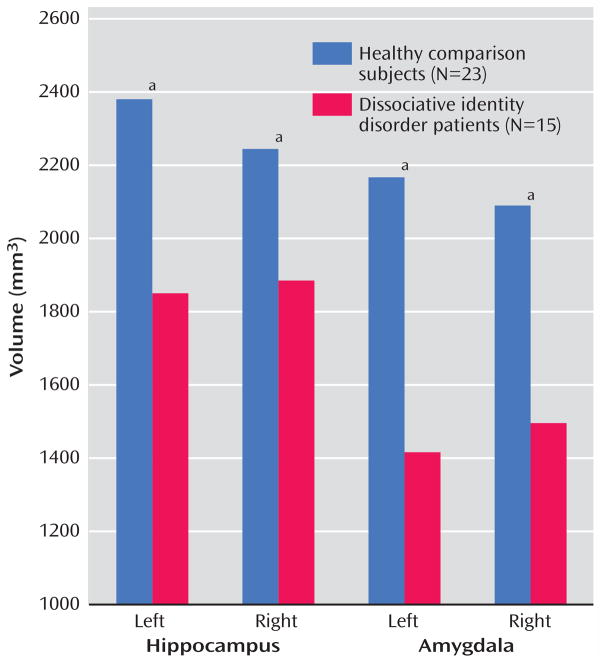
Results: Hippocampal volume was 19.2% smaller and amygdalar volume was 31.6% smaller in the patients with dissociative identity disorder, compared to the healthy subjects. The ratio of hippocampal volume to amygdalar volume was significantly different between groups.
Conclusions: The findings are consistent with the presence of smaller hippocampal and amygdalar volumes in patients with dissociative identity disorder, compared with healthy subjects.
Figures
Comment in
-
Recognizing traumatic dissociation.Am J Psychiatry. 2006 Apr;163(4):566-8. doi: 10.1176/ajp.2006.163.4.566. Am J Psychiatry. 2006. PMID: 16585425 No abstract available.
-
Reduced hippocampal and amygdalar volume in dissociative identity disorder: not such clear evidence.Am J Psychiatry. 2006 Sep;163(9):1643; author reply 1643-4. doi: 10.1176/ajp.2006.163.9.1643a. Am J Psychiatry. 2006. PMID: 16946196 No abstract available.
References
-
- Loewenstein RJ, Putnam FW. In: The dissociative disorders, in Comprehensive Textbook of Psychiatry. 8. Sadock BJ, Sadock VA, editors. Vol. 1. Philadelphia: Lippincott Williams & Wilkins; 2004. pp. 1844–1901.
-
- Armstrong JG, Loewenstein RJ. Characteristics of patients with multiple personality and dissociative disorders on psychological testing. J Nerv Ment Dis. 1990;178:448–454. - PubMed
-
- Loewenstein RJ. Diagnosis, epidemiology, clinical course, treatment, and cost effectiveness of treatment for dissociative disorders and multiple personality disorder: report submitted to the Clinton administration task force on health care financing reform. Dissociation. 1994;7:3–11.
-
- Putnam N, Stein M. Self-inflicted injuries in childhood: a review and diagnostic approach. Clinical Pediatr (Phila) 1985;24:514–518. - PubMed
-
- Ross CA, Miller SD, Bjornson L, Reagor P, Fraser GA, Anderson G. Abuse histories in 102 cases of multiple personality disorder. Can J Psychiatry. 1991;36:97–101. - PubMed
Publication types
MeSH terms
Grants and funding
LinkOut - more resources
Full Text Sources