Comparative Study
. 2006 Apr 11;103(15):5817-22.
doi: 10.1073/pnas.0507903103. Epub 2006 Apr 3.

Differential effects of Hsc70 and Hsp70 on the intracellular trafficking and functional expression of epithelial sodium channels

Affiliations
Comparative Study

Differential effects of Hsc70 and Hsp70 on the intracellular trafficking and functional expression of epithelial sodium channels

Samuel B Goldfarb et al. Proc Natl Acad Sci U S A. .

Abstract

The members of the cytoplasmic 70-kDa heat shock protein family are involved in appropriate folding and trafficking of newly synthesized proteins in the cell. Hsc70, which is expressed constitutively, and Hsp70, the expression of which is stress- and heat shock-induced, are often considered to have similar cellular functions in this regard, but there are suggestions that the intracellular functions of these homologous but not identical proteins may differ. We tested the hypothesis that Hsc70 and Hsp70 would have differential effects on the expression of the epithelial sodium channel (ENaC). In Xenopus oocytes, overexpression of human Hsc70 decreased the functional (defined as amiloride-sensitive whole-oocyte current) and surface expression of murine ENaC (mENaC) in a concentration-dependent fashion. In contrast, coinjection of a moderate amount of Hsp70 cRNA (10 ng) increased the functional and surface expression of mENaC, whereas a higher amount of coinjected Hsp70 cRNA (30 ng) decreased mENaC functional and surface expression. The increase in mENaC functional expression with coinjection of 10 ng of Hsp70 cRNA was antagonized by the additional coinjection of Hsc70 cRNA in a concentration-dependent fashion. These data are consistent with Hsc70 and Hsp70 having differential and antagonistic effects with regard to the intracellular trafficking of mENaC in oocytes, which may have an impact on our understanding and potential treatment of diseases of aberrant ion channel trafficking.


Conflict of interest statement

Conflict of interest statement: No conflicts declared.

Figures
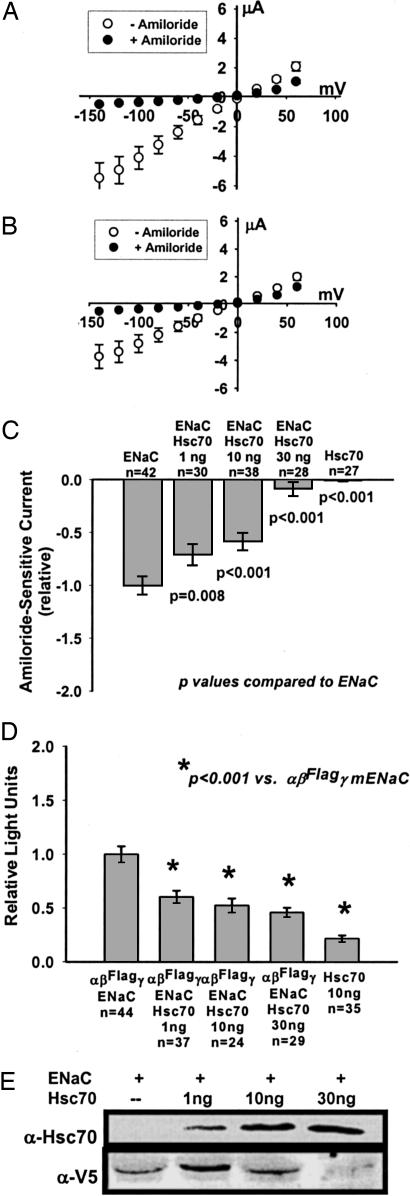
Fig. 1.
Fig. 1.
Effect of Hsc70 on mENaC expression in Xenopus oocytes. Xenopus laevis oocytes were injected with cRNA for all three subunits of mENaC, α, β, and γ (αβγ-mENaC) (0.33 ng per subunit), either alone (A) or with 10 ng of cRNA for human Hsc70 (B). TEV was performed 24 h after injection as described in Materials and Methods. Shown are the I/V relationships (mean ± SEM) for n = 42 (A) and n = 38 (B) oocytes before (open circles) and after (filled circles) the addition of 10 μM amiloride. (C) Oocytes were injected with cRNA for αβγ-mENaC (0.33 ng per subunit), Hsc70 (10 or 30 ng), or coinjected with cRNA for αβγ-mENaC (0.33 ng per subunit) and the indicated amount of Hsc70 cRNA. TEV was performed 24 h after injection, and data are expressed as the relative amiloride-sensitive current at −100 mV holding potential (mean ± SEM), with P values determined by ANOVA as described in Materials and Methods. The ENaC and ENaC + 10 ng of Hsc70 data in C correspond to the I/V plots of A and B, respectively. (D) Expression of mENaC at the oocyte surface was assessed 24 h after injection with cRNAs for mENaC (0.33 ng per subunit) or Hsc70 (10 ng) alone or injection with mENaC and the indicated amount of Hsc70 cRNAs. In these experiments, the β-mENaC subunit contained an external FLAG epitope (βFLAG). Relative surface expression is expressed as the mean ± SEM, with P values determined by ANOVA. (E) Oocytes were injected with cRNA for αβγ-mENaC (0.33 ng per subunit) where the β subunit contained a C-terminal V5 epitope (β-V5) and the indicated amount of Hsc70 cRNA. Whole-oocyte lysates were prepared 24 h after injection, and expression of Hsc70 and β-V5 was assessed by immunoblot using specific antisera. These data are representative of three or four independent experiments.
Fig. 2.
Fig. 2.
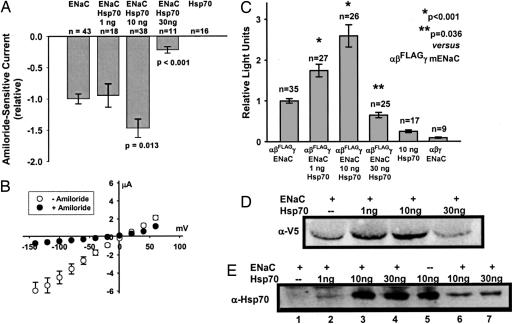
Effect of Hsp70 on mENaC expression in oocytes. (A) Oocytes were injected with cRNA for αβγ-mENaC (0.33 ng per subunit) or Hsp70 (10 or 30 ng), or coinjected with cRNA for αβγ-mENaC (0.33 ng per subunit) and the indicated amount of Hsp70 cRNA. TEV was performed 24 h after injection, and data are expressed as the relative amiloride-sensitive current at −100 mV holding potential (mean ± SEM), with P values determined by ANOVA. (B) I/V relationship (mean ± SEM) for oocytes (n = 38) coinjected with cRNA for αβγ-mENaC (0.33 ng per subunit) and 10 ng of cRNA for human Hsp70. TEV was performed 24 h after injection before (open circles) and after (filled circles) the addition of 10 μM amiloride. These data correspond to those for ENaC/Hsp70 10 ng in A. (C) Expression of mENaC at the oocyte surface was assessed 24 h after injection with cRNAs for αβFLAGγ-mENaC (0.33 ng per subunit) or Hsp70 (10 ng) alone, or injection with αβFLAGγ-mENaC and the indicated amount of Hsp70 cRNAs. A separate group of control oocytes were injected with cRNA for WT αβγ-mENaC (0.33 ng per subunit, β-mENaC lacking the FLAG epitope). Relative surface expression is expressed as the mean ± SEM, with P values determined by ANOVA. (D) Oocytes were injected with cRNA for αβ-V5γ-mENaC (0.33 ng per subunit) and the indicated amount of Hsp70 cRNA. Whole-oocyte lysates were prepared 24 h after injection, and expression of β-V5 was assessed by immunoblotting. (E) Oocytes were injected with cRNA for αβ-V5γ-mENaC (0.33 ng per subunit, except lane 5) and the indicated amount of Hsp70 cRNA. Whole-oocyte lysates were prepared 24 h after injection, and expression of Hsp70 was assessed by immunoblotting. Lanes 6 and 7 correspond to lanes 3 and 4 but were loaded with one-fourth the amount of sample. D and E are representative of three or four independent experiments.
Fig. 3.
Fig. 3.
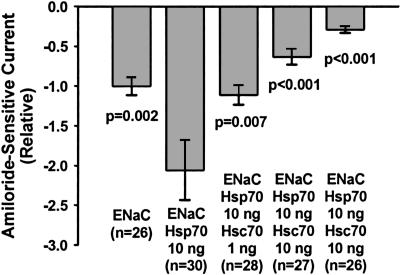
Antagonistic effects of Hsc70 and Hsp70 on mENaC functional expression. Oocytes were injected with cRNAs encoding αβγ-mENaC alone (0.33 ng per subunit), coinjected with αβγ-mENaC (0.33 ng per subunit) and Hsp70 (10 ng) cRNAs, or coinjected with cRNAs for αβγ-mENaC (0.33 ng per subunit) and Hsp70 (10 ng) and the indicated amount of Hsc70 cRNA. TEV was performed 24 h after injection, and relative amiloride-sensitive currents at −100 mV were determined. P values were determined by ANOVA compared with oocytes coinjected with αβγ-mENaC and Hsp70 cRNAs.
Fig. 4.
Fig. 4.
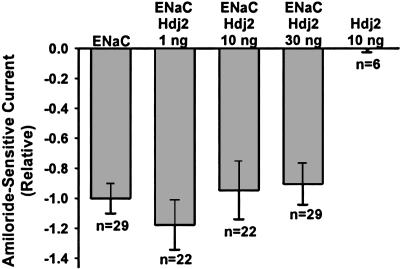
Hdj-2 overexpression does not alter mENaC functional expression. Oocytes were injected with cRNAs encoding αβγ-mENaC alone (0.33 ng per subunit) or Hdj2 alone (10 ng), or coinjected with αβγ-mENaC (0.33 ng per subunit) and the indicated amount of Hdj2 cRNA. TEV was performed 24 h after injection, and relative amiloride-sensitive currents at −100 mV were determined. Statistical analysis was performed by ANOVA compared with oocytes injected with αβγ-mENaC cRNA alone. There were no statistically significant differences in amiloride-sensitive currents between oocytes coinjected with mENaC and 1, 10, or 30 ng of Hdj2 compared with oocytes injected with mENaC alone.

References

    1. Stutts M. J., Canessa C. M., Olsen J. C., Hamrick M., Cohn J. A., Rossier B. C., Boucher R. C. Science. 1995;269:847–850. - PubMed
    1. Ling B. N., Zuckerman J. B., Lin C., Harte B. J., McNulty K. A., Smith P. R., Gomez L. M., Worrell R. T., Eaton D. C., Kleyman T. R. J. Biol. Chem. 1997;272:594–600. - PubMed
    1. Knowles M. R., Paradiso A. M., Boucher R. C. Hum. Gene Ther. 1995;6:445–455. - PubMed
    1. Matsui H., Grubb B. R., Tarran R., Randell S. H., Gatzy J. T., Davis C. W., Boucher R. C. Cell. 1998;95:1005–1015. - PubMed
    1. Ward C. L., Kopito R. R. J. Biol. Chem. 1994;269:25710–25718. - PubMed

Publication types

LinkOut - more resources