


A temporally distinct role for group I and group II metabotropic glutamate receptors in object recognition memory
- PMID: 16585793
- PMCID: PMC1409835
- DOI: 10.1101/lm.77806
A temporally distinct role for group I and group II metabotropic glutamate receptors in object recognition memory
Abstract
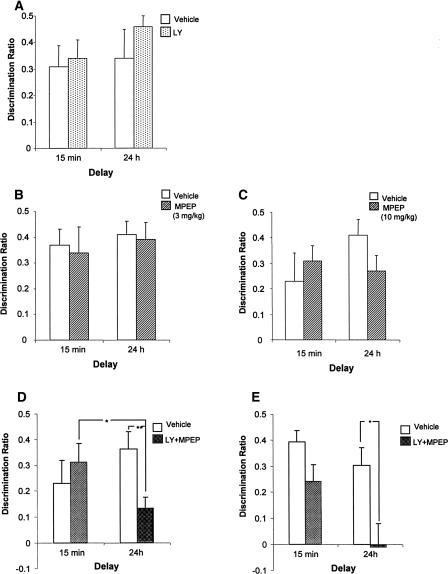
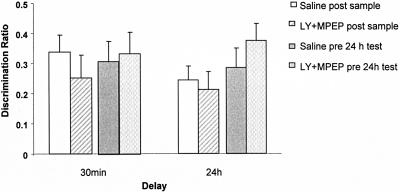
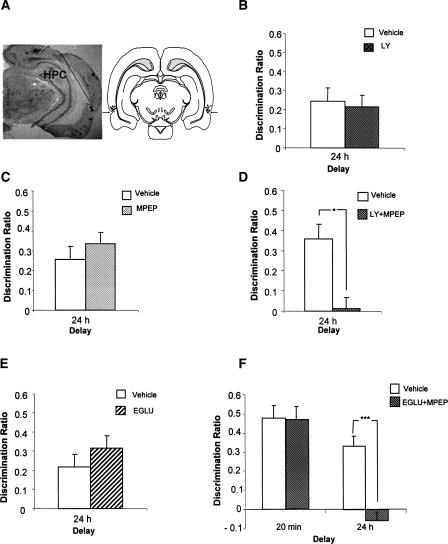
Recognition memory, involving the ability to discriminate between a novel and familiar object, depends on the integrity of the perirhinal cortex (PRH). Glutamate, the main excitatory neurotransmitter in the cortex, is essential for many types of memory processes. Of the subtypes of glutamate receptor, metabotropic receptors (mGluRs) have received less study than NMDA receptors; thus, the reported experiments examined the role of mGluRs in familiarity discrimination in the rat PRH. Experiments 1 and 2 assessed the effects of systemic administration of MPEP, a group I mGluR (specifically mGluR5) antagonist, and/or LY341495, a group II mGluR antagonist, on a spontaneous object novelty preference task. Simultaneous antagonism of both group I and II mGluRs impaired familiarity discrimination following a 24-h but not a 15-min delay, while antagonism of either mGluR subtype alone had no effect at either delay. The impairment was in acquisition, as in Experiment 3 coadministration of MPEP and LY341495 did not affect recognition memory performance when administered either after the sample phase or prior to test. The impairment in long-term recognition memory was mediated by mGluRs in the PRH, as localized intracortical antagonism of group I and II mGluRs also produced a deficit (Experiment 4). No evidence was found for an involvement of group III mGluRs in the acquisition of long-term familiarity discrimination (Experiment 5). These findings establish that glutamatergic neurotransmission in the PRH via group I and II mGluRs is crucial for the acquisition, but not for the consolidation or retrieval of long-term object recognition memory.
Figures
References
-
- Aggleton J.P., Keen S., Warburton E.C., Bussey T.J. Extensive cytotoxic lesions involving both the rhinal cortices and area TE impair recognition but spare spatial alternation in the rat. Brain Res. Bull. 1997;43:279–287. - PubMed
-
- Baldwin A.E., Sadeghian K., Holahan M.R., Kelly A.E. Appetitive instrumental learning is impaired by inhibition of cAMP-dependent protein kinase within the nucleus accumbens. Neurobiol. Learn. Mem. 2002;77:44–62. - PubMed
-
- Balschun D., Wetzel W. Inhibition of mGluR5 blocks hippocampal LTP in vivo and spatial learning in rats. Pharm. Biochem. Behav. 2002;73:375–380. - PubMed
-
- Barker G.R., Brown M.W., Warburton E.C.2003The role of glutamate receptors in recognition memory. Soc. Neurosci. Abs. 721.9.
-
- Bogacz R., Brown M.W. Comparison of computational models of familiarity discrimination in the perirhinal cortex. Hippocampus. 2003;13:494–524. - PubMed
Publication types
MeSH terms
Substances
Grants and funding
LinkOut - more resources
Full Text Sources
Other Literature Sources