Comparative Study
. 2006 Mar-Apr;13(2):187-91.
doi: 10.1101/lm.134706.

Reversible hippocampal lesions disrupt water maze performance during both recent and remote memory tests

Affiliations
Comparative Study

Reversible hippocampal lesions disrupt water maze performance during both recent and remote memory tests

Nicola J Broadbent et al. Learn Mem. 2006 Mar-Apr.

Abstract

Conventional lesion methods have shown that damage to the rodent hippocampus can impair previously acquired spatial memory in tasks such as the water maze. In contrast, work with reversible lesion methods using a different spatial task has found remote memory to be spared. To determine whether the finding of spared remote spatial memory depends on the lesion method, we reversibly inactivated the hippocampus with lidocaine either immediately (0-DAY) or 1 mo (30-DAY) after training in a water maze. For both the 0-DAY and 30-DAY retention tests, rats that received lidocaine infusions exhibited impaired performance. In addition, when the 0-DAY group was retested 2 d later, (when the drug was no longer active), the effect was reversed. That is, rats that had previously received lidocaine performed as well as control rats did. These findings indicate that the rodent hippocampus is important for both recent and remote spatial memory, as assessed in the water maze. What determines whether remote spatial memory is preserved or impaired following disruption of hippocampal function appears to be the type of task used to assess spatial memory, not the method used to disrupt the hippocampus.


Figures
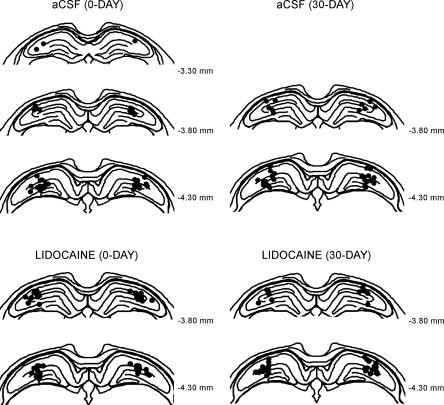
Figure 1.
Figure 1.
Schematic representation of injection sites in the dorsal hippocampus for each of the four groups (0-DAY aCSF, 0-DAY lidocaine, 30-DAY aCSF, 30-DAY lidocaine). Each black dot shows the injection site for a single cannula per animal.
Figure 2.
Figure 2.
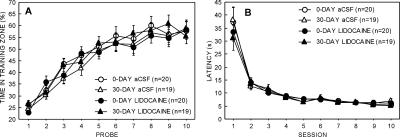
Acquisition of spatial memory in the water maze. (A) Percentage of time spent in the training quadrant on each of ten 60-sec daily probe trials. Chance = 25%. (B) Average latency to escape to the hidden platform on each of the 10 daily training sessions. Parentheses show SEM.
Figure 3.
Figure 3.
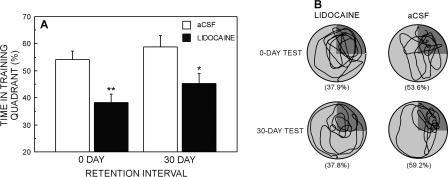
(A) Performance of the aCSF and lidocaine groups on probe trials given 0 or 30 d after the completion of training. Chance = 25%. Parentheses show SEM. Asterisks denote that the lidocaine group was different from the aCSF group (**P < 0.01, *P < 0.05). (B) Swim paths for representative animals that received either lidocaine or aCSF infusions prior to the 0-DAY or 30-DAY retention tests. The training quadrant appears in dark gray. Percentages in parentheses refer to the percentage of time spent in the training quadrant.
Figure 4.
Figure 4.
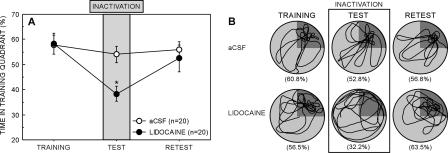
(A) Spatial memory performance of the 0-DAY aCSF and lidocaine groups on the final probe trial of training (training), on the probe test 5 min after drug infusion (test), and on the probe trial given 2 d later (retest). The gray bar indicates the time that the drug was active. Chance = 25%. Parentheses show SEM. Asterisk denotes impairment relative to the aCSF group (P < 0.05). (B) Swim paths during training, during the test, and during the retest for representative animals that received lidocaine or aCSF infusions 5 min prior to the 0-DAY retention tests. The training quadrant appears in dark gray. Percentages in parentheses refer to the percentage of time spent in the training quadrant.

References

    1. Bolhuis J.J., Stewart C.A., Forrest E.M. Retrograde amnesia and memory reactivation in rats with ibotenate lesions to the hippocampus and subiculum. Q. J. Exp. Psychol. 1994;47B:129–150. - PubMed
    1. Cho Y.H., Kesner R.P. Involvement of entorhinal cortex or parietal cortex in long-term spatial discrimination memory in rats: Retrograde amnesia. Behav. Neurosci. 1996;110:436–442. - PubMed
    1. Cho Y.H., Beracochea D., Jaffard R. Extended temporal gradient for the retrograde and anterograde amnesia produced by ibotenate entorhinal cortex lesions in mice. J. Neurosci. 1993;13:1759–1766. - PMC - PubMed
    1. Clark R.E., Broadbent N.J., Squire L.R. Hippocampus and remote spatial memory in rats. Hippocampus. 2005a;15:260–272. - PMC - PubMed
    1. Clark R.E., Broadbent N.J., Squire L.R. Impaired remote spatial memory after hippocampal lesions despite extensive training beginning early in life. Hippocampus. 2005b;15:340–346. - PMC - PubMed

Publication types

LinkOut - more resources